
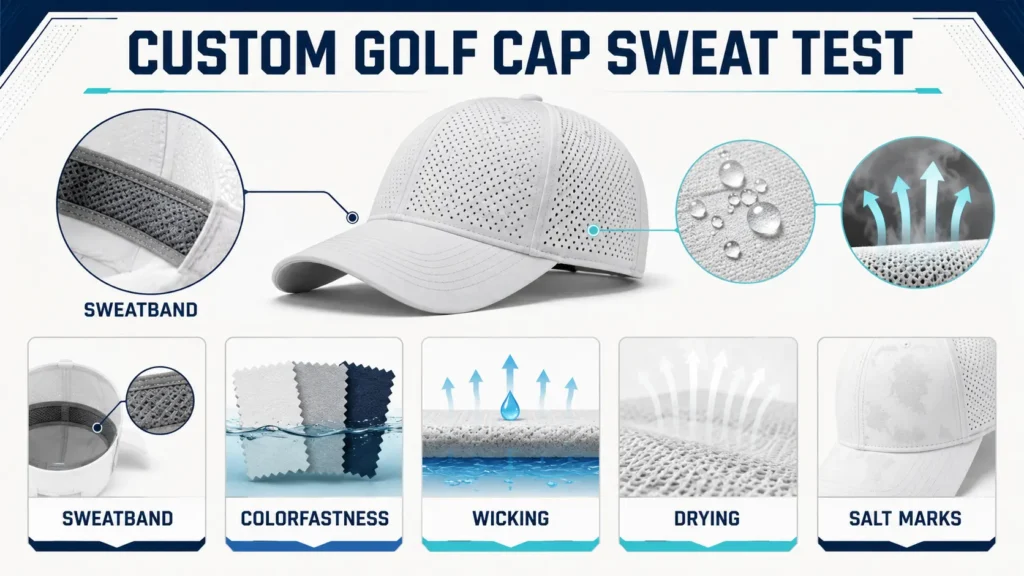
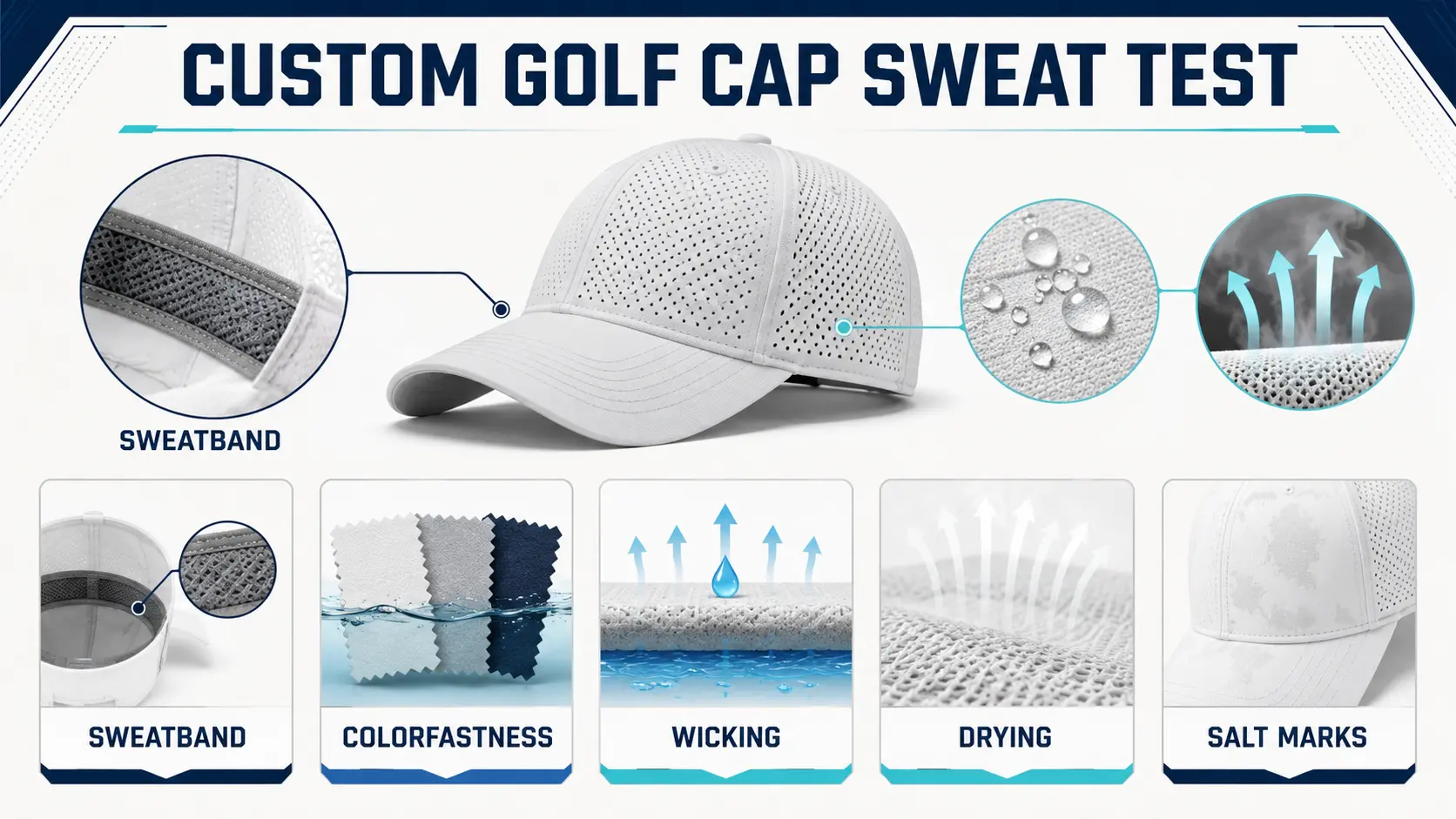
A cap can feel cool for five minutes. By the back nine, it may become heavy, stained, or slippery. A fabric label that says “moisture wicking” does not tell the whole story. Embroidery, seams, the sweatband, and the shaped brim all affect the finished cap.
A custom golf cap sweat test should check the complete product and the conditions your customer will face. It can combine simple development checks, controlled laboratory methods when needed, and real wear feedback before bulk production.
Broad searches for custom golf caps often start with light weight, breathability, and moisture wicking. Those are useful entry points. A mature golf brand must go further and decide what each claim means, which evidence supports it, and how the tested build will remain unchanged across colorways, production lots, and reorders.
Start with a measurable use case
Describe the player, climate, season, round length, and care expectation. A hot and humid tournament cap has a different job from a cool-weather club shop cap. Decide whether the main goal is fast sweat movement, fast drying, low visible staining, sun comfort, light weight, or a balance of these.
Avoid a broad rule such as “breathable performance fabric.” Turn it into checks. The band should move moisture away from the forehead. The cap should not show clear salt lines after the agreed wear routine. The fit should stay stable as the band becomes damp.
Test the full sweat-management system
Moisture passes through several parts. It touches the sweatband first, moves into nearby fabric and seam areas, and may appear on the outer crown. Thread, labels, reinforcement, and adhesive can change the path. A good fabric cannot fix a sweatband that holds water against the skin.
| Component | What to check | Buyer question |
|---|---|---|
| Sweatband | Absorption, transfer, drying, softness when wet | Does it stay comfortable and stable? |
| Crown fabric | Moisture spread, drying, cling, transparency | Does wetness form one obvious dark patch? |
| Decoration | Color change, puckering, edge lift, stiffness | Does the logo area trap moisture or distort? |
| Seams and tape | Local saturation and drying | Do thick areas stay wet much longer? |
| Color system | Bleeding, transfer, fading, salt marks | Will the cap still look clean after use? |
| Fit system | Slippage, pressure, closure behavior | Does dampness change how the cap sits? |
Build a claim-to-evidence plan for the collection
Start with the exact claim the brand plans to make. “Moisture wicking,” “quick drying,” “stays comfortable,” and “resists sweat marks” are not the same promise. Each one may need a different material method, product observation, wear condition, and acceptance rule. Do not let a supplier data sheet decide the final marketing language by itself.
Create a matrix by SKU and colorway. Name the claim, target user, climate, material, full-cap construction, test or wear method, acceptance owner, report location, and renewal trigger. A core tournament cap may need stronger evidence than a lifestyle cap that makes no technical claim. A major material or factory change may require revalidation even when the style name stays the same.
| Evidence layer | What it can answer | What it cannot prove alone |
|---|---|---|
| Material supplier data | Properties of the named fabric under stated conditions | Performance of the assembled cap |
| Development screen | Relative difference between controlled sample options | A broad consumer claim |
| Laboratory method | Result for the tested material or product under that method | Every use condition or future material lot |
| Controlled wear trial | Comfort and behavior in a defined player scenario | The experience of an entire market |
| Production control | Whether the shipped build matches the tested specification | Performance when untested inputs change |
This matrix lets legal, marketing, product, sourcing, and quality teams review the same evidence. It also keeps a strong result from one fabric or color from being applied to every cap in the range without support.
Use a simple development screen before a lab test
For early samples, weigh the dry cap. Add a set amount of test liquid to named sweatband zones. Take time-stamped photos. Note when moisture reaches the outer crown and how far it spreads. Also note when the cap returns to the agreed dry state. Keep the room and method the same when comparing options.
This internal screen does not create a certified performance claim. It helps your team compare two fabrics, sweatbands, or constructions and choose which version deserves a formal test. Document the liquid amount, location, temperature, humidity if available, and judgment rule so the next sample can be compared fairly.
Select formal methods based on the claim
AATCC TM195 evaluates liquid moisture management properties of textile fabrics. It can support material comparison, but a fabric test result is not automatically the result of the assembled cap. Thick seams, embroidery, and sweatband construction still need product review.
If your brand is concerned about color change from perspiration, ISO 105-E04 describes a color-fastness-to-perspiration method. State which cap materials and colors will be tested and what result your company requires. Do not publish “sweat proof” or a pass claim unless your team holds a result that directly supports the wording.
Run a controlled wear test on the real sample
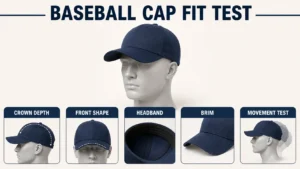
Choose wearers and conditions that match the intended product. Record head size, closure setting, weather, activity time, and any pauses. Ask each tester to use the same care instructions before a second trial. A single professional photo is not a wear test.
During and after the session, inspect:
- forehead comfort and rubbing;
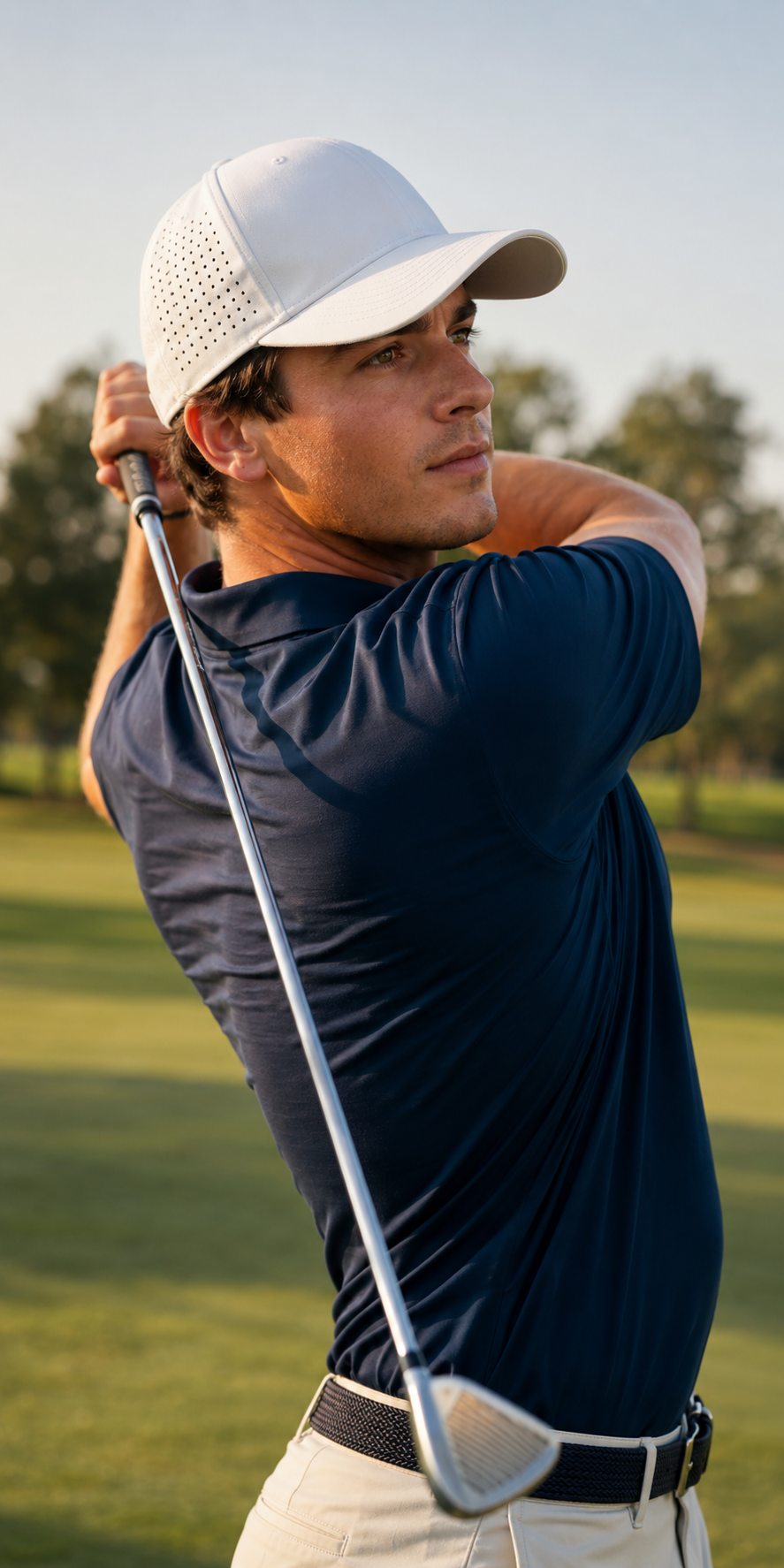
- cap movement during the swing and walk;
- wet weight and heavy spots;
- visible darkening, salt lines, or color transfer;
- odor after the defined rest period;
- time to reach the agreed dry state;
- shape and logo appearance after drying.
Use a consistent photo setup with front, side, back, and sweatband views. Compare results with the unworn control sample. If the test is small, present it as product-development evidence, not a universal consumer claim.
Do not forget dark and light colorways
A light cap may show yellowing or dirt. A dark cap may show pale salt lines or color change. Thread and patch colors can react differently from the body fabric. Test the highest-risk colorways, not only the color that was easiest to sample.
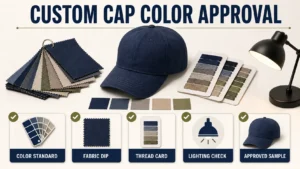
Record the approved fabric, sweatband, logo method, test needs, and color references in a controlled custom hat tech pack. If the color is custom-dyed, keep the approved lot or swatch with the performance sample.
Use a risk-based sample and test matrix
Testing every possible SKU can add cost without adding the same amount of learning. Instead, identify the combinations most likely to change the result. Consider fabric family, color depth, sweatband, ventilation, support layer, logo coverage, adhesive or transfer, and intended climate.
Choose a base sample that represents the main construction, then add the highest-risk variants. A dark cap may need a salt-mark review. A light cap may need stain and show-through checks. A large silicone or embroidered logo may create a local drying issue. A second sweatband source may need its own comparison.
Document why each test sample was chosen and which other SKUs it is meant to represent. If an untested SKU later changes a key input, remove it from the shared approval and review it separately. This keeps the program efficient without pretending that all options are identical.
Turn test results into product decisions
If moisture stays at the forehead, review the sweatband fiber, knit, thickness, and transfer path. If the crown remains wet, review fabric weight, finish, lining, seam density, and ventilation. If the cap slips, fit and band grip may matter more than absorption alone. A “better fabric” is not always the complete answer.
Write changes as controlled versions. Sample B may use the same crown with a different sweatband; Sample C may add perforated side panels. Change one major factor at a time when practical. This makes the next result easier to understand and gives the factory a clear instruction.
Carry approved performance into production
Keep the approved cap and bill of materials together. Add the fabric, sweatband, colors, test report, and care instructions. During production, check that the named materials and build match. A final visual check cannot prove long-term performance. It can confirm that the tested design was not quietly changed.
Read JoinTop’s custom golf performance hat guide e quality control process when building the full specification.
Govern performance changes across suppliers and reorders
Name the owner who may approve a change to fabric, sweatband, coating, ventilation, reinforcement, logo method, or care instruction. If a supplier proposes an alternate, compare it with the tested build before it enters production. A lower-cost material is not equivalent because its description sounds similar.
For bulk production, confirm material codes, approved sources, lot references where available, component construction, and the sample or report used as the master. Quality reports should record whether the inputs match and whether the agreed production checks were completed. They should not claim that a visual inspection repeats a laboratory test.
Before a reorder, review changes in the bill of materials, production site, claim language, care instructions, and destination market. Keep the evidence date and scope visible. If the brand receives wear complaints, group them by SKU, colorway, lot, climate, and failure type before changing the full collection.

 English
  German
  Spanish
  French
  Amharic
  Portuguese
  Italian
  Swedish
  Turkish
  Belarusian
  Danish