
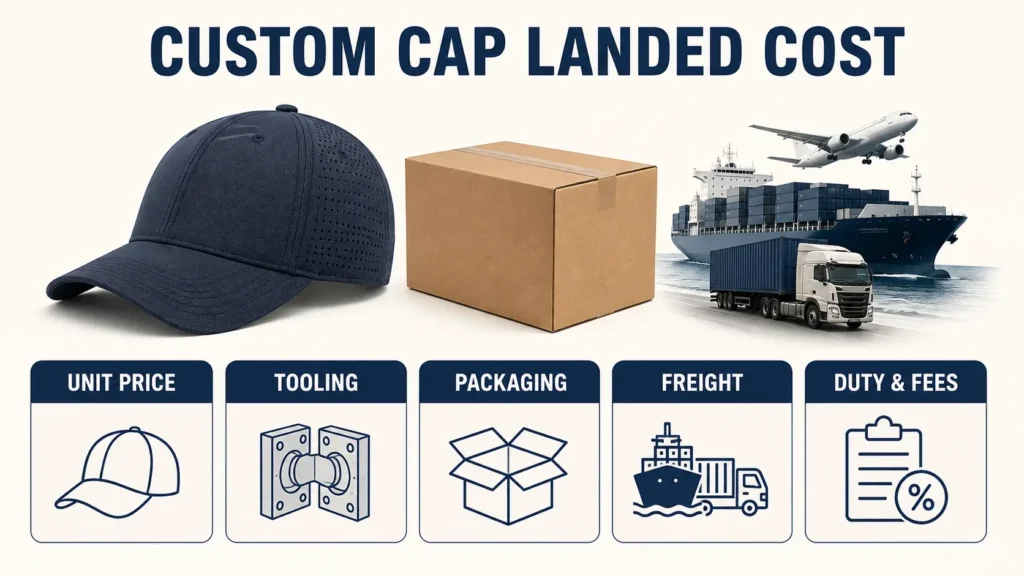
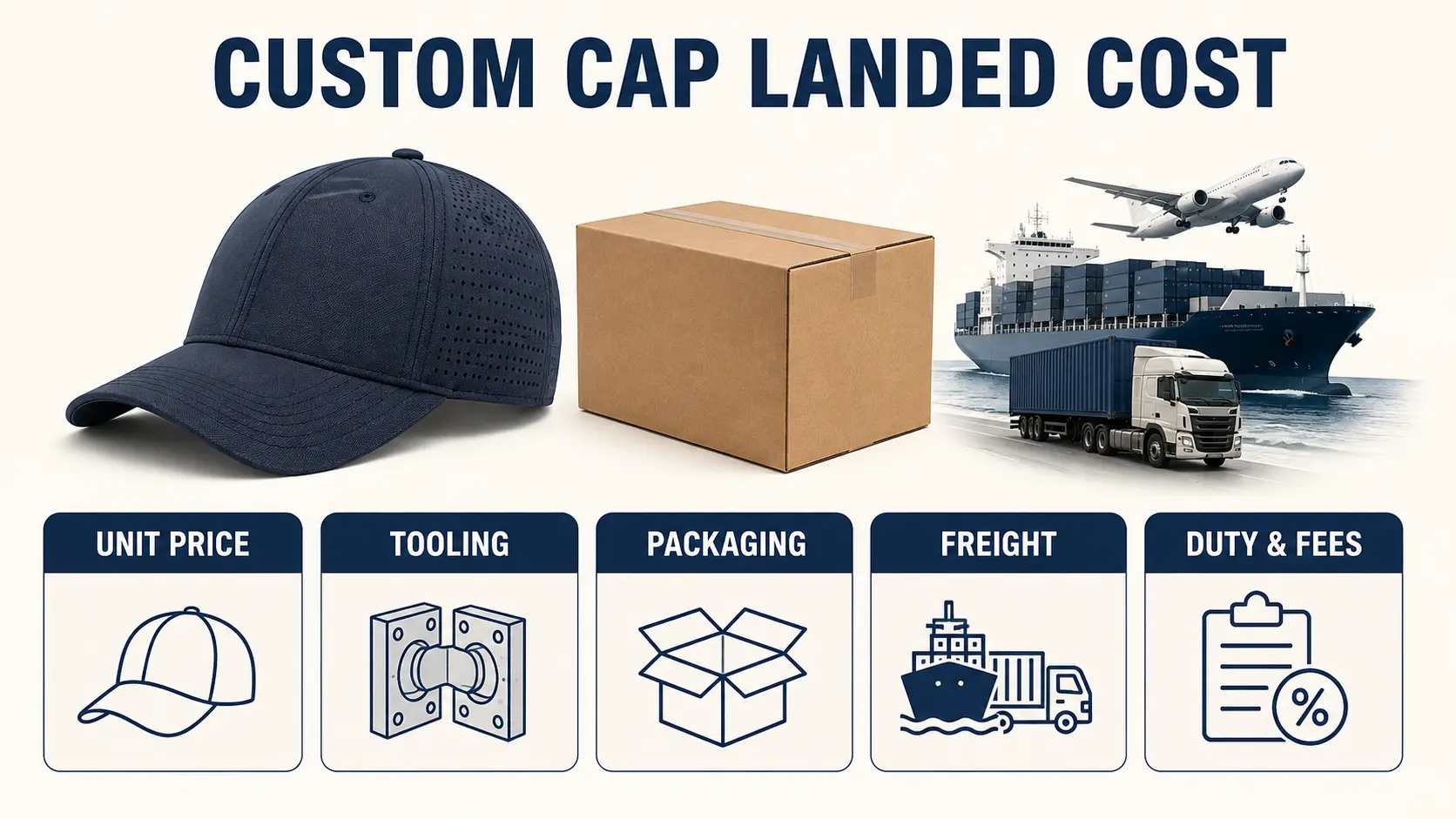
Imagine one factory quote at $4.20 and another at $4.70. Those figures alone do not tell you which cap costs less at your warehouse. The first price may exclude a mold, branded packaging, inspection, or inland delivery. The second may include some of them. Until every cost is placed on the same basis, the cheaper unit price can lead to the more expensive order.
A custom cap landed cost worksheet turns a quote into a buying decision. For a mature brand, it should also show how cost changes across SKUs, colorways, order sizes, freight modes, delivery waves, and reorders. That view matters more than a single “average” cost that hides where the program is exposed.
Custom caps should be compared as complete, delivered products. The worksheet keeps a low factory price from hiding a higher final cost.
What landed cost should answer
Your worksheet should answer one simple question. What does one sellable cap cost when it reaches the agreed destination? The exact boundary matters. “Landed at a U.S. port,” “delivered to a warehouse,” and “ready for an e-commerce pick shelf” are three different cost points.
Write the boundary at the top of the sheet. Then use the same currency, quantity, destination, shipping method, and delivery term for every quote. If one supplier’s answer uses a different condition, mark it instead of forcing a false comparison.
Build the worksheet in six cost groups
| Cost group | Typical lines to include | Question to ask |
|---|---|---|
| Prodotto | Cap, logo, labels, trims, special finish | Is every approved feature included? |
| Development | Sample, digitizing, mold, tooling, courier | Is it one-time or charged again on reorder? |
| Quality | Testing, inspection, replacement allowance | Who pays and when is it performed? |
| Imballaggio | Polybag, insert, sticker, inner box, export carton | What is the packed carton size and count? |
| Logistics | Pickup, export handling, freight, insurance, destination charges | Which parts are included under the delivery term? |
| Import and delivery | Broker, duty, tax where applicable, port fees, final delivery | Has the importer or broker verified the current basis? |
Do not spread a one-time mold fee across only one order if the tool will support several planned reorders. Keep both numbers: first-order landed cost and repeat-order landed cost. This shows whether a higher first order creates a better long-term cost.
Model the portfolio, not only one average cap
A collection can contain a high-volume core style, several small seasonal colors, and one complex logo treatment. One blended cost may make the total look simple, but it can hide an unprofitable SKU or an expensive exception. Build the worksheet at SKU level first, then roll it up to the order and season.
Keep common costs separate from SKU-specific costs. A shared packaging design, inspection visit, or ocean shipment may be allocated across the program. A special mold, low-volume custom color, extra sample, or market-specific label belongs to the SKU that causes it. State the allocation rule so finance can reproduce the number instead of accepting a hidden formula.
Then compare at least three views:
- initial buy: includes development, setup, and launch-specific work;
- steady reorder: removes only the one-time costs that truly do not return;
- change case: shows what happens when volume, freight mode, packaging, material, or delivery timing changes.
This prevents a core-volume SKU from hiding the true cost of smaller extensions. It also shows whether a “free” development item was simply moved into the unit price.
Normalize the product before comparing prices
Two caps that look similar in a photo may not be the same product. Their fabric, crown support, sweatband, brim insert, logo method, or closure may differ. Copy the approved product specification into the worksheet header. Link each supplier quote to the same custom hat tech pack.

If a supplier proposes a substitute, price it as a separate option. Do not let a stock fabric quote sit in the same column as a custom-dyed fabric without a note. The worksheet should reveal differences, not erase them.
Use Incoterms correctly, but ask beyond the three letters
Il ICC Incoterms rules describe delivery responsibilities between buyer and seller. They help define who arranges and bears parts of the transport process. Still, a quote should name the exact place and show included costs. “FOB” without a named port or “DDP” without a destination is incomplete.
Ask for separate logistics lines when possible. These may include pickup, origin handling, freight, insurance, destination handling, customs brokerage, and final delivery. This makes changes easier to model. For example, you can compare air and ocean freight without rebuilding the product cost.
Do not copy an old duty rate into a new order
Import rules, classifications, and rates can change. A cap’s material and construction can affect classification. For U.S. shipments, use the official CBP basic importing guidance and ask the importer of record or a licensed customs broker to confirm current treatment. A factory can provide product details, but the buyer should not treat an unverified duty estimate as legal advice.
Keep the classification reference, duty assumption, source, and verification date in the worksheet. If the number is only an estimate, label it as an estimate. This is safer than hiding uncertainty inside the unit cost.
Packaging can change freight more than expected
Caps hold shape, so a carton can contain more air than a dense product. Ask for the units per carton, carton dimensions, gross weight, and packing method. A hard front, flat brim, individual box, or protective insert may increase volume. Crushing caps to lower freight can damage the product and create a different cost later.
Request one packed-carton plan before bulk production. If e-commerce labels or retail barcodes are needed, add their setup and application cost. Check relevant U.S. labeling questions with the FTC apparel labeling resources and your own compliance team.
Add the cost of delay and quality risk
A worksheet should not invent a penalty, but it can show business risk. Add columns for sample timing, production timing, inspection point, and required delivery date. A quote that misses a launch window may not be useful even if the unit cost is lower.
List the inspections or tests required by your product. For a first production run, the team may want a pre-production sample and a final inspection. JoinTop’s hat quality control process explains how approved specifications support inspection. Put confirmed testing and inspection fees in the price, not in a hidden contingency.
Show risk as a scenario, not a made-up surcharge
Supplier risk matters, but an invented “risk percentage” can make the model look more exact than it is. Keep measurable costs and scenario risks separate. Model what the team would actually do if a problem occurs: use air freight for a late balance, repeat a test, reinspect a failed lot, replace damaged packaging, or split a delivery.
For each scenario, state the trigger, estimated response, cost owner, and business impact. Use confirmed quotes where available and label estimates clearly. A risk column should help a decision team compare exposure; it should not be used to force a preferred supplier to win.
Also compare cash timing. Deposits, balance payments, tooling, samples, duty, and freight may occur in different periods. Two suppliers can have a similar landed cost but a different cash requirement. Finance should be able to see that difference before the purchase order is approved.
Calculate three numbers, not one
Show the total order cash outlay, landed cost per accepted unit, and expected repeat-order landed cost. If you include a defect or replacement allowance, keep it visible and state the basis. Do not subtract expected tax recovery or add a sales margin unless the finance team has approved that method.
Then test a few scenarios: lower or higher quantity, air versus ocean shipment, standard versus premium packaging, and first order versus reorder. Scenario columns show which decision truly drives cost. They also stop a small product change from being judged only by the factory unit price.
Lock the cost model to the approved product version
Every approved cost sheet should name the tech-pack version, quote version, date, currency, Incoterm and named place, quantity matrix, freight assumption, and owner of duty or tax verification. When product development changes the material, logo, packaging, or SKU mix, issue a new cost version rather than editing the old total without a record.
At the end of the season, compare planned and actual cost by major group. The purpose is not to blame a department. It is to improve the next buy: refine carton assumptions, identify repeated air-freight causes, confirm which setup costs returned, and update reorder forecasts with real data.


 English
  German
  Spanish
  French
  Amharic
  Portuguese
  Italian
  Swedish
  Turkish
  Belarusian
  Danish