
Custom bucket hat embroidery needs a different approval process from embroidery on a standard baseball cap. The crown and brim move in more directions, the fabric can be softer, and the logo may sit close to a seam or curved edge. A brand should approve the embroidery on the finished bucket hat, with the actual backing and thread settings, before releasing a bulk order.

Start with the bucket-hat construction
Confirm the crown height, brim width, seam layout, lining, sweatband, eyelets, and closure before digitizing the logo. A shallow crown may need a smaller design than a deep crown. A wide brim changes the visual balance of the front panel. If the hat is intended for golf or outdoor use, decide whether the bucket is a stand-alone product or part of a wider Performance Cap collection.
For a brand that also sells normal five-panel or six-panel performance caps, keep the logo family consistent while allowing the decoration size to follow each silhouette. The same artwork does not need to be the same physical width on every hat.
Digitizing decisions that affect the finished logo
Digitizing controls stitch direction, density, underlay, pull compensation, and the way small details are simplified. Fine type and narrow gaps often close up when the crown curves. A good digitizer will identify which details must be enlarged or removed instead of promising that a very small file will sew perfectly.
Ask for a sew-out on a fabric close to the final crown. A flat twill sample may hide puckering that appears on a lightweight or washed fabric. Record the thread references, backing, hoop size, and design version with the approval.
Where should the embroidery sit?
Front-center placement is common, but it is not the only option. Side embroidery can work for a small mark, while a rear logo needs enough distance from the closure and sweatband. On a bucket hat, measure from the crown seam or lower edge rather than relying on a visual guess. Mark the centerline on the sample and photograph the placement from front and side views.
When the logo is close to a seam, test the hoop access and the risk of distortion. A logo that is centered on a flat drawing may appear off-center once the hat is shaped. The approval should show the hat on a form or in its finished shape.
Bulk inspection points for embroidered bucket hats
- Logo position matches the approved distance from the crown seam.
- Stitch density is consistent without bald areas or heavy ridges.
- Small type remains legible at normal viewing distance.
- There is no puckering, thread looping, loose backing, or skipped stitch.
- The brim remains flat or follows the approved curve after embroidery.
- Thread colors match the approved reference under normal light.
When a patch may be a better choice
Embroidery is useful when the brand wants texture and a stitched appearance. A woven patch may be better for very fine artwork, small lettering, or a deliberately flat graphic. Printing can suit a large tonal image on a smooth fabric. Compare the methods on the actual bucket hat rather than choosing from a catalog photograph.
How to quote a custom bucket-hat program
Send the logo file, preferred bucket-hat material, crown and brim reference, decoration position, colors, quantity by style and color, packaging, target market, and delivery date. JoinTop accepts projects from 100 pieces per style and color, subject to the final specification. A clear brief lets the factory separate digitizing, sample, hat, decoration, packaging, and freight assumptions.
Cost decisions that affect embroidered bucket hats
The decoration price is only one part of the landed product cost. Digitizing, backing, thread count, hoop setup, sample revisions, hat construction, packaging, and freight can all change the final number. A buyer comparing suppliers should ask for the same logo dimensions and the same crown fabric so that the comparison is meaningful.
Large dense embroidery may look impressive but can add stiffness and create puckering on a light crown. A smaller, cleaner mark can be more comfortable and more repeatable. Ask the factory to explain the trade-off between coverage, stitch count, hand feel, and appearance rather than choosing the densest possible design.
How to run a useful sample review
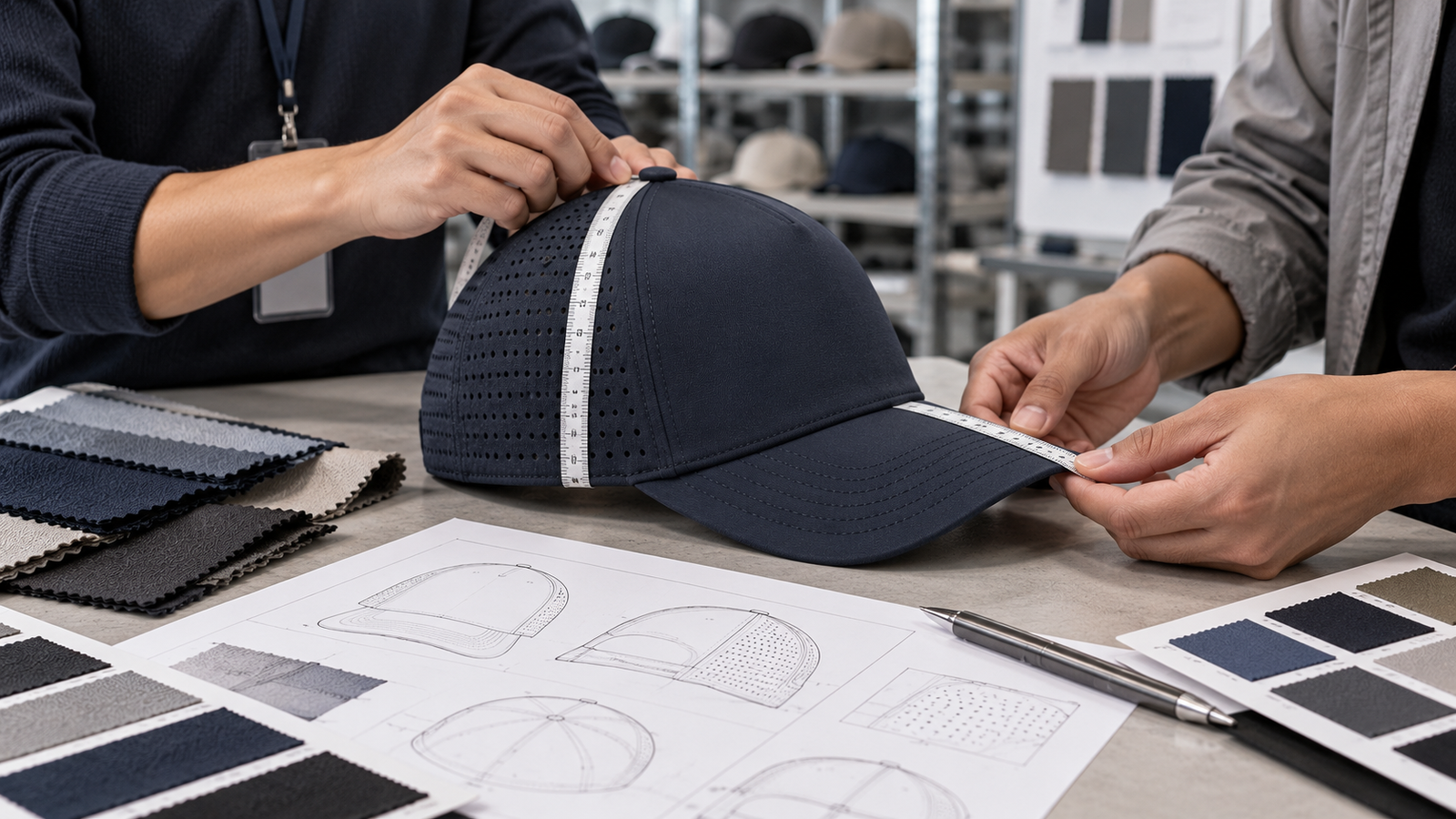
Review the sample in the shape in which it will be sold. Lay it flat once to inspect the back, then place it on a head form or wear it to see how the crown pulls around the embroidery. Photograph the front, side, inside, and close-up of the logo. Mark any correction with a measurement, arrow, or reference line.
Approve the artwork file and the physical sew-out separately. The artwork proves what the logo should be; the sew-out proves how that logo behaves on the selected fabric. Both records should carry a version number. If the brand changes the artwork after the sample, the factory should not rely on the earlier digitized file.
What to monitor during bulk production
Inspect samples from the beginning, middle, and end of the run. Look for drift in logo placement, different stitch density, thread shade changes, loose backing, and brim distortion. If several colors use different fabrics, inspect each colorway rather than assuming the first approval covers every material.
For repeat orders, keep the approved bucket hat and its measurement sheet. A reorder should be compared against that reference before cartons are closed. This protects the brand from small changes that may be invisible in a supplier photograph but obvious when customers compare two seasons of product.
A buyer’s decision matrix
| Decision | What to specify | What to inspect |
|---|---|---|
| Logo size | Width, height, centerline, distance from seam | Position on shaped hat |
| Thread and backing | Thread reference, backing type, density | Puckering, loops, loose backing |
| Bucket construction | Crown height, brim width, lining, sweatband | Shape after sewing and wear |
| Repeat order | Approved sample and tolerance | Lot-to-lot consistency |
What can go wrong after a good sample
A sample can look correct while the bulk process remains undefined. The production team may use a different hoop, a different backing, a different fabric lot, or a different logo file. This is why the approval record needs more than a photograph. It should identify the cap construction, embroidery file, thread references, backing, placement measurements, and any accepted deviation.
Ask for a pre-production confirmation before the full run. The factory should be able to show that the production file matches the approved sample. If the order contains several colors, approve the first production piece for each material rather than assuming one color proves every color.
How embroidery affects the wider product range
A logo developed for a bucket hat may also appear on a five-panel or six-panel Performance Cap, visor, or trucker hat. Keep the brand artwork consistent, but do not force one physical size or one stitch plan across every silhouette. The crown curvature, usable area, and fabric stability are different. A small adjustment can protect readability and comfort while preserving the same visual identity.
For a collection, create a decoration standard that lists the logo family, color references, permitted size range, and acceptable placement for each silhouette. That gives the design and sourcing teams a common reference when new styles are added.
Keeping the approval record usable
The approval record should be short enough for a production team to use and detailed enough for a buyer to defend. Include the product name, sample date, fabric or construction reference, artwork version, measurements, approved color, packaging instruction, and the person who approved the sample. Attach marked photographs for details that are difficult to describe in words.
When a change is requested, update the record instead of adding an untracked message. State what changed, why it changed, and whether the change affects cost, delivery, or the next sample. This gives the brand a clear trail from the first idea to the product that enters bulk production.
What a serious supplier conversation sounds like
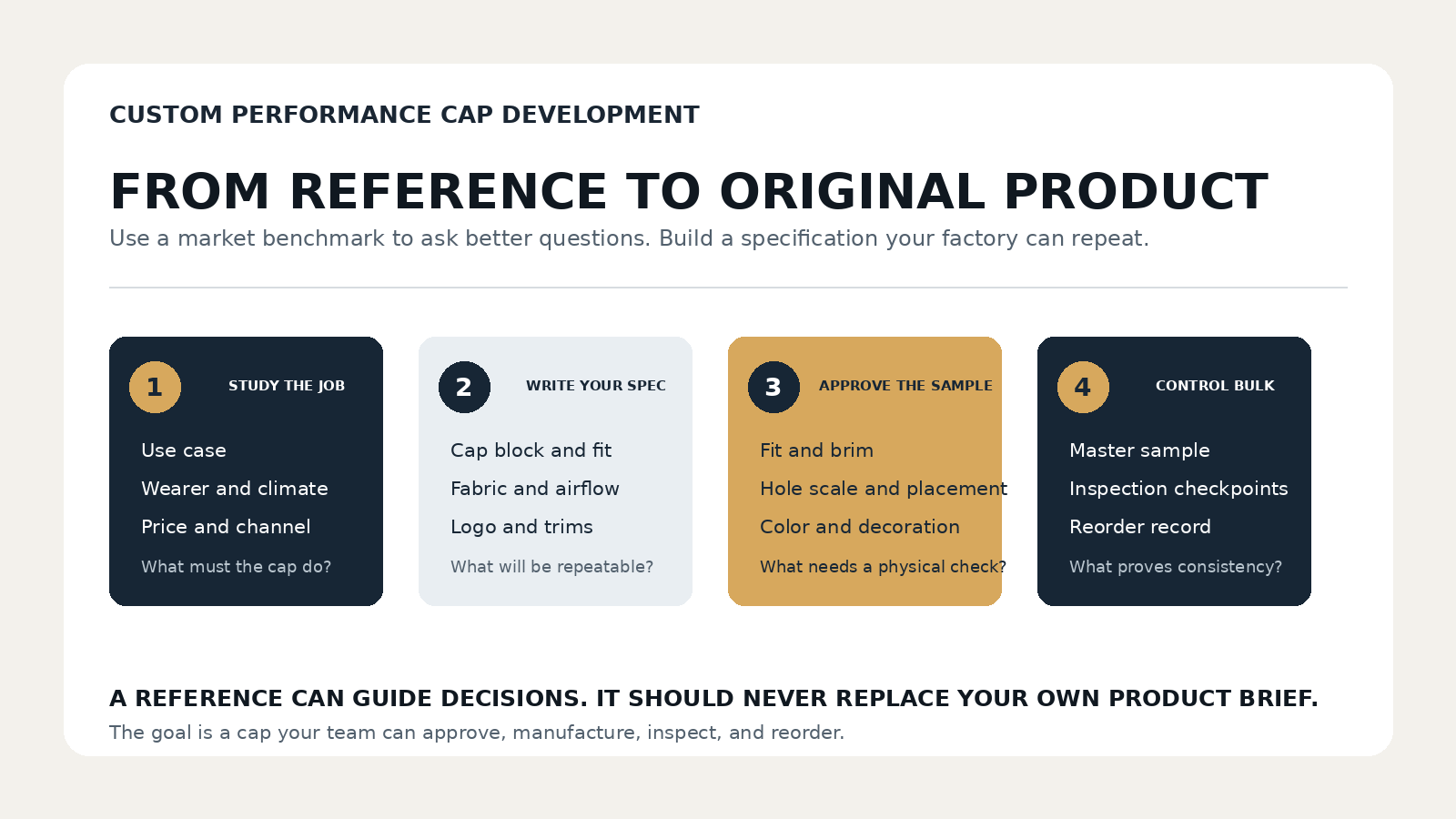
A capable supplier should ask questions about use, fit, material, logo, quantity, and timing. It should identify a risk when a requested detail conflicts with the construction. That conversation is part of product development. The goal is a cap that the factory can make consistently and the brand can explain confidently to its own customers.
Send the complete brief before requesting the final quotation. JoinTop can then review the product as a complete program, recommend practical options, and prepare a sample against a specification rather than a loose reference image.
Questions buyers should settle before approval
Can the same logo file be used on every hat?
The artwork can stay consistent, but the digitized size and stitch plan may need to change with crown shape and fabric.
What should the sample record include?
Keep the approved hat, artwork version, thread references, backing, logo measurements, and marked photographs.
Is a bucket hat automatically suitable for performance use?
No. The material, sweatband, brim, ventilation, and intended use must be evaluated together. Do not assume a fashion bucket hat has the same function as a technical Performance Cap.
Share the complete specification before sampling so the embroidery can be judged on the product customers will actually receive.



 English
 German
 Spanish
 French
 Amharic
 Portuguese
 Italian
 Swedish
 Turkish
 Belarusian
 Danish