
Here is the thing about golf and rain: one makes the other miserable, and every golfer knows it. A wet head, rain dripping down your neck, a brim that absorbs water until it flops into your eyes — this is the stuff that makes people walk off the course. The gear industry has spent decades solving the jacket and pants problem. The hat problem? Mostly ignored until the last few years.
Now there is a genuine category of waterproof golf caps worth paying attention to. Some are built like technical outerwear shrunk down to head size. Others slap a DWR coating on a regular cap and call it waterproof, which it is not.
Since we manufacture custom headwear for brands — and since waterproof golf caps are one of the fastest-growing request categories in our factory — we went through the top models on the market to break down what works, what does not, and what spec actually matters if you are building your own.
The Market Leaders at a Glance
Here is every waterproof golf hat worth knowing about in 2026, lined up side by side:
| Brand & Model | Style | Waterproof Tech | Material | Price | Key Feature |
|---|---|---|---|---|---|
| Galvin Green Argo | Baseball cap | Gore-Tex Paclite | Polyester + ePTFE membrane | $65 | 100% waterproof, tournament-approved |
| Galvin Green Atlas | Baseball cap | Pertex Shield 3L stretch | Polyamide + elastane | $53 | Softest hand feel in category |
| Galvin Green Asher | Bucket hat | Pertex Shield 3L stretch | Polyamide + PU membrane | $99 | Wide brim + storm strap |
| FootJoy HydroSeries Bucket | Bucket hat | Proprietary waterproof membrane | Polyester | $45 | Best packable option |
| FootJoy HydroSeries Hat | Baseball cap | Proprietary waterproof membrane | Polyester | $35 | Traditional golf cap look |
| Outdoor Research Seattle Rain Hat | Bucket hat | GORE-TEX 2L | Recycled nylon | $70 | Gold standard for extreme weather |
| Titleist Players StaDry Bucket | Bucket hat | StaDry bonded seams | Polyester | $50 | UPF 50+ sun + rain crossover |
| Melin A-Game Hydro | Baseball cap | DWR coating | Polyester blend | $79 | Water-repellent, NOT waterproof |
The feature that separates the top half of this table from the bottom half is not marketing language — it is whether the hat has a membrane. More on that in a minute.
Galvin Green: The Brand That Owns This Category
Nobody in the golf industry has invested more in waterproof headwear than Galvin Green. They offer three distinct models — a baseball cap (Argo), a stretch baseball cap (Atlas), and a wide-brim bucket (Asher) — and all three use either Gore-Tex or Pertex Shield membranes.
The Galvin Green Argo is the one to study if you are a brand looking to build a waterproof cap. It uses Gore-Tex Paclite, which is essentially a two-layer construction that bonds the waterproof membrane directly to the outer shell fabric. This makes the cap lighter than a standard three-layer Gore-Tex build, which matters when that weight is sitting on your head for four hours.
The seams are taped. Every single one. This is the difference between “water-resistant” and “100% waterproof.” A regular sewn seam will leak at the needle holes no matter how waterproof the fabric is. Tape seals those holes.
At $65 MSRP, the Argo is not cheap. But in the waterproof cap category, price tracks directly with performance. There are no hidden gems at $20. There are only caps that will eventually let water in.
Our custom performance hats guide breaks down the manufacturing side of waterproof treatments, including what testing standards you should ask your factory for.
FootJoy HydroSeries: The Workhorse Option
FootJoy dominates golf apparel the same way Titleist dominates golf balls — they are the default for a reason. Their HydroSeries line includes a bucket hat ($45) and a traditional baseball cap ($35), both using FootJoy’s proprietary waterproof membrane.
These are the most accessible entries in the category. At $35-45, they cost less than Galvin Green and Outdoor Research, and they deliver solid rain protection for everything short of a monsoon. The baseball cap version is the one most golfers will actually wear, because it looks like a normal golf hat — structured crown, pre-curved brim, snapback closure — and nobody on the tee box needs to know it is waterproof.
The trade-off: FootJoy’s membrane is less breathable than Gore-Tex or Pertex Shield. On a humid day, your head will feel warmer than it would in the Galvin Green Argo. For most golfers playing in moderate rain for a few holes, this does not matter. For a caddie looping 36 holes in Scotland, it does.
If you are speccing a custom waterproof golf cap for your brand, the FootJoy HydroSeries cap is a good benchmark for what the mid-tier market looks like in terms of feel, weight, and construction. Our custom baseball hats guide covers the key construction points you will need in your tech pack.
Outdoor Research Seattle Rain Hat: The Over-Engineered Option
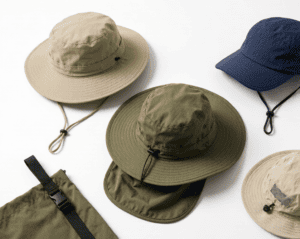
The Outdoor Research Seattle Rain Hat is a bucket style built with GORE-TEX 2L, a floating foam-stiffened brim, and a removable chin cord that actually works in wind. At $70, it used to be the most expensive hat on this list — now the Galvin Green Asher takes that crown at $99 — and it remains the most waterproof thing you can put on your head without joining the Navy.
The brim is wider than any golf-specific hat on the market, which is both its best feature and its biggest drawback. In heavy rain, nothing keeps you drier. But it looks like a hiking hat, not a golf hat, and for a lot of golfers that matters. Style still sells, even in a downpour.
Outdoor Research also makes a Seattle Rain Cap ($56) — a baseball cap version with the same GORE-TEX 3L construction and fully taped seams, for those who want the waterproofing without the bucket silhouette. Worth a look if you are deciding between cap styles for your own line.
From a manufacturing perspective, Outdoor Research proves something useful: the membrane is what matters, but the seam taping is what makes the membrane matter. You can spec Gore-Tex for your custom hat. If your factory skips the seam tape to save a dollar, you have built an expensive water-resistant hat, not a waterproof one. More on what to ask factories in our performance hats product breakdown.
Titleist Players StaDry Bucket: The Crossover Pick
Titleist took a different approach with their Players StaDry Bucket. Instead of adding a membrane, they built the hat from performance waterproof polyester and bonded the seams instead of sewing them. No needle holes means no leaks, even without tape.
This is a clever manufacturing approach that keeps the cost at $50 while delivering genuine waterproof performance. The trade-off: bonded seams are not as durable long-term as taped seams on a membrane hat. After a season of heavy use, the bond points can start to separate. But for a hat that lives in your golf bag as a backup for sudden showers, it works.
The StaDry also doubles as a UPF 50+ sun hat, which makes it more versatile than a dedicated rain hat. If you market your brand’s hat as a year-round piece rather than a single-purpose rain accessory, you get more utility per dollar in the customer’s mind.
For brands thinking about customizing Melin-style premium caps, the StaDry approach is worth understanding: sometimes skipping a membrane and focusing on seam construction gives you a price-to-performance ratio that hits a different segment of the market.
Melin Hydro: The One That Is Not Actually Waterproof
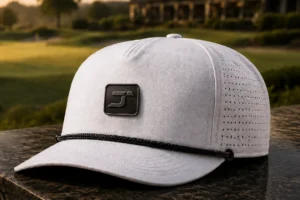
This needs to be said because a lot of buyers get it wrong: the Melin Hydro collection (A-Game Hydro, Odysea Stacked Hydro, Trenches Icon Hydro) is water-repellent, not waterproof. There is a functional difference, and it is not subtle.
A DWR-treated cap (which is what Melin uses) will shed light rain for 10-15 minutes. After that, the fabric saturates, the seams leak, and your head gets wet. This is fine for a sprinkle. It is not fine for a real round of golf in real rain. Melin themselves market it as “water-friendly” and “water-repellent” — they are honest about the category they play in.
Melin is a brilliant brand — their marketing, their community, their colorway drops are all best-in-class. But their hats sit in the “lifestyle performance” category, not the “technical waterproof” category. At $79, you are paying for design and brand cachet, not for the ability to stay dry through 18 holes in the Pacific Northwest.
If your brand wants to position in this space, the Melin golf hat guide we published earlier breaks down the material choices and pricing architecture of premium lifestyle-performance headwear.
Baseball Cap vs. Bucket Hat: What the Data Says
Here is the reality from the manufacturing side: of the eight waterproof hats in the comparison table above, four are bucket hats and four are baseball caps (plus Outdoor Research offers a Seattle Rain Cap that bridges both worlds). The bucket hats consistently perform better in heavy rain because they cover more surface area. The baseball caps sell better because people actually want to wear them.
| Style | Rain Protection | Breathability | Sales Appeal | Best For |
|---|---|---|---|---|
| Baseball cap | Moderate | Better | High | Light-to-moderate rain, style-conscious golfers |
| Bucket hat | Excellent | Good | Moderate | Heavy rain, tournament play, all-day protection |
| Wide brim bucket | Maximum | Moderate | Lower | Extreme weather, high-wind coastal courses |
The fashion problem is real. Joel Dahmen made the bucket hat cool on Tour for about six months, and then it went back to being a functional choice rather than a style choice. Most golfers will reach for a baseball cap first unless the forecast is grim.
This affects how you should think about your product line. If you are launching a single waterproof SKU, make it a baseball cap with a membrane and taped seams. It covers 80% of use cases and 90% of buyer preferences. If you are launching a capsule collection, lead with a baseball cap and follow with a bucket hat for the “serious rain” crowd.
What Actually Makes a Golf Cap Waterproof
There are three layers of waterproofing, and they are not interchangeable:
Level 1: DWR Coating (Water-Repellent) A chemical treatment on the fabric surface. Water beads up and rolls off initially. Degrades with washing and abrasion. This is what Melin uses. It handles light rain for 15-20 minutes. After that, the fabric wets out. Do not call this waterproof on your product page or customers will call you on it.
Level 2: Waterproof Membrane (Gore-Tex, Pertex Shield, Proprietary) A microporous layer bonded to the fabric that blocks water molecules while allowing water vapor (sweat) to pass through. This is what Galvin Green, Outdoor Research, and FootJoy use. With taped seams, this delivers genuine waterproof performance that lasts through hours of rain.
Level 3: Full Seam Sealing The membrane means nothing if the seams leak. Taped seams or bonded seams are the only ways to seal the needle holes from stitching. This is the step that separates the properly waterproof caps from the ones that look waterproof on a spec sheet and leak on the course, and it is the first thing factories try to skip when you negotiate on price.
Articles like GolferHive’s rain hat comparison and GolfGearAdvisor’s roundup do a solid job of testing these differences in real conditions. Their field testing aligns with what we see at the production level: the membrane + tape combination is the only approach that holds up to a full round in the rain.
How These Compare to What You Can Build as a Brand
Every hat in the comparison table above is a retail product. If you are a brand looking to manufacture your own waterproof golf cap, the question is: can you match this quality at a price that lets you make margin?
The short answer: yes, if you spec it right.
A custom waterproof golf cap with a PU membrane (the most common alternative to Gore-Tex at the factory level), taped seams, and a DWR outer treatment costs roughly $5.50 to $8.00 FOB per unit at 500-piece MOQ, depending on fabric choice and trim complexity. That compares favorably to the retail prices above, which range from $35 to $99.
The spec sheet you need to hand your factory should include:
- Fabric: waterproof polyester with PU or TPU membrane (specify hydrostatic head rating — 10,000mm minimum)
- Seams: fully taped, not stitched-and-coated
- Brim: waterproof construction with memory (a cardboard brim in a waterproof cap defeats the purpose)
- Sweatband: quick-dry or antimicrobial liner
- Testing: AATCC 35 rain test or equivalent
Our custom hat development process guide walks through the full sampling cycle for technical headwear, including what to expect at each round.
Which Cap Should Your Brand Model?
If you are building a waterproof golf cap for your line, here is the quick hit on what to copy from each brand:
- Performance benchmark: Galvin Green Argo — copy the membrane + tape construction
- Price-to-value ratio: FootJoy HydroSeries Hat — this is the price point most buyers expect
- Style reference: Melin Hydro collection — copy the silhouette and branding, upgrade the waterproofing
- Extreme coverage: Outdoor Research Seattle — if your market is Pacific Northwest or coastal UK
- Sun + rain crossover: Titleist Players StaDry — the UPF 50 + waterproof combo is an underrated selling point
The types of caps article we published covers silhouette options in more detail if you are still deciding between a structured cap, an unstructured runner, or a bucket style.
The Bottom Line
Waterproof golf caps are a small but growing category, and the gap between the good ones and the “we sprayed DWR on a regular cap” ones is enormous. Galvin Green owns the technical high ground. FootJoy owns the accessible middle. Outdoor Research owns the extreme end. Melin owns the lifestyle positioning but not the actual waterproofing.
For a brand entering this space, the opportunity is clear: build a proper waterproof baseball cap with a membrane and taped seams, price it between $45 and $55, and market it honestly. Do not call DWR “waterproof.” Golfers who play in real rain will know the difference immediately, and they are the ones who will buy more than one.
If you are ready to spec your own waterproof golf cap, reach out to our team. We have been making technical headwear for over twenty years across factories in China, Vietnam, and Bangladesh. We will tell you what your spec needs, what it costs, and how long it takes — no marketing fluff, just production numbers.

 English
  German
  Spanish
  French
  Amharic
  Portuguese
  Italian
  Swedish
  Turkish
  Belarusian
  Danish