

Custom waterproof performance hats need to balance weather protection, ventilation, comfort, branding, and repeatable production. For a brand buyer, the right development brief is more than a logo placed on a cap: it defines the fabric claim, laser-cut ventilation, sweatband, fit, decoration method, sample approval, and bulk quality controls before an order is released.
This guide helps golf, outdoor, sports, lifestyle, and promotional headwear brands evaluate a waterproof performance cap program. It keeps the product decision practical: what to specify, what to verify in sampling, and what information to send a manufacturer when requesting an OEM, ODM, wholesale, or bulk quotation.

What should a custom waterproof performance cap do?
Start with the use case rather than the word “waterproof.” A golf brand may need a light rain-ready cap that remains breathable during a long round. An outdoor brand may need stronger water protection and a structured crown. A lifestyle brand may prioritize a clean laser-cut appearance, soft hand feel, and a shape that works beyond sport.
Write the intended claim precisely: waterproof, water resistant, or weather resistant. The claim should match the fabric, finish, seam and construction details, and any testing the brand has completed. If testing is not available, describe the material and intended use without promising a performance level that has not been verified.
Performance cap specification checklist for brand buyers
| Decision area | What to define in the brief | What to check in the sample |
|---|---|---|
| Outer fabric | Fiber content, surface finish, hand feel, target weight, and weather claim | Appearance, comfort, moisture response, and consistency across panels |
| Ventilation | Laser-cut pattern, mesh insert, eyelets, or another airflow method | Hole placement, clean edges, airflow, and crown stability |
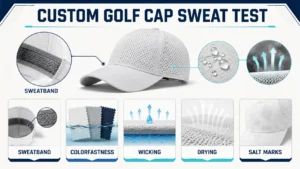
| Moisture management | Sweatband material, width, and wicking requirement | Skin comfort, absorbency, stitching, and placement |
| Sun protection | Whether a UPF claim is required and what evidence supports it | Test report or material documentation before publishing a claim |
| Branding | Embroidery, heat transfer, rubber or silicone patch, woven label, or print | Logo position, adhesion, puckering, color, and wash or wear response |
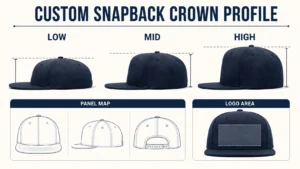
| Fit and closure | Structured or unstructured crown, brim shape, size range, and closure | Fit on the target head range, adjustment, balance, and brim recovery |
Laser-cut ventilation, moisture wicking, and UPF: specify the feature, not a slogan
Laser-cut ventilation can create a precise visual signature, but the pattern still has to support airflow without weakening the crown. The brief should show the location, density, shape, and orientation of the perforations. A sample review should check the cut edge, symmetry, comfort against the head, and whether the crown keeps its intended profile.
“Moisture wicking” also needs a defined point of control. Ask which fabric or sweatband is intended to move moisture, how it will be identified in the specification, and which available test evidence supports the claim. A label alone is not a substitute for a material record or test result.
UPF is a separate sun-protection claim. If the brand wants to use a UPF rating on packaging or a product page, confirm the applicable fabric evidence and claim wording before production. A manufacturer can help identify suitable materials and organize samples, but the final public claim should follow the evidence available for the finished product.
How to approve a custom waterproof performance hat sample
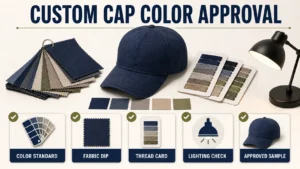
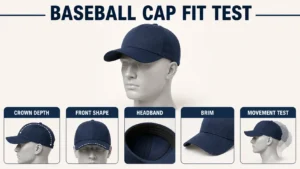
Use a written sample review instead of approving only from a product photo. The reviewer should record the sample version, fabric, color, logo artwork, ventilation layout, closure, and requested changes. This creates a reference for the pre-production sample and later bulk inspection.
- Fit: Check crown height, front panel shape, brim curve, adjustment range, and comfort during movement.
- Weather feature: Confirm that the material and construction match the intended water or weather claim; record any test still required.
- Airflow: Inspect laser perforations or mesh for clean execution, symmetry, and comfort.
- Branding: Compare logo size, position, color, stitch density, backing, and distortion against the approved artwork.
- Construction: Review seams, taping, sweatband attachment, closure, brim, loose threads, and overall finish.
- Packaging: Confirm folding, protective materials, carton marks, labels, and any SKU or color separation needed for delivery.
OEM, ODM, wholesale, and bulk production questions
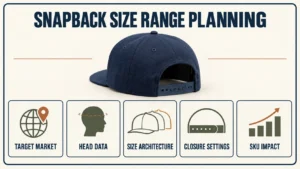
For an OEM or ODM project, send the manufacturer enough information to assess the product honestly: target market, use case, reference shape, material preference, color standards, logo files, ventilation idea, size range, expected order quantity, packaging needs, and target launch date. If some details are undecided, mark them as open decisions instead of assuming a standard specification.
MOQ, sampling cost, production timing, and unit pricing depend on the selected fabric, decoration, construction, quantity, and packaging. They should be confirmed against the final brief and sample plan. Do not use a generic MOQ or lead-time promise for every performance cap project.
For a broader development sequence, see custom hat development process. For a purchasing checklist, see custom hat RFQ checklist. Brands comparing factory capabilities can also review the custom performance hats manufacturer page and the Capsules de performance product page.
Quality control from approved sample to repeat order
The approved sample should become the comparison reference for bulk production. A practical control plan records the approved fabric, color, artwork, logo placement, ventilation pattern, measurements, closure, packing method, and acceptable visual differences. During production, inspection should focus on the features that affect fit, performance claims, branding, and cross-lot consistency.
Repeat orders need the same discipline. Keep the approved specification and sample reference available when changing color, fabric lot, logo method, or packaging. If the brand is launching several SKUs, use one shared measurement and artwork system so the collection feels consistent while each product keeps its intended performance purpose.

FAQ for custom waterproof performance cap projects
Are waterproof and water-resistant performance caps the same?
No. The terms describe different levels of protection. The correct wording depends on the material, construction, and evidence for the finished product. Confirm the claim before it appears in sales or packaging copy.
Can a performance cap include laser-cut ventilation?
Yes. The ventilation layout should be developed with the crown shape, fabric, comfort, and appearance in mind. Approve the cut pattern and sample execution before bulk production.
Can brands add a UPF claim?
They can consider a UPF claim when the relevant material or finished-product evidence supports it. Ask the manufacturer what documentation is available and use claim wording that matches the evidence.
What should be included in a bulk quotation request?
Include the target use, fabric or reference, colors, logo files, decoration method, ventilation, size and closure, quantity by SKU, packaging, destination, sample requirements, and target launch date. This gives the factory a usable basis for MOQ, timing, and pricing.
Can JoinTop help develop a custom performance cap?
JoinTop can review a brand’s performance cap brief, discuss fabric and construction options, support sampling, and prepare a production quotation based on the confirmed requirements. Send the target market, reference images or tech pack, logo artwork, quantity by style and color, and the performance features that matter most.
For a custom waterproof performance cap program, the next useful step is a reviewable brief and sample plan. Request a sample, technical recommendation, or bulk quotation from JoinTop with your product requirements so the team can assess the right construction before production.

 English
 German
 Spanish
 French
 Amharic
 Portuguese
 Italian
 Swedish
 Turkish
 Belarusian
 Danish