
Custom hunting hats are outdoor products first and branded products second. A buyer needs to decide how the hat will be worn, what weather it should handle, how it will fit with other equipment, and which details must remain consistent in bulk. A logo added to a generic hat does not answer those production questions.
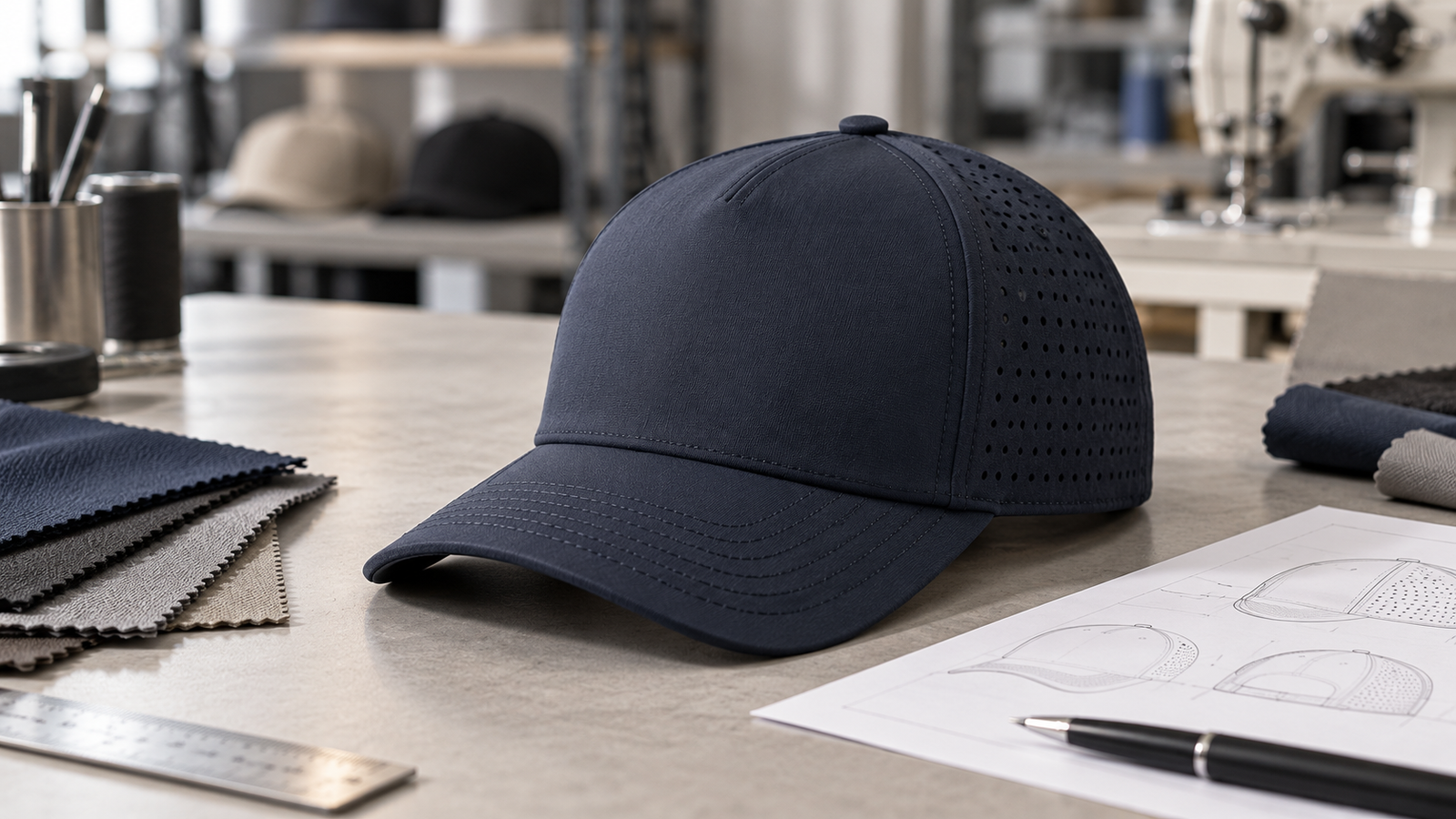
Choose the silhouette for the field use
A five-panel or six-panel Performance Cap may suit warm-weather movement, running between locations, or a lightweight outdoor collection. A brimmed bucket or boonie silhouette offers different coverage and can be useful when the brand wants a wider brim or a more traditional field look. Decide the silhouette before choosing fabric and decoration.
Check whether the wearer needs a low profile that fits under hearing protection, a longer brim for glare control, a secure chin cord, or a closure that can be adjusted with gloves. These details change the pattern and should appear in the brief.
Fabric choices and honest claims
Compare weight, surface, noise from movement, drying behavior, colorfastness, and resistance to snagging. A lightweight fabric may improve comfort in warm weather but may require additional structure around the brim or front panel. A heavier fabric can feel durable while becoming uncomfortable in heat.
Use precise language for water resistance, camouflage, sun protection, and performance. If the brand wants to make a claim, define the relevant test, labeling requirement, or supplier evidence for the target market. A fabric name alone does not prove a finished-hat claim.
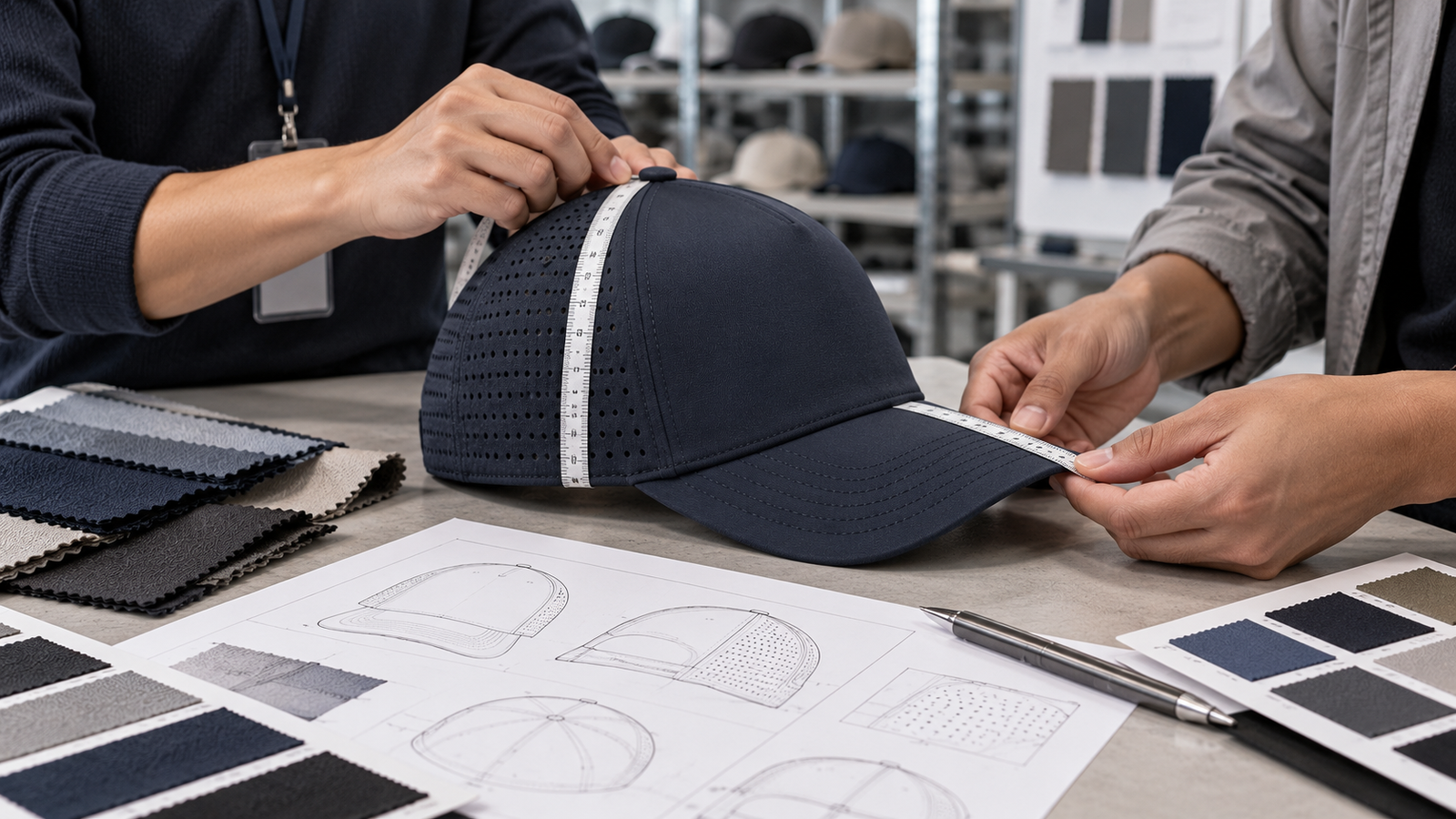
Fit and equipment compatibility
Wear the sample with the clothing or equipment used by the target customer. Check whether the brim interferes with optics, whether the closure catches on a collar, and whether the crown retains its shape after repeated adjustment. If a chin cord is used, inspect the attachment and cord-lock position.
Measure the size range rather than relying on “one size fits most.” Record the adjustment range, sweatband opening, and the location of any internal seam. A good field fit is a combination of pattern, material, and closure.
Branding without weakening the product
Embroidery can work on a stable front panel, while a woven patch or print may be better for detailed artwork or a lightweight fabric. Keep logos away from ventilation holes, seams, and high-friction areas. Approve the decoration on the finished hat, including backing and thread or ink references.
Outdoor production checklist
- Silhouette and brim purpose are written in the product brief.
- Fabric weight, color, surface, and approved supplier reference are recorded.
- Closure and size range are checked on more than one head size.
- Logo location does not interfere with seams, ventilation, or equipment.
- Brim edge, cord attachment, eyelets, and internal finishing are inspected.
- Any performance or compliance claim has a defined evidence path.
Planning a collection and reorder
Keep the base pattern stable across colors and seasonal fabric changes. When a fabric substitute is required, compare hand feel, weight, color, shape retention, and decoration result against the approved sample. JoinTop accepts projects from 100 pieces per style and color, subject to the final specification.
Send the intended use, silhouette, fabric reference, artwork, quantity by color, packaging, target market, and delivery date for a production-focused quotation.
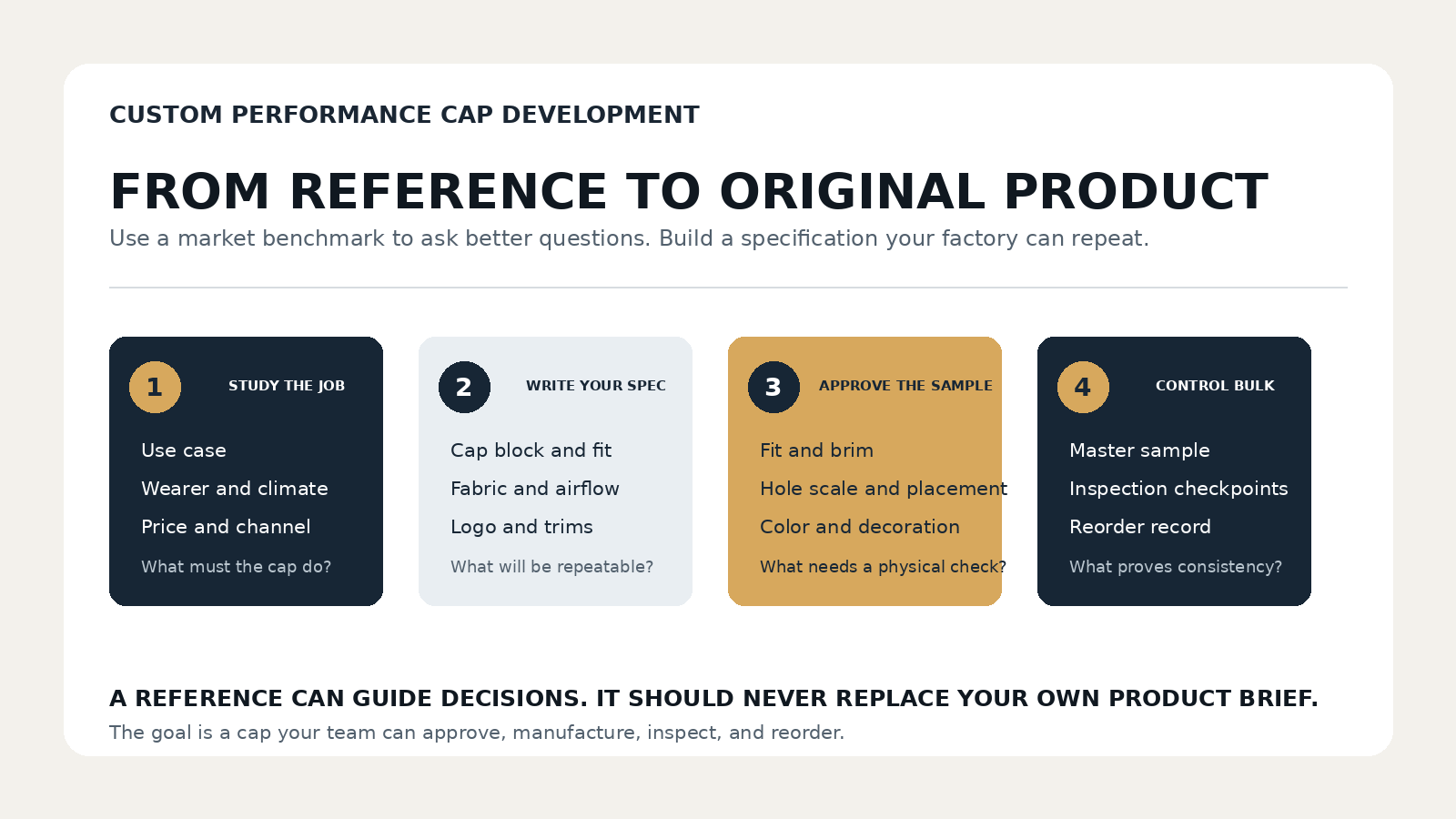
Outdoor claims need a specification trail
Hunting and outdoor brands often use words such as water-resistant, breathable, sun-protective, quiet, durable, or camouflage. Each word creates a different expectation. The product brief should state whether a term describes appearance, material construction, a tested result, or a marketing position that still needs evidence.
For example, a quiet fabric may be important to the wearer, but “quiet” depends on movement, layering, and environment. A water-resistant finish can be useful without making the hat waterproof. Clear language helps the brand avoid promising more than the finished product has been evaluated to deliver.
Evaluate the complete field system
Wear the sample with the jacket, eyewear, hearing protection, backpack, or other equipment used by the target customer. Check the brim from standing and crouched positions. Test the closure with one hand if that is part of the use case. Inspect the chin cord, cord lock, eyelets, and attachment points after repeated adjustment.
A lightweight five-panel Performance Cap may be appropriate for warm-weather movement, while a brimmed outdoor hat may provide a different level of coverage. The collection should explain that difference clearly so a buyer does not select a silhouette based only on a product photograph.
Cost and sourcing choices
Outdoor fabric cost is affected by weight, finish, color, availability, and minimum dye quantity. A fabric that is inexpensive in one color may carry a different minimum in another. Ask whether the quoted material is a stock option or a custom development and whether it will remain available for a reorder.
When comparing factories, ask for the same pattern, fabric description, logo position, packaging, and quantity. Otherwise a lower price may simply reflect a lighter material, simpler closure, or a different brim construction.
Pre-shipment inspection for field products
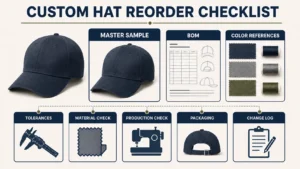
Inspect the hat from the outside and inside. Check pattern symmetry, brim edge, crown seams, sweatband, closure, cord attachment, logo placement, thread trimming, color, and packing. Pull gently on attachments that will be handled by the wearer. Record any approved tolerance in the inspection sheet.
Keep one approved sample from the first order. A field product is easier to reorder when the brand can compare the new season’s material and construction against a physical reference instead of a memory or a compressed phone photograph.
Outdoor product decision matrix
| Field requirement | Specification question | Evidence to retain |
|---|---|---|
| Coverage | Five-panel, six-panel, bucket, or brimmed outdoor form? | Approved pattern and photographs |
| Weather | What exposure is expected? | Material description and any test record |
| Movement | How will closure and brim behave? | Wear-test notes |
| Branding | Which decoration survives the surface? | Approved sample and artwork |
Separating product design from marketing language
Outdoor buyers often use the same words differently. “Durable” may mean abrasion resistance, seam strength, colorfastness, or simply a heavier hand. “Breathable” may refer to open construction, a fabric finish, or wearer comfort. Define the word in the specification before it appears in product copy.
This protects the brand and improves supplier communication. The factory can recommend a construction based on a defined need, while the marketing team can describe only what the finished product and available evidence support.
How to manage a material change
Material availability can change between seasons. If a substitute is proposed, compare weight, surface, color, noise, shape retention, decoration result, and hand feel. Make a new sample when any of those properties could affect the wearer or the brand claim. Do not approve a substitute from a fabric swatch alone.
Record the reason for the change and whether the new material is approved for future reorders. This gives the sourcing team a clear decision trail when a similar issue appears next season.
Keeping the approval record usable
The approval record should be short enough for a production team to use and detailed enough for a buyer to defend. Include the product name, sample date, fabric or construction reference, artwork version, measurements, approved color, packaging instruction, and the person who approved the sample. Attach marked photographs for details that are difficult to describe in words.
When a change is requested, update the record instead of adding an untracked message. State what changed, why it changed, and whether the change affects cost, delivery, or the next sample. This gives the brand a clear trail from the first idea to the product that enters bulk production.
What a serious supplier conversation sounds like
A capable supplier should ask questions about use, fit, material, logo, quantity, and timing. It should identify a risk when a requested detail conflicts with the construction. That conversation is part of product development. The goal is a cap that the factory can make consistently and the brand can explain confidently to its own customers.
Send the complete brief before requesting the final quotation. JoinTop can then review the product as a complete program, recommend practical options, and prepare a sample against a specification rather than a loose reference image.
Questions buyers should settle before approval
Should an outdoor brand use a Performance Cap or a hunting hat?
Choose according to coverage, climate, equipment, and customer expectation. A Performance Cap and a brimmed outdoor hat solve different product jobs.
Can a camouflage fabric be treated as a performance claim?
No. Appearance, fabric composition, and any functional claim should be specified and supported separately.
What should the factory receive first?
Send the use case, silhouette, measurements, fabric reference, artwork, quantity, packaging, and delivery date before sampling.
A clear field brief gives the factory enough information to make an outdoor hat that can be evaluated, approved, and repeated.



 English
 German
 Spanish
 French
 Amharic
 Portuguese
 Italian
 Swedish
 Turkish
 Belarusian
 Danish