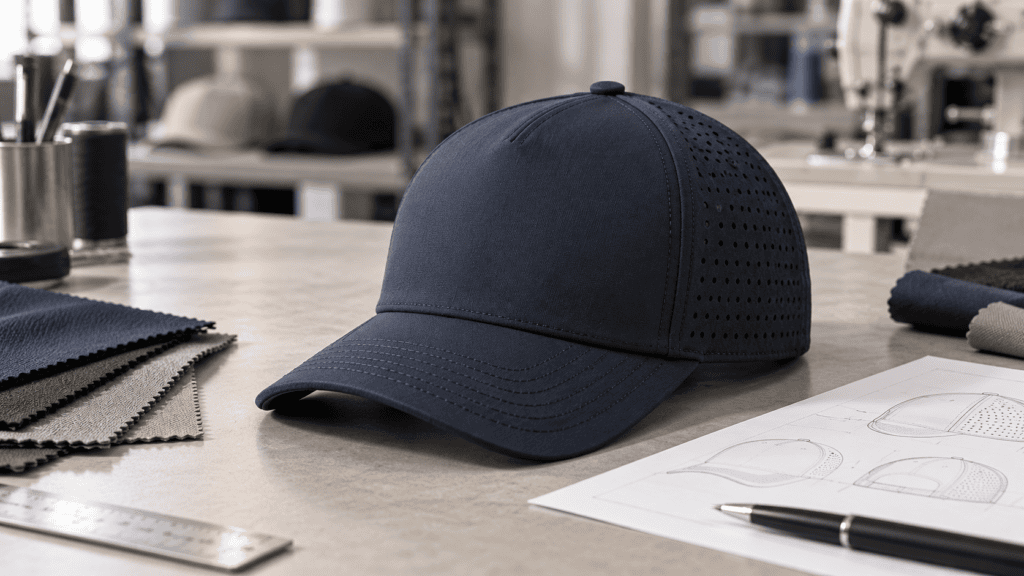
Quick answer: “Melin hats custom” should be treated as a product-development question, not a request to copy another brand. Use a premium performance cap as a reference point, then define your own cap block, fabric, ventilation pattern, logo treatment, fit target, approval gates, and bulk controls. The result should be an original product that your team can approve, manufacture, inspect, and reorder.
Melin is useful to study because its current performance range makes the product logic easy to see. Its A-Game Hydro page describes a performance snapback built around hydrophobic crown technology, breathability, moisture-wicking lining, antimicrobial treatment, lightweight construction, and other problem-solving details. Those details show how a premium cap earns its position. They do not give another brand permission to reproduce the shape, graphics, wording, or identity.
For a brand owner, product manager, or sourcing team, the more useful question is: which parts of that experience matter for your customer, and how can a factory turn those priorities into a repeatable specification? That is where a custom performance cap program becomes more than a logo placed on a blank hat.
What “Melin hats custom” means to a serious buyer
Searchers use this phrase for several different reasons. Some want to understand the construction behind a premium performance hat. Some are looking for a custom version for a golf, outdoor, running, or lifestyle collection. Others are comparing factories before they send an artwork file. These are different moments in the buying journey, but they share one need: a clear way to turn a reference product into an original, manufacturable brief.
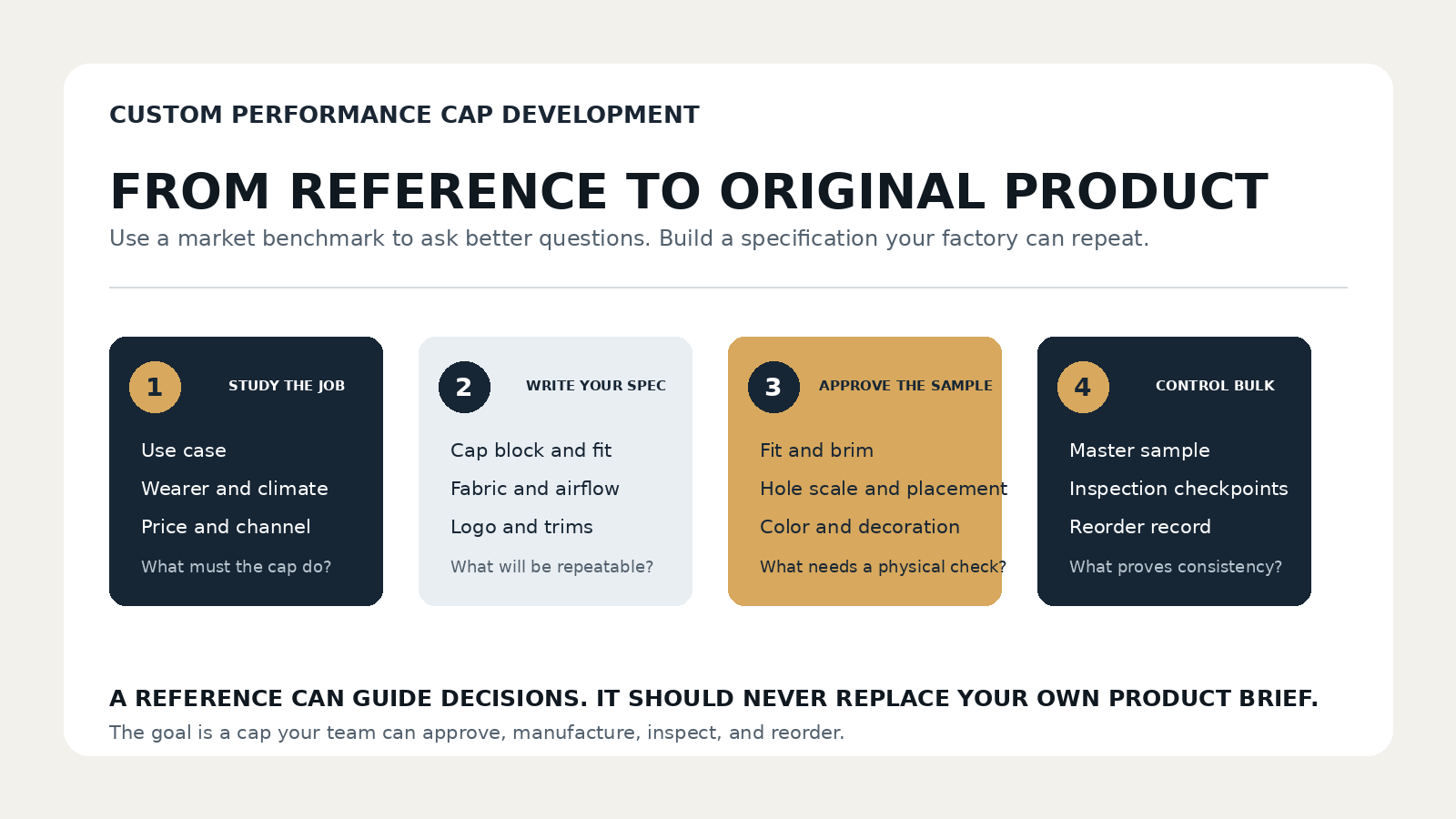
A reference cap should help your team discuss four questions:
- What job must the hat do? Golf rounds, daily wear, running, travel, or a mixed lifestyle use will change the fit, fabric, airflow, and brim decisions.
- What experience should the wearer notice? You may care most about light weight, a dry sweatband, a stable brim, a soft hand feel, or a secure fit.
- What can the factory verify? A visual promise needs a physical sample, a measurement, a material reference, or a defined inspection point.
- What needs to repeat across colorways and reorders? A premium cap is a program. One attractive sample is not enough.
Turn a premium reference into an original product brief
Start by writing the buyer task in plain language. For example: “Create a lightweight golf and travel cap with a clean front logo, controlled airflow, a mid-depth crown, and a curved brim that works on and off the course.” This sentence is more useful to a factory than “Make it like Melin,” because it explains the intended result without asking anyone to duplicate a protected design identity.
Next, break the idea into decisions that can be measured or approved.
| Product area | Buyer decision | What the factory should confirm |
|---|---|---|
| Cap platform | Five-panel or six-panel, crown depth, closure, and brim curve | Pattern, seam map, front-panel support, and fit sample |
| Airflow | Where ventilation is needed and how visible it should be | Perforation or mesh zone, hole scale, edge finish, and placement |
| Material | Hand feel, weight, stretch, durability, and care expectations | Fabric swatch, composition, color standard, and any requested test plan |
| Branding | Embroidery, patch, rubber, transfer, woven label, or a combination | Artwork size, stitch-out or physical trim, backing, placement, and approval file |
| Bulk control | What must stay unchanged across colors and reorders | Master sample, measurement sheet, approved materials, and inspection points |
For an unstructured or overly generic brief, the factory has to guess. Guessing creates extra sample rounds, inconsistent quotes, and a finished cap that looks close in a product photo but feels wrong in the hand. A short, specific brief usually saves more time than a long paragraph full of adjectives.
Build a premium performance cap without copying a brand
Choose the cap block before the decoration
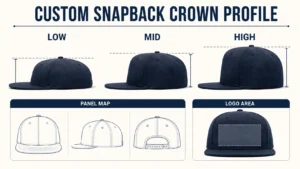
The cap block controls the front panel, crown height, brim relationship, and overall fit. A five-panel performance cap gives a clean, uninterrupted front area for a small or medium logo. A six-panel cap may give a familiar baseball-cap look but introduces a center seam and a different decoration decision. Neither is automatically better. The right choice depends on the collection, the wearer, and the front-panel graphic.
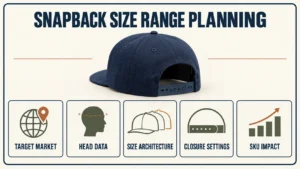
Ask for the crown depth, brim length, brim curve, closure setting, and target head range to be written into the sample brief. “Premium fit” is not a usable measurement. A buyer should be able to compare a revised sample with the approved version without relying on memory.
Use ventilation as a design system
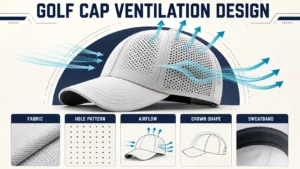
Laser perforation is one route for a clean performance look, but it should be planned as a zone rather than scattered across the cap. For JoinTop’s laser-perforated Performance Cap direction, the smaller holes belong on the side and back panels. The front panel stays clean for structure and branding. This is visually different from a large-hole trucker mesh back, and the two constructions should not be described as interchangeable.
The sample review should check hole scale, spacing, edge quality, the transition into solid fabric, and whether the ventilation pattern supports the intended use. A larger opening is not automatically better. It can change the hand feel, appearance, structure, and perceived product tier. The brief should state the airflow goal and the visual limit before production.
Specify performance materials without making unsupported claims
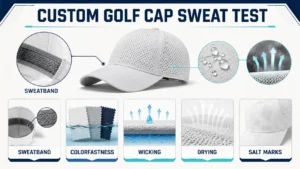
“Technical fabric” is a starting label, not a complete material specification. Ask for swatches and record the chosen composition, weight, stretch, surface, color reference, and care expectation. If the product will carry a claim such as water resistance, UV protection, odor control, or a specific moisture-management result, define who will test it, which method will be used, and what evidence is required before the claim appears on packaging or a product page.
This protects both the brand and the factory. The material may be suitable for a performance cap, but a material possibility is not the same as a finished-product guarantee. A disciplined team keeps the design promise, test requirement, and marketing wording aligned.
Make the logo belong to the cap
A premium performance cap usually benefits from a restrained front treatment. Embroidery, a patch, a rubber detail, or a small transfer can all work when the artwork matches the panel, fabric, and use case. The decision should include the logo width, stitch density or trim thickness, backing, edge clearance, and how the decoration behaves on a curved surface.
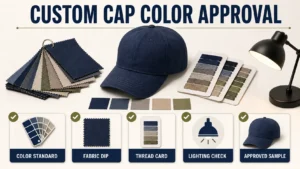
Approve a physical sew-out or trim sample before you approve the whole collection. A flat digital mockup cannot show puckering, distortion, shine, stiffness, or how the logo sits beside a seam. If the cap is intended for several colors, review the logo on every material or color group that could change the contrast or surface tension.
Need a second opinion before sampling? Send the cap use case, reference image, target wearer, logo file, and expected colorways to JoinTop’s cap development team for a manufacturability review. The useful question is not “Can you make it look like this?” It is “Which parts should become a measurable specification for our own product?”
Use four approval gates before releasing bulk
A strong sample process gives different people the same decision record. It also stops a small change from disappearing in a long email thread.
- Brief gate: confirm cap platform, use case, target fit, fabric direction, airflow zones, logo method, color references, packaging needs, and the required delivery window.
- Construction gate: review the first sample on the head and on a flat worktable. Check crown height, panel shape, brim curve, closure, seam work, sweatband feel, and the perforation or mesh transition.
- Branding gate: approve the sew-out, patch, or transfer on the actual cap material. Record placement measurements and keep the approved artwork version with the sample record.
- Pre-production gate: compare the final sample with the brief, confirm the chosen materials and trims, and agree on the inspection points that matter during bulk production.
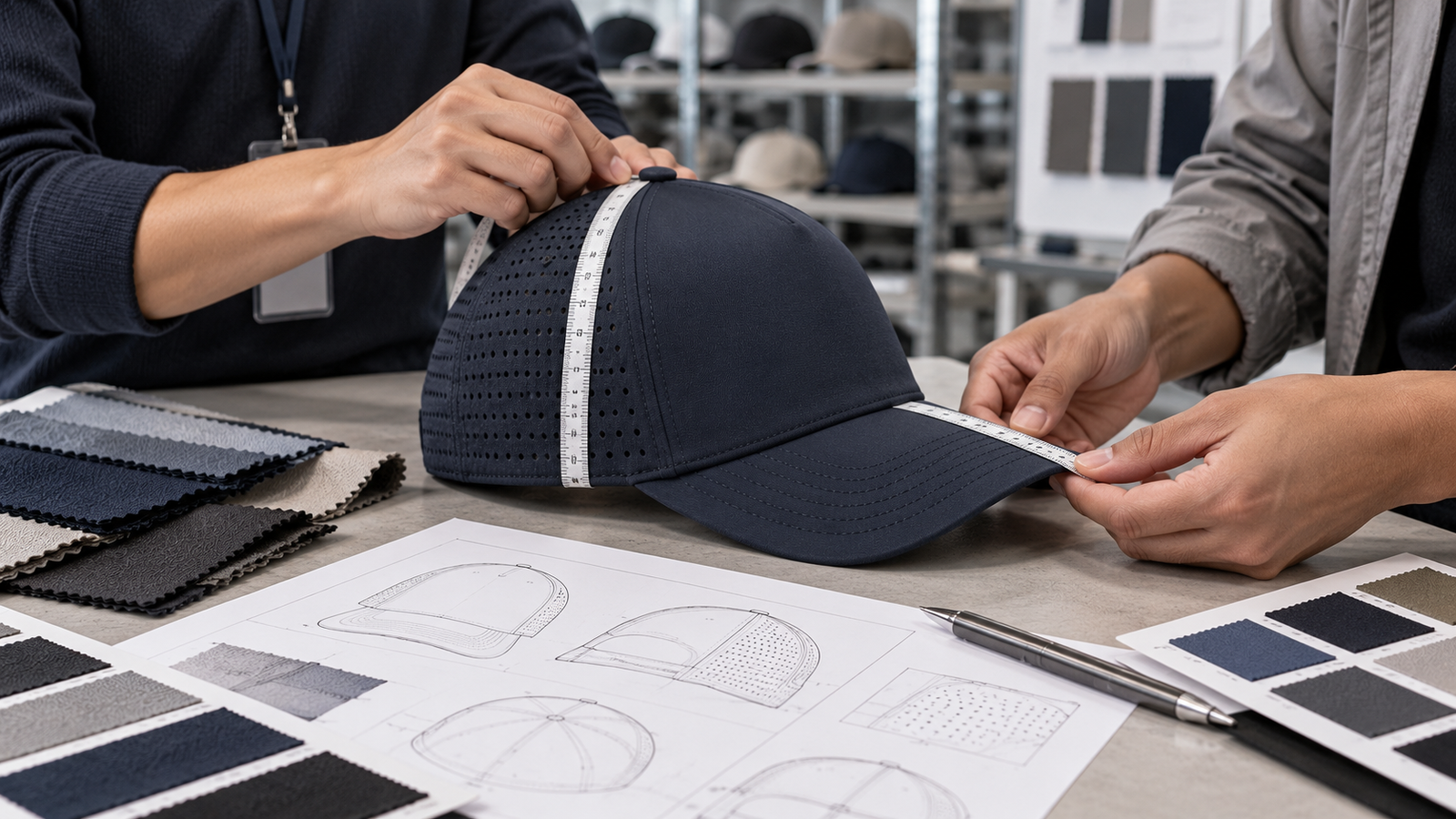
Use photos with measurement marks when a point is difficult to describe. “Lower the front logo by 5 mm” is actionable. “Make it feel more premium” is not.
Plan MOQ, factory location, and reorder risk together
Price and MOQ are connected to the product brief. A simple embroidered cap, a laser-perforated performance cap, and a cap with custom trims do not create the same development work. When you request a quote, include the number of styles, colors, sizes, logo methods, packaging requirements, and target delivery window. Otherwise, two factories may quote different scopes and appear to have different prices.
JoinTop’s current B2B planning standard is a minimum order of 100 pieces per style and color when the project fits that route. Typical planning ranges are 7–14 days for sample development and 35–45 days for bulk production after sample approval. These are planning ranges rather than unconditional promises; design changes, buyer approvals, sample transport, international shipping, and the final production plan can affect the calendar.
JoinTop operates production in China, Vietnam, and Bangladesh. For a brand team, the useful discussion is not simply “Which country is cheapest?” It is whether the selected route can support the cap construction, materials, quality records, delivery plan, and future reorder without changing the approved product behind your back.
Before selecting a supplier, ask:
- Can the team explain the cap construction in terms of panels, seams, brim, closure, and decoration?
- Can it show how the actual sample will be checked before bulk?
- Can it separate confirmed specifications from optional performance features?
- Can it keep an approved master sample and color or material references for reorders?
- Can it give a quote based on the same quantity, color, logo, packaging, and delivery assumptions?
These questions are more useful than asking whether a supplier makes “Melin-style hats.” They test whether the supplier can help you build and control an original product.
What to include in your custom performance cap RFQ
A practical RFQ does not need to be complicated. Include your company or website, product use case, cap platform, target wearer, material direction, ventilation preference, logo files or reference images, number of styles and colors, quantity per style and color, packaging needs, target market, and required delivery date. Add any testing, labeling, or inspection requirements that are part of your sales promise.
Use this custom hat RFQ checklist to keep supplier quotes comparable, and use the sample feedback guide when your team reviews revisions. For broader product planning, the custom performance hats guide explains how materials, ventilation, branding, sampling, and QC fit together.
FAQs about custom Melin-style performance hats
Can a factory make a custom performance cap inspired by a premium reference?
Yes, a factory can develop an original performance cap using a reference product to discuss the intended function, fit, materials, and finish. The buyer should create its own pattern, artwork, trim choices, and written specification rather than copying a brand’s protected identity or product presentation.
Should I choose laser perforation or mesh?
Choose based on the product brief. Smaller laser perforations can keep a cleaner performance-cap appearance across side and back panels. Large-hole mesh creates a different structure and visual language. Compare the airflow goal, front branding area, hand feel, durability, and target price tier before approving the construction.
What is the MOQ for a custom performance cap?
JoinTop’s current standard is 100 pieces per style and color for suitable projects. The exact quotation still depends on the cap structure, materials, logo method, trims, packaging, and quantity plan.
What should I send before requesting a quote?
Send your company or website, cap use case, reference images, logo file, preferred platform, colorways, quantity per style and color, target market, packaging or testing requirements, and required delivery date. If you do not have a finished tech pack, a clear brief and reference images are enough to begin a manufacturability discussion.
Start with an original brief, not a copied label
A premium reference is valuable when it helps your team make better decisions. It becomes a problem when it replaces those decisions. Define the cap block, airflow zones, material evidence, logo treatment, approval gates, and bulk records that make sense for your customer. Then ask the factory to develop the product against that brief.
To start a project with JoinTop, send:
- your company name or website;
- the cap style and use case;
- quantity per style and color;
- logo files or reference images;
- target market and any required tests or labels; and
- your requested delivery date.
For projects following JoinTop’s standard route, the minimum is 100 pieces per style and color. You can request a sample plan or project quote after the product brief is ready. The goal is a cap your brand can own, approve, manufacture, and reorder with confidence.
Reference used for the product-function discussion: Melin A-Game Hydro official product page. Product references are for analysis only; JoinTop is not affiliated with Melin.

 English
  German
  Spanish
  French
  Amharic
  Portuguese
  Italian
  Swedish
  Turkish
  Belarusian
  Danish