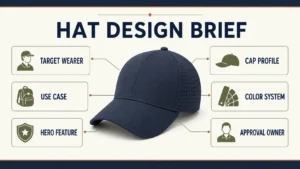
American hat brands love the clean, premium look of custom melin hats. The challenge is making a custom version that still feels sharp, comfortable, durable, and retail-ready. One weak fabric, poor logo placement, or awkward fit can turn a promising product into something customers quietly leave in the closet.
Custom Melin-style hats are premium performance caps made with structured crowns, durable fabrics, moisture-control sweatbands, clean branding, and high-end finishing. For brands, the goal is not to copy Melin. It is to build your own premium custom hats with the right materials, fit, logo method, and manufacturing partner so the final product feels ready for golf shops, outdoor stores, lifestyle retailers, and direct-to-consumer sales.
Before choosing colors, patches, or packaging, brands need to understand what actually makes a premium performance hat feel premium.
Melin is a third-party brand name. This article discusses the broader category of Melin-style performance hats and premium custom headwear, not official Melin products. Brands should also be careful with origin and marketing claims, especially when selling in the United States. The Federal Trade Commission’s Made in USA standard is a useful reference for companies making product origin claims.
What Are Custom Melin-Style Hats?
When buyers search for custom melin hats, they are usually looking for more than a regular promotional cap.
They want a hat with a premium feel. They want structure, comfort, clean branding, water-resistant or performance fabric, and a fit that feels intentional. In simple terms, they want a custom hat that looks good on a golf course, at the beach, on a boat, during travel, or while grabbing coffee on a Monday morning and pretending everything is under control.
A better industry term is custom Melin-style hats o premium custom performance hats.
These hats usually include a structured crown shape, durable outer fabric, moisture-wicking sweatband, breathable panels, laser perforation, premium logo decoration, clean inner taping, strong brim construction, and retail-quality packaging.
For American hat brands, the opportunity is clear. A premium cap can sell at a higher price point than a basic custom cap. It can also build stronger brand loyalty because customers wear it more often.
That is why more buyers are searching for terms like custom performance hats, premium custom hats, custom hats for brands, and custom hat manufacturer for brands.
Why Are Premium Performance Hats So Popular With American Brands?
The American hat market is no longer only about basic baseball caps.
Customers want hats that match their lifestyle. A single cap may need to work for golf, fishing, boating, travel, workouts, outdoor events, and casual weekends. That is why custom performance caps have become attractive for golf brands, outdoor brands, fishing brands, resort brands, sportswear brands, and lifestyle apparel companies.
A regular custom baseball cap can still be useful. But a premium performance hat gives customers more reasons to wear it again.
For brands, that means more value. A well-made custom performance hat can help build a stronger product line, increase perceived value, support higher retail pricing, improve customer retention, stand apart from low-cost promotional caps, and offer a product that feels more retail than giveaway.
This is why search demand often connects terms like custom logo hats, custom golf hats, custom rope hats, custom snapback hats, private label hats, and wholesale custom hats.
The buyer is not just asking, “Can I put my logo on a hat?”
The better question is, “Can I create a hat people actually want to keep wearing?”
That is where premium custom headwear begins.
What Makes a Melin-Style Hat Different From a Regular Custom Cap?
A regular custom cap often starts with a blank hat. The buyer chooses a color, adds embroidery, approves a mockup, and places the order.
That works for simple projects.
But custom Melin-style hats require more product thinking. The details matter because customers expect a better feel.
The main differences include fabric, structure, comfort, fit, finishing, and quality control.
A premium performance hat usually has a stronger crown shape. It does not collapse easily. The brim feels stable. The sweatband feels soft and functional. The logo looks balanced instead of randomly placed. The inside of the hat looks clean enough that the customer does not feel like the factory gave up halfway through the job.
That last part matters more than many brands think.
Customers may not know the technical terms for crown depth, panel tension, or sweatband construction. But they know when a hat feels cheap.
A premium custom hat should not feel like a free conference giveaway. It should feel like part of a serious retail product line.
That is why brands looking for high-quality custom hats should work with a custom cap manufacturer that understands product development, not just logo application.
Which Materials Work Best for Custom Melin-Style Hats?
Material selection is one of the most important decisions in premium cap manufacturing.
The wrong fabric can make a strong design feel ordinary. The right fabric can make a simple design feel expensive.
For custom performance hats, brands commonly consider polyester performance fabric, nylon blends, water-resistant fabric, moisture-wicking sweatbands, laser-perforated panels, and stretch performance fabric.
Polyester performance fabric is often used for lightweight, durable, moisture-friendly hats. It works well for golf, sports, and outdoor lifestyle caps.
Nylon blends can create a smooth technical feel. They are useful for outdoor hats, travel caps, fishing hats, and water-friendly designs.
Water-resistant fabric is popular for boating, beach, fishing, golf, and travel hats. Brands can ask suppliers to explain how the fabric is tested and whether the product has passed relevant performance checks. For general textile testing context, organizations such as AATCC y ASTM International are widely used references in the textile and material testing world.
Moisture-wicking sweatbands improve comfort and help the hat feel more functional. This is especially important for custom golf hats, custom athletic hats, and custom outdoor hats.
Laser-perforated panels can improve breathability while keeping the hat design clean and modern.
Stretch performance fabric can improve comfort and fit, especially for customers who wear hats for long periods.
Some brands may also ask about fabric safety, restricted substances, or material certifications. Programs such as OEKO-TEX are commonly referenced in the textile industry when buyers want additional confidence around tested materials.
The best fabric depends on the target customer. A golf brand may want lightweight breathability. A fishing brand may care about water resistance. A lifestyle brand may focus on smooth hand feel and clean color.
This is where a professional custom headwear manufacturer becomes valuable. A strong factory can help brands compare materials, test samples, and choose the right option before bulk production.
Which Hat Styles Work Best for Premium Custom Headwear?
Not every hat style fits the premium performance category equally well.
For custom Melin-style hats, several styles are especially useful.
Performance snapback hats are one of the best starting points. A structured performance snapback offers a strong retail look, adjustable fit, and broad customer appeal.
Custom 5-panel hats work well for outdoor, running, hiking, and modern lifestyle brands.
Custom rope hats are popular in golf, fishing, resort, and outdoor lifestyle markets. They feel classic, sporty, and highly wearable.
Custom trucker hats can be upgraded with better front fabric, premium mesh, improved sweatbands, and rubber patch branding.
Custom dad hats can work for lifestyle brands, but they need better materials and cleaner decoration to feel premium.
Custom golf hats are a natural fit for performance fabrics, structured crowns, and clean branding.
The best choice depends on the brand’s audience. A golf brand, fishing brand, streetwear label, resort shop, and outdoor company may all want premium custom hats, but they should not use the exact same design.
A smart brand starts with the customer, not the trend.
Where will the customer wear this hat? What price point will they accept? What fabric will feel right? What logo style fits the brand? What hat shape will they actually wear?
Those questions lead to better products and better repeat orders.
How Should Brands Add Logos to High-End Custom Hats?
Logo decoration is one of the fastest ways to make a premium hat look either polished or painfully cheap.
For custom logo hats, embroidery is common. But for premium performance caps, brands should consider several decoration methods.
Rubber patch hats are popular for outdoor, golf, fishing, and technical lifestyle brands. They create a clean, modern look.
Silicone patch hats feel smooth and flexible. They work well with performance fabrics.
PVC patch hats are durable and useful for bold, dimensional logos.
Woven label hats are lighter and more subtle. They are a good choice for minimalist branding.
Custom embroidered hats are classic, but embroidery must be tested carefully on performance fabric. Heavy embroidery can pull or wrinkle some materials.
3D embroidered hats can look strong on structured caps, but they should not overpower the design.
Heat transfer logo hats can work for lightweight technical hats, but durability should be tested before bulk production. Brands may request wash, abrasion, or adhesion testing depending on how the product will be used. For broader product testing and materials standards, ASTM International is a useful reference point.
For premium hats, logo size matters. Bigger is not always better.
A large logo can make a premium hat feel like a billboard with a sweatband. A smaller, cleaner mark often feels more expensive.
The best logo placement supports the brand without shouting at the customer.
What Details Make a Custom Hat Feel Retail-Ready?
A retail-ready hat is not built from one big feature. It is built from many small details done correctly.
For custom hats for retail brands, details like clean panel alignment, consistent stitching, smooth inner taping, comfortable sweatbands, balanced crown height, accurate brim curves, strong closure hardware, clean label placement, accurate color matching, and protective packaging all matter.
The customer’s first impression starts the moment they open the package. If the hat arrives crushed, bent, or poorly finished, the customer will not care how nice the design looked on a screen.
This is especially important for e-commerce brands. A premium hat needs to survive shipping and still look good when it reaches the buyer. For brands that want to evaluate packaging durability, the International Safe Transit Association is a useful packaging testing resource.
For private label hats, inside branding also matters. Custom labels, branded taping, hang tags, barcode stickers, and packaging can all help the product feel more complete. If a brand plans to sell through retail channels, GS1 barcode standards may also become relevant.
These details help B2B buyers trust the supplier. A factory that controls small details usually controls the big ones better too.
That is why brands should not only ask for a low price. They should ask how the factory controls quality from sample to bulk production.
Why Does Fit Matter So Much in Custom Performance Hats?
Fit is one of the most important parts of premium headwear.
A customer may buy a hat because of the design, but they keep wearing it because of the fit.
For custom performance hats, brands should review crown depth, crown height, front panel angle, brim width, brim curve, sweatband thickness, closure type, head size range, and overall balance.
A hat can have beautiful fabric and a great logo, but if the fit is wrong, the customer will not wear it.
A crown that is too tall can look awkward. A crown that is too shallow can feel unstable. A brim that is too flat may not match the target customer. A brim that curves badly can make the whole hat feel cheap.
Customers are honest with hats. A hoodie can be oversized on purpose. A T-shirt can be relaxed fit. But a bad hat fit announces itself immediately.
That is why sample development is important.
A reliable custom cap manufacturer for brands should help test fit before bulk production. The goal is to create a hat that feels natural the moment the customer puts it on.
No mirror debate. No awkward adjustment. No “maybe it looks okay from one angle.”
Just a good fit.
How Can Brands Find the Right Custom Hat Manufacturer?
Choosing the right custom hat manufacturer is one of the biggest decisions in the project.
A cheap supplier can look attractive at first. But if the samples fail, colors shift, logos are off-center, or production arrives late, the real cost becomes much higher.
For premium hats, brands should look for a manufacturer that can support material sourcing, OEM hat manufacturing, ODM hat development, sample making, logo testing, fit adjustment, bulk custom hat production, private label packaging, quality inspection, and repeat order consistency.
Some buyers also ask factories about social compliance, responsible sourcing, and supply chain visibility. Depending on the buyer’s retail channel, programs such as WRAP y Sedex may be part of the conversation. Brands should always verify a supplier’s current certificates directly instead of assuming certification from a website claim.
This is where ÚneteTop can fit naturally into the process.
JoinTop is a custom cap factory and private label headwear manufacturer that supports brands developing premium custom hats, performance caps, and custom headwear programs. With owned factory capacity in China, Vietnam, and Bangladesh, JoinTop can help brands choose suitable production options based on product complexity, order quantity, cost target, and delivery needs.
This matters for American brands because sourcing flexibility is becoming more important.
A brand may need advanced sample development for a new premium cap. Another project may need larger-volume production. Another may need cost-efficient manufacturing for a wholesale custom hat line.
A multi-country production setup gives brands more options without forcing every project into the same factory path.
Should Brands Manufacture Hats in China, Vietnam, or Bangladesh?
For custom cap production, China, Vietnam, and Bangladesh can each offer different advantages.
China hat factories are often strong in development, sampling, material sourcing, decoration techniques, and complex custom projects. For a premium performance hat with special fabric, laser perforation, rubber patch branding, and custom packaging, China can be useful during product development.
Vietnam cap manufacturers can be a good fit for brands that want stable production, balanced quality, and sourcing flexibility.
Bangladesh hat factories can support larger-scale production and cost-efficient programs, especially for more standardized custom caps.
There is no single best country for every hat. The best choice depends on the product.
A technical custom Melin-style hat may need one production approach. A simple bulk embroidered cap may need another. A private label golf hat line may require stronger packaging and quality control. A wholesale custom hat order may focus more on cost and delivery.
For U.S. importers, product classification, country of origin, and customs documentation should also be handled carefully. The U.S. Customs and Border Protection trade resources are a useful starting point for understanding import-related requirements.
JoinTop’s factory network in China, Vietnam, and Bangladesh helps brands match the project to the right production base.
For growing brands, that flexibility can reduce sourcing risk and support long-term product planning.
How Much Do Custom Melin-Style Hats Cost?
There is no honest single price for custom Melin-style hats.
Cost depends on the specifications.
Key cost factors include fabric type, crown structure, brim construction, sweatband quality, logo method, patch material, order quantity, packaging, factory location, sample complexity, inspection requirements, and shipping method.
A simple embroidered cap will usually cost less than a premium water-resistant performance snapback with a rubber patch, moisture-wicking sweatband, custom inner taping, and private label packaging.
Order quantity also matters. Bulk custom hats usually have better unit pricing than small trial orders. But brands should not rush into large production before approving samples.
The better approach is to define the product level, confirm the target customer, choose the material, select the logo method, develop samples, review fit and quality, and confirm final cost after specifications are clear.
A good custom hat factory should explain what drives cost. Sometimes a small adjustment in fabric, patch size, lining, or packaging can improve margins without hurting the final product.
That kind of guidance is valuable for brands that care about both quality and profit.
How Can New Hat Brands Compete With Premium Names?
New brands do not need to become Melin, New Era, ’47 Brand, or Sunday Swagger overnight.
That would require a lot of inventory, a lot of marketing, and probably too much coffee.
Instead, new brands should compete with focus.
A golf brand can create clean performance hats for players who want comfort without loud branding. A fishing brand can build water-friendly caps with strong patches and breathable fabric. An outdoor brand can make durable custom hats for hiking, camping, and travel. A resort brand can create premium souvenir hats people actually want to wear. A streetwear brand can launch limited custom caps with better materials and strong identity.
The opportunity is not to copy bigger brands. The opportunity is to build a better product for a specific customer.
That is why private label headwear is powerful.
Brands can create their own fit, fabric, logo system, packaging, and product standard. Over time, the hat becomes part of the brand identity.
A strong manufacturing partner stays behind the scenes. The brand owns the customer relationship. The factory helps make sure the product is strong enough to support that relationship.
That is the kind of partnership serious brands usually need.
What Should Brands Ask a Custom Hat Factory Before Ordering?
Before placing an order, brands should ask better questions.
Good questions reduce mistakes.
Ask your potential custom headwear supplier whether they can develop premium performance hat samples, support OEM and ODM hat manufacturing, recommend fabrics for golf or outdoor caps, make water-resistant or moisture-wicking hats, offer rubber patches and embroidery, support private label packaging, control crown shape and fit, match colors across bulk production, manufacture in multiple countries, inspect bulk orders before shipping, and support repeat orders with consistent quality.
These questions help separate a basic supplier from a real custom hat production partner.
For premium brands, that difference matters.
The wrong factory may be acceptable for a simple promo cap. But premium performance headwear requires better development, stronger communication, and more careful quality control.
How Should Brands Start a Custom Performance Hat Project?
The smartest way to start is not by asking, “How cheap can we make it?”
That usually leads to a cheap-looking answer.
A better process starts with defining the target customer. Then the brand should choose the hat style, select the performance level, pick the right fabric, choose the logo method, confirm fit requirements, develop the first sample, review comfort and structure, adjust the sample if needed, approve pre-production details, start bulk production, and inspect quality before shipment.
This process works for custom snapback hats, custom golf hats, custom outdoor hats, custom rope hats, custom trucker hats, and other premium headwear styles.
For brands planning a premium line, the sample stage is not just a formality. It is where the product becomes real.
As a private label headwear manufacturer, JoinTop can help brands review materials, test logo techniques, adjust fit, and prepare production-ready samples before bulk manufacturing. With factories in China, Vietnam, and Bangladesh, JoinTop can also help brands choose a production path that fits the product and business goal.
That is the kind of support that turns a design idea into a product customers can actually wear and buy again.
Why This Article Should Bring Better Inquiries, Not Just More Traffic
Traffic is useful. Qualified traffic is better.
For a B2B hat business, the goal is not only to rank for broad terms like custom hats o custom caps. Those searches may include individuals looking for one personal hat.
The stronger inquiry keywords are more specific:
custom hat manufacturer for brands, custom cap manufacturer for clothing brands, private label headwear manufacturer, OEM headwear manufacturer, custom performance hats manufacturer, bulk custom cap supplier, wholesale custom hat manufacturer, premium cap manufacturer, and custom cap production factory.
These keywords attract buyers who are closer to action.
They may already have a logo. They may be comparing factories. They may need samples. They may be building a premium cap line. They may be looking for a long-term production partner.
That is why a strong blog article should do more than explain what custom Melin-style hats are. It should help buyers understand what to prepare before contacting a factory.
A better inquiry usually includes the target hat style, logo file, reference photos, estimated order quantity, target market, material preference, packaging needs, and expected delivery timeline.
When buyers know what to send, the conversation becomes easier for both sides.
Ready to Develop Custom Melin-Style Hats for Your Brand?
Premium custom hats are not just about looking expensive. They need the right fabric, fit, structure, branding, packaging, and production control.
For American hat brands, the best move is to build a product that feels intentional from the first sample to the final shipment.
ÚneteTop supports custom Melin-style hats, premium performance caps, private label hats, and bulk custom headwear through owned factories in China, Vietnam, and Bangladesh.
If your brand is planning a premium custom hat project, send your logo, target style, estimated quantity, and reference photos. JoinTop can help review fabric options, decoration methods, sample development, and the most suitable production location for your order.
A good hat should not need a long explanation.
The customer puts it on, checks the mirror, and thinks, “Yep. This works.”
That is the goal.
FAQ: Custom Melin-Style Hats
Can I make custom hats similar to Melin?
Yes. Brands can develop premium performance hats with similar high-end features, such as structured crowns, water-resistant fabrics, breathable panels, clean logo decoration, and comfortable sweatbands. The goal should be creating your own branded product, not copying another brand.
What is the best material for premium custom performance hats?
Polyester performance fabric, nylon blends, stretch fabric, and water-resistant materials are common choices. The best option depends on whether the hat is designed for golf, outdoor use, fishing, boating, travel, or daily lifestyle wear.
What is the best logo method for high-end custom hats?
Rubber patches, silicone patches, PVC patches, woven labels, embroidery, and heat transfer logos can all work. For premium hats, the logo method should match the fabric, crown structure, and brand style.
How do I find a custom hat manufacturer for my brand?
Look for a manufacturer that supports sample development, material sourcing, OEM/ODM production, logo testing, quality inspection, private label packaging, and repeat order consistency.
Can JoinTop manufacture premium custom hats for US brands?
Yes. ÚneteTop supports custom cap production through its factories in China, Vietnam, and Bangladesh. The company can help brands develop premium custom hats, performance caps, private label hats, and bulk custom headwear.
Are custom Melin-style hats good for golf brands?
Yes. Golf brands often need hats that are lightweight, breathable, structured, and clean-looking. Custom Melin-style performance hats are a strong fit for golf, resort, country club, and sports lifestyle markets.
What information should I send to a custom cap factory?
Send your logo file, reference photos, preferred hat style, estimated quantity, target customer, material ideas, packaging needs, and timeline. This helps the factory recommend the right fabric, decoration method, sample plan, and production option.



 English
  German
  Spanish
  French
  Amharic
  Portuguese
  Italian
  Swedish
  Turkish
  Belarusian
  Danish