

Custom trucker hats are not defined by “mesh” alone. For a brand, the
five-panel or six-panel construction determines the front branding area,
seam layout, foam or fabric support, mesh placement, brim profile, and
the way embroidery or a patch should be approved. Fix the cap platform
first, then decide how the mesh, front material, and decoration work
together.
This guide is for brand owners, product teams, and sourcing managers
planning a custom trucker program. It treats a five-panel trucker as the
active example and compares a six-panel option where the front center
seam changes the approval work. The goal is a repeatable reference for
sampling and bulk, not a generic list of decoration methods.

Lock
the five-panel or six-panel trucker construction first
The term “trucker” usually communicates a front branding area plus
mesh ventilation, but it does not fully specify the pattern. A
five-panel trucker can provide one uninterrupted front panel with mesh
side and rear panels. A six-panel trucker splits the front into two
panels and adds a center seam that affects logo clearance.
| Platform | Useful when | Inputs to lock | Common failure when unspecified |
|---|---|---|---|
| Five-panel trucker | The brand wants a broad front panel and a clean badge or embroidery zone |
Front material and support, mesh zones, crown height, brim curve, closure, seam map, and logo safe zone |
The factory changes the front shape or moves decoration toward a side seam |
| Six-panel trucker | The brand wants a traditional baseball-cap profile with segmented front panels |
Center seam, front-panel symmetry, mesh placement, crown profile, brim attachment, and logo clearance |
The logo crosses the center seam or the two front panels look uneven |
Both platforms can be sampled as trucker products. The buyer should
not approve a generic “trucker hat” image as the construction reference.
The panel count and front-panel drawing belong in the tech pack or
sample record.
Separate the
front material from the mesh decision
Foam, cotton, polyester, technical fabric, and other front materials
each behave differently under embroidery, patch attachment, and heat.
Mesh also has its own variables: hole size, hand feel, edge stability,
color, and the way it joins the front panels. The brief should identify
what is fixed and what the factory may recommend.
Record these inputs before sampling:
- five-panel or six-panel layout and front seam map;
- front material, thickness or hand requirement, support layer, and
lining; - mesh material, color, hole pattern, and the panels where it is
allowed; - crown height, brim shape, closure, sweatband, and interior
finishing; - logo method, artwork version, size, placement, and clear space;
- fabric, thread, patch, trim, and closure colors by style and
colorway; - quantity by style and color, target market, packaging, and delivery
date.
If foam is part of the concept, approve its actual height and
recovery on the finished panel. A screen mock-up cannot show how a dense
sew-out, patch edge, or heat process will sit on foam.
Keep the
front branding zone clear of seams and mesh
For a five-panel trucker, the uninterrupted front panel can make a
centered mark easier to position, but the crown seam and brim attachment
still need clearance. For a six-panel trucker, the center seam is a hard
reference: the logo can be centered across it only when the artwork and
decoration method are designed for that construction. Most programs
should define a safe zone that stays clear of the seam.
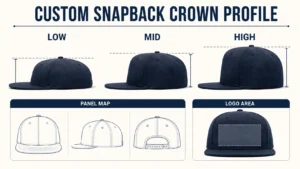
Use a placement map that shows:
- The front-panel boundaries and centerline.
- The distance from the crown seam and brim seam.
- The maximum width and height of the embroidery, patch, or
print. - The mesh edge and any support or backing under the front.
- The approved orientation and location for every colorway.
This map prevents a factory from treating a flat artwork file as the
only instruction. It also gives the buyer something measurable to
compare when the sample or bulk lot is reviewed.
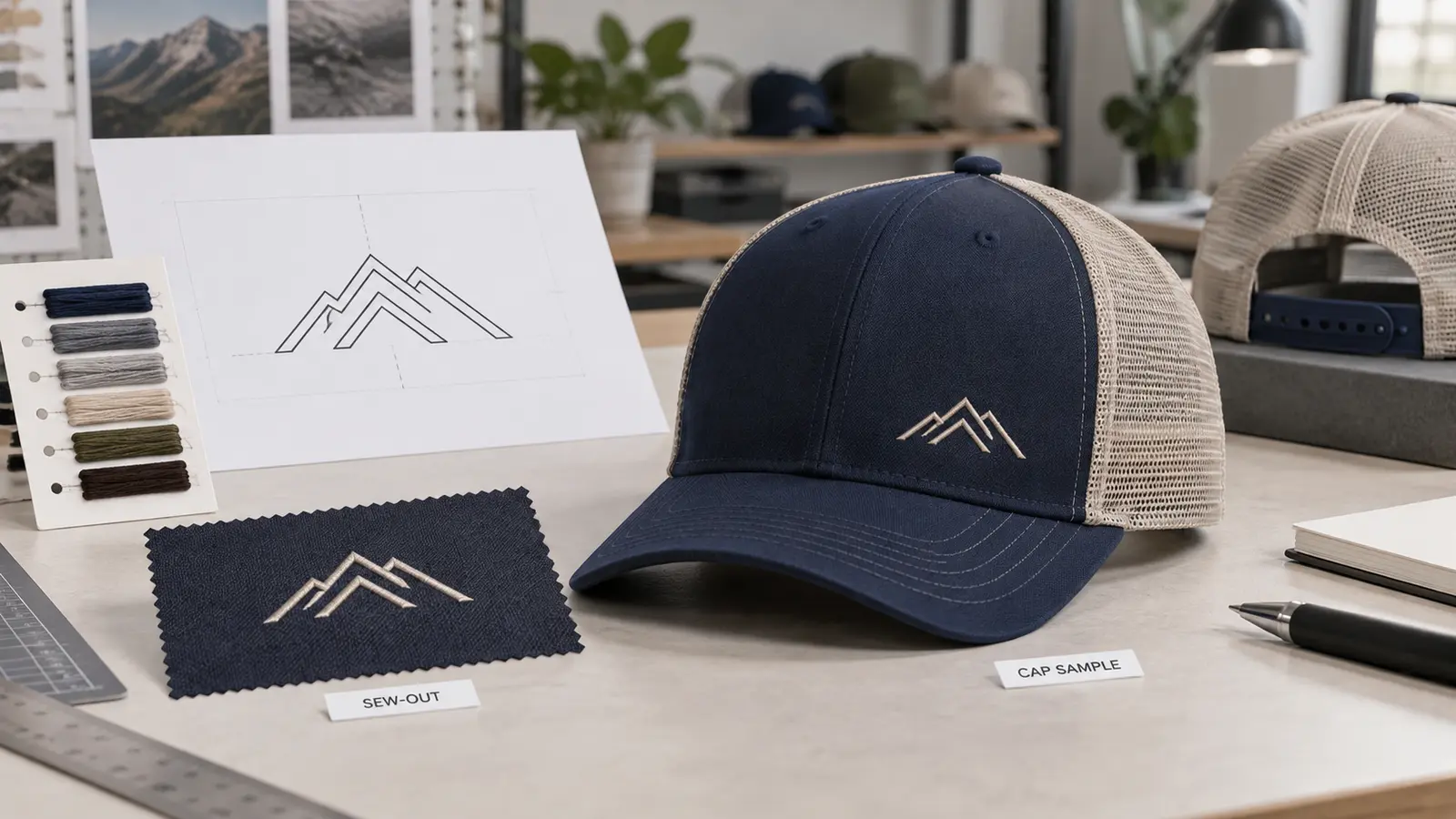
Choose
embroidery, patch, or print after the surface is known
Decoration should follow the front material and panel geometry.
Embroidery may need a stabilizer and enough support to avoid puckering.
A woven or rubber patch changes the weight and edge profile.
Heat-applied decoration depends on the surface, temperature, pressure,
and the way the front panel recovers. Screen or transfer printing may
require a specific surface finish and color-control reference.
Before approving the method, ask the factory for a physical sample on
the intended front material. Check:
- edge definition and registration;
- thread, ink, or patch color against the actual fabric;
- stitch density, backing, and underside finish;
- foam compression or distortion around the decoration;
- distance from the seam, brim, and mesh edge;
- appearance after the cap is shaped, not only while flat.
For a six-panel trucker, inspect the two front panels separately and
confirm the center seam is not pulling the decoration off line. For a
five-panel trucker, confirm that the single front panel remains smooth
and that the top seam is not mistaken for a center split.
A trucker sample
review that buyers can repeat
Use the same order for every colorway and revision.
1. Verify construction
Count the panels, confirm the front material and mesh zones, inspect
the crown and brim, and compare the closure and sweatband with the
brief.
2. Verify fit and silhouette
Check the crown height, brim curve, adjustment range, rear profile,
and interior finish on a consistent head form or wearer.
3. Verify decoration
Compare the physical sew-out, patch, or print with the approved
artwork. Check scale, placement, color, edge quality, backing, and
interaction with seams or foam.
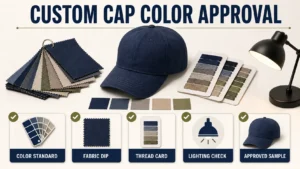
4. Verify colorways
Review each front material, mesh, thread, trim, and closure
combination under consistent lighting. Keep a colorway matrix rather
than relying on a single sample.
5. Freeze the reference
Record the sample number, panel map, artwork version, materials,
measurements, inspection points, and change history before bulk
production.
After the construction is clear, request a custom
trucker hat manufacturing review. Send the five-panel or six-panel
preference, front and mesh references, logo file, decoration method,
quantities by style and color, target market, and delivery date.
Bulk controls for
mesh, foam, and decoration
The bulk inspection record should compare the lot with the approved
construction and decoration reference. Check panel symmetry, front-panel
support, mesh attachment, crown and brim shape, closure function, logo
or patch placement, thread or patch color, backing, measurements,
labels, and packaging.
If the order has multiple mesh or front-material combinations, list
each as a separate colorway. A dark mesh can make the same thread appear
different from a light mesh; foam can also change how an edge reads
after shaping. Keep the approved reference with the purchase order and
reorder file.
JoinTop’s current working guidance is 100 pieces per style
and color. Sampling is usually 7–14 days, and
bulk production is commonly 35–45 days after sample
confirmation, excluding design changes, approval delays, sample
transportation, and international logistics. These are planning ranges;
the confirmed schedule depends on the final construction, material
availability, and approvals.
For the decoration handoff, the custom
embroidered trucker hats production-control guide provides a related
route. The trucker hat vs
snapback comparison can help explain the broader style choice, while
this article stays focused on five-panel and six-panel production
controls.
What to send in a
qualified trucker inquiry
Include:
- Company name or website and intended customer or market.
- Five-panel or six-panel preference, front material, mesh zones,
crown, and brim references. - Logo artwork, preferred decoration, finished size, placement, and
clear-space rules. - Quantity by style and color, mesh and front-material colorways,
packaging or label needs, and target delivery date. - Existing sample, tech pack, or reference cap if the project is based
on an approved shape.
If the trucker is still a concept, identify which elements can
change. That allows the factory to recommend a surface and decoration
route without silently changing the cap platform.
FAQ
Are
five-panel trucker hats better than six-panel trucker hats?
Neither is automatically better. A five-panel trucker offers one
uninterrupted front panel, while a six-panel trucker has a center seam
and a traditional segmented front. Choose the platform that fits the
logo, silhouette, mesh plan, and target wearer.
Can a six-panel
trucker use a front patch?
Yes, when the patch size, center-seam clearance, support, and
attachment method are approved on the actual six-panel sample. The patch
should not be positioned from a flat drawing alone.
Does foam make
a trucker hat easier to decorate?
Not automatically. Foam changes the support, surface, and recovery of
the front panel. The buyer should approve the decoration on the intended
foam or front material and check the shaped cap for distortion.
What should
be approved before a trucker bulk order?
Approve panel count, front and mesh materials, crown and brim,
closure, decoration sample, placement map, colorway matrix,
measurements, inspection points, and a version-controlled reference.
Conclusion
Custom trucker hats become repeatable when the five-panel or
six-panel construction is fixed before the buyer chooses mesh, foam,
embroidery, patch, or print. Map the seams and branding zone, approve
the decoration on the actual front material, and carry the same
reference into bulk inspection and reorders. A complete brief lets the
factory quote and sample the intended trucker platform instead of
guessing from a generic image.

 English
  German
  Spanish
  French
  Amharic
  Portuguese
  Italian
  Swedish
  Turkish
  Belarusian
  Danish