

A waterproof running cap for a brand program must balance rain protection with low weight, airflow, sweat control, fit stability, and logo durability. That balance is more important than the word “waterproof” on a fabric card. A shell may resist water in a laboratory test while a finished cap still admits water through seams, laser holes, embroidery needles, the visor joint, or an exposed rear opening.
For product developers, the practical sourcing sequence is simple: define the weather claim, map protected and ventilated zones, select the shell and finish, approve the complete cap through repeatable tests, and lock the approved construction for bulk production. This guide explains that sequence for running, trail, outdoor, and performance headwear buyers.
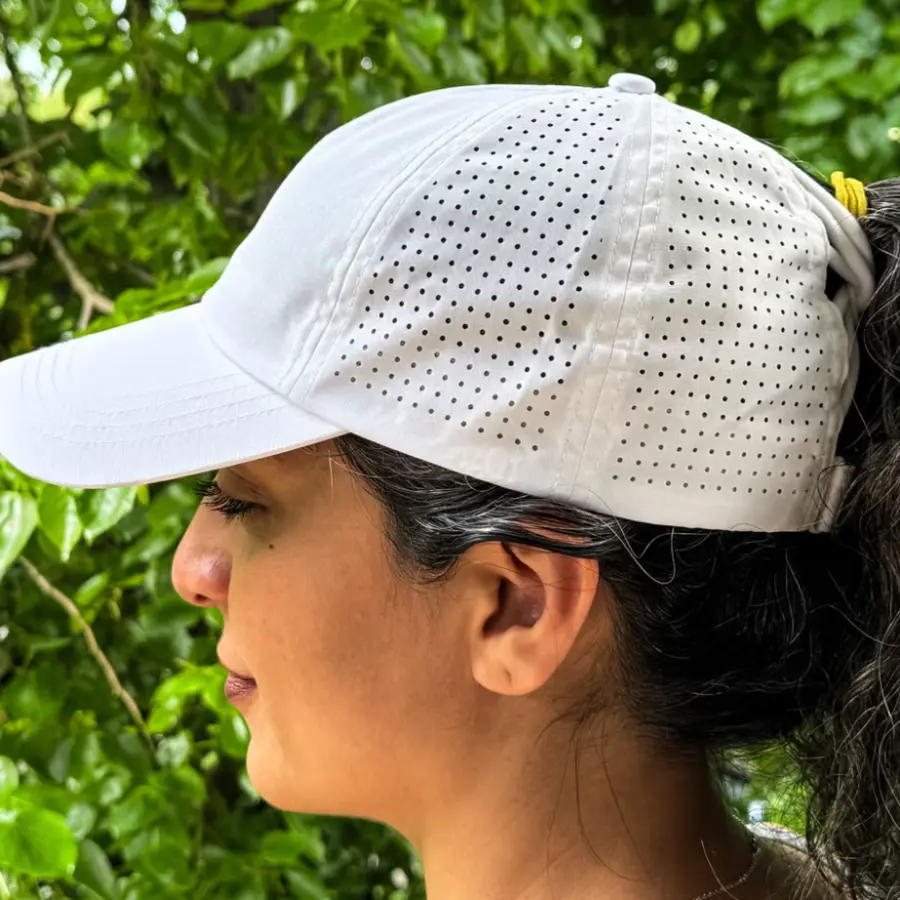
What should a waterproof running cap specification include?
A complete specification should state the intended rain exposure, shell composition and weight, water-repellent or barrier treatment, protected zones, ventilation layout, seam plan, sweatband, visor construction, closure, finished measurements, logo method, care method, and pass criteria. It should also distinguish between surface repellency and resistance to water penetration. Those are different performance questions and require different evidence.
| Claim level | Useful product meaning | Evidence to define | Development risk |
|---|---|---|---|
| Water repellent | The surface sheds light spray and resists rapid wetting. | Agreed spray rating before and after the selected care cycle. | The shell may bead water while seams or openings still leak. |
| Rain resistant | The finished cap handles a stated period of light or moderate rain. | Finished-cap rain simulation, duration, angle, and pass observations. | Different teams may use different rain intensity and duration. |
| Waterproof construction | Fabric and selected construction zones meet a defined resistance target. | Material test, seam method, finished-cap test, and claim limitations. | Ventilation holes and needle penetrations can conflict with the claim. |
| Fast-drying weather cap | The cap manages wet use and returns to a wearable condition quickly. | Drying method, environment, measurement points, and care sequence. | A fast-drying fabric does not guarantee a fast-drying sweatband or visor. |
If you are preparing a running collection, send JoinTop your target use, reference cap, expected order quantity, colors, logo files, and required test claims. Our team can turn that information into a development checklist through the custom running cap inquiry form.
Choose the shell around exposure, weight, and hand feel
Light woven nylon and polyester are common starting points because they can offer low weight, good shape recovery, and controlled stretch. A tightly woven structure can reduce rapid wetting. A durable water-repellent finish can improve surface shedding, while a coating or laminate can add a stronger barrier. Every added treatment, however, can change softness, noise, breathability, color appearance, bonding behavior, and logo adhesion.
Do not approve the shell by composition alone. Two fabrics described as “90% nylon, 10% spandex” can behave differently because of yarn size, weave density, weight, stretch direction, finish, and dye process. Review a physical swatch, then build the running-cap sample in the actual color and treatment. Dark and light colors may also show different heat, staining, and transfer behavior.
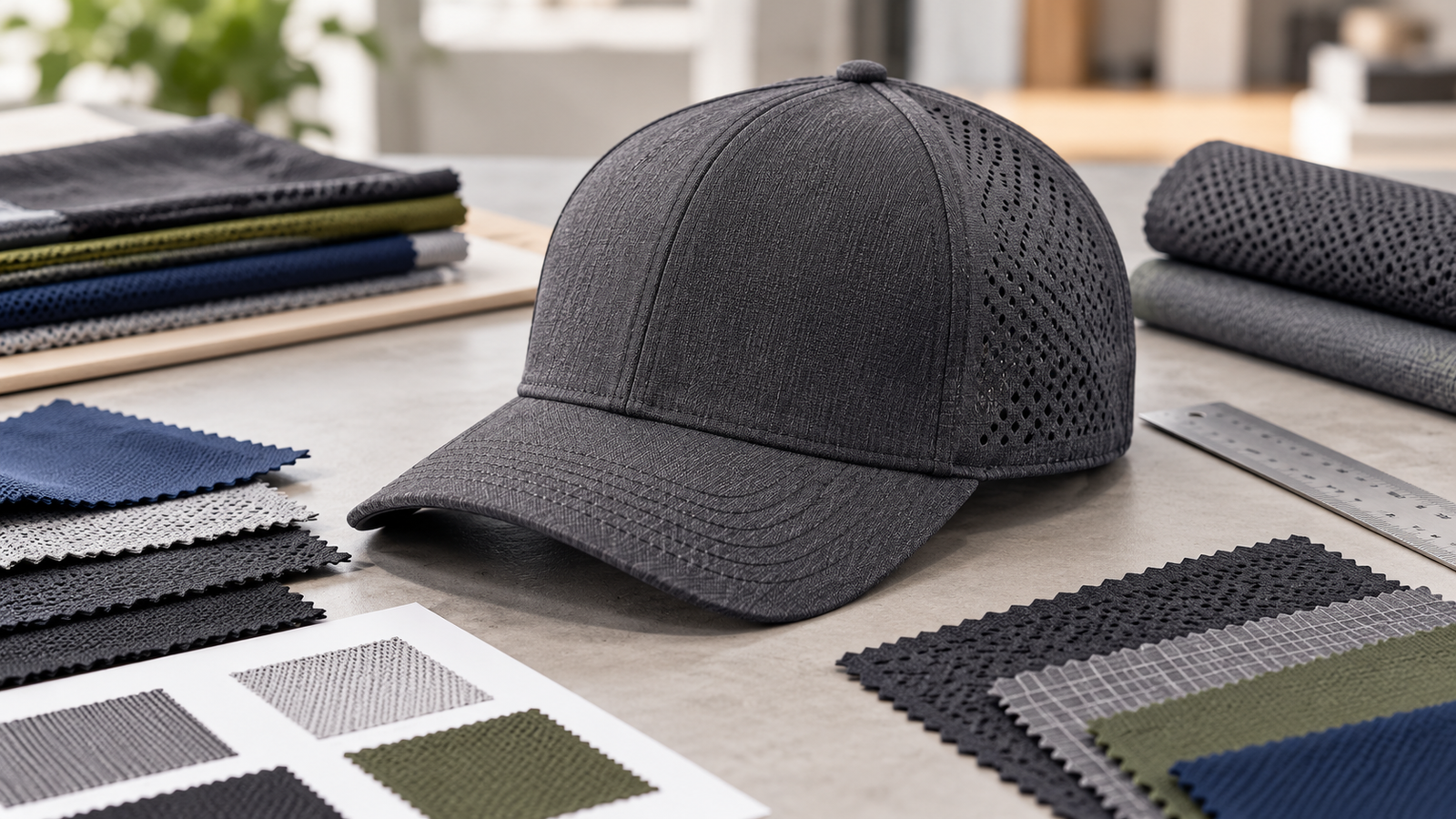
The custom hat fabric selection guide explains how weight, stretch, hand feel, color availability, finishing, and decoration interact. For a water-repellent program, request the finish chemistry and care limitations in writing. If a PFAS-free treatment is required, state that in the request for quotation and define the evidence your market or retailer expects.
Map rain protection and ventilation by cap zone
A runner produces heat and moisture while moving through changing weather. Full coverage can reduce air exchange; unrestricted perforation can undermine rain protection. A better design assigns a function to each zone. The front can prioritize weather resistance and logo stability. Side or rear panels can prioritize airflow. The sweatband can manage skin moisture. The visor can control rain around the eyes without becoming heavy or distorted.
| Cap zone | Primary function | Recommended development check | Common conflict |
|---|---|---|---|
| Front panel | Rain coverage, profile, and logo presentation | Check strike-through, puckering, seam entry, and logo attachment. | Large embroidery adds needle holes and may stiffen a light shell. |
| Side panels | Air exchange and heat release | Approve hole size, pitch, edge quality, stretch, and placement. | Open perforation creates a deliberate path for water. |
| Rear panels | Ventilation, fit range, and closure support | Check closure load, opening size, and rain exposure during movement. | A large rear opening can expose the head in wind-driven rain. |
| Sweatband | Moisture transfer and comfort | Evaluate absorption, transfer, drying, staining, and skin feel. | A thick band can retain more water than the shell. |
| Visor | Face shading, rain deflection, and shape | Check insert recovery, edge stitching, attachment, and wet distortion. | Absorbent inserts or edges can become heavy and slow to dry. |
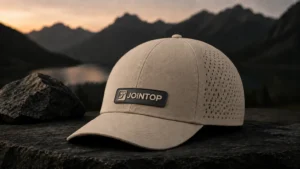
Laser-cut holes should be treated as a designed ventilation feature, not as proof that a cap is breathable. Hole diameter, spacing, panel location, fabric stability, and backing all affect airflow and durability. Keep perforation clear of seam allowances, closure stress points, and decoration edges. The factory should reproduce the approved digital layout and verify it against a physical measurement template.
Control seams, visor materials, and closures
Seams are often the weakest part of a weather cap. Standard stitching punctures the shell, and overlapping layers can channel water. Seam tape may improve selected areas, but tight curves, small crown panels, stretch fabrics, and heat-sensitive finishes can make application difficult. Approve seam tape width, color, adhesion, temperature, pressure, and position on the exact cap pattern. Then inspect it after flexing and the agreed care process.
- Specify which seams require sealing and which remain conventional.
- Define whether eyelets are removed, sealed, embroidered, or replaced by laser ventilation.
- Choose a visor insert that resists wet distortion and matches the required curve.
- Confirm whether the visor edge and stitch rows can admit or retain water.
- Evaluate the rear closure when wet, including grip, slippage, and adjustment range.
- Record thread type, stitch density, seam allowance, and tape placement in the approved specification.
For fit, specify crown depth, finished circumference, closure range, visor length, visor width, and visor curve. A light running cap can feel larger after the support layers are reduced, while seam tape can make another area feel tighter. Use the sample feedback guide to mark each change with a measurement, photo, and clear approval status.
Need help deciding where to use perforation, conventional seams, or sealing? Share your reference sample and rain target through JoinTop’s performance headwear team. We can review the trade-offs before a paid prototype is finalized.

Select a logo method that supports performance
Decoration changes the performance of a light shell. Direct embroidery adds punctures, thread weight, and backing. A woven patch can preserve fine details but adds an attachment seam. A silicone or TPU transfer can reduce needle holes, yet it must be tested for adhesion, color migration, stretch, and surface compatibility. Reflective transfer can support low-light visibility, but reflection level and wash durability should be defined rather than assumed.
Keep the first logo sample at the intended production size. Record width, height, vertical position, distance from seams, color references, backing, edge finish, and approval photo. For light or stretch panels, test whether the logo causes rippling when the cap is worn. The logo placement guide provides a useful brief for front, side, and rear branding.
Build a test plan that matches the claim
Testing should answer the product claim, not produce a random stack of reports. AATCC TM22 evaluates surface water repellency with a spray method, while AATCC TM127 addresses resistance to water penetration under hydrostatic pressure. They are not interchangeable. A material result should also be connected to a finished-cap evaluation because seams, holes, decoration, and the visor are absent from a fabric-only specimen.
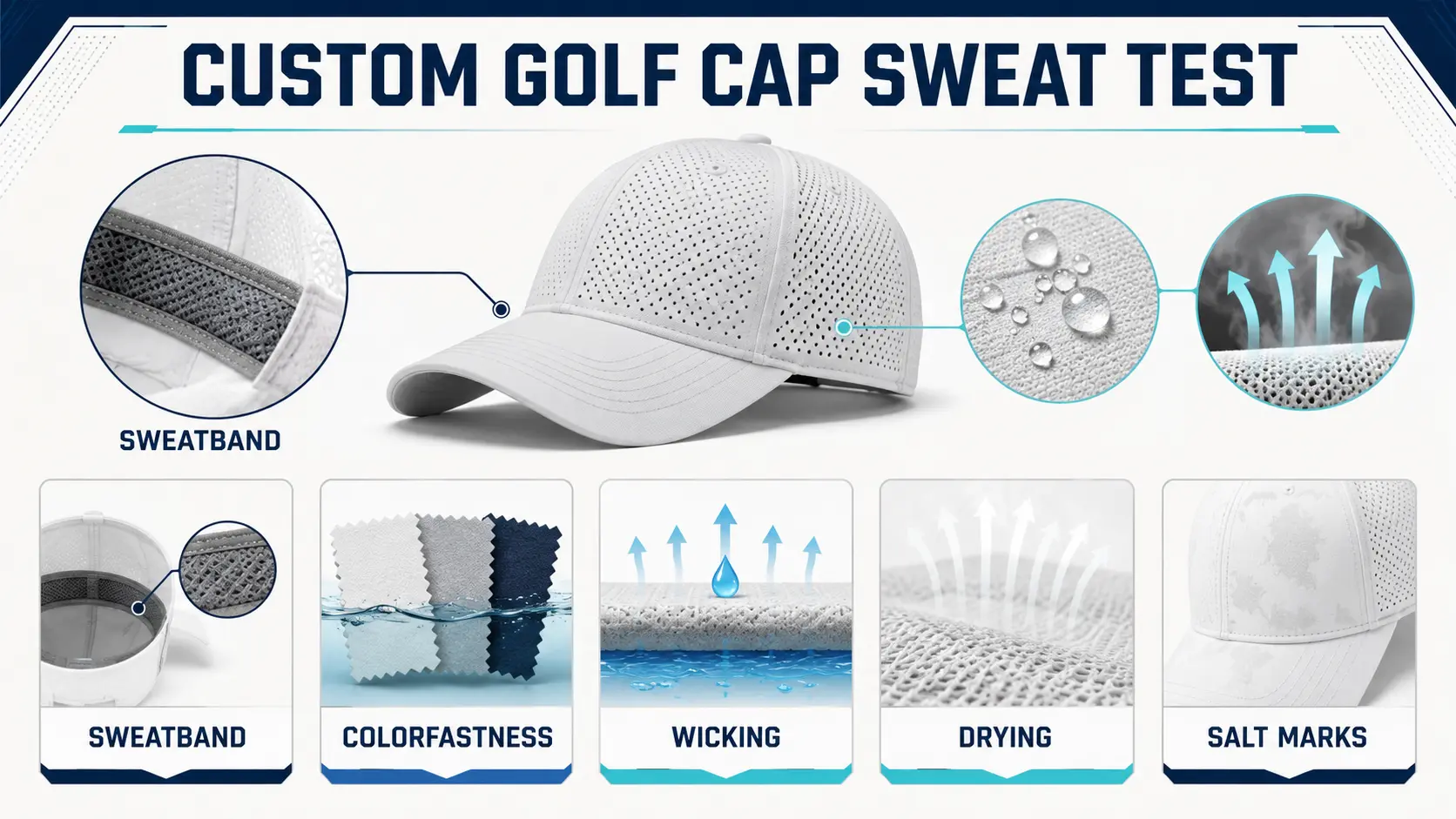
Moisture management and drying need their own methods. AATCC TM195 measures liquid moisture management properties in textile fabrics, and AATCC TM201 covers drying rate using a heated plate. A buyer should agree on which component is tested, conditioning requirements, number of specimens, pass criteria, and whether results are needed before and after care.
| Question | Possible evidence | Apply it to | Approval note |
|---|---|---|---|
| Does water wet the surface quickly? | AATCC TM22 or another agreed spray method | Finished shell fabric and selected colors | Record initial and after-care targets. |
| How much pressure can the fabric resist? | AATCC TM127 or the buyer’s specified method | Barrier fabric or laminate | Do not extend the result automatically to open seams. |
| How does liquid move through the fabric? | AATCC TM195 or another agreed moisture method | Sweatband and shell candidates | Compare components under the same conditions. |
| How quickly does a component dry? | AATCC TM201 or a documented internal method | Shell, sweatband, visor package, and complete cap | Define wetting amount and end point. |
| Does the cap remain consistent after care? | Agreed washing and drying cycle, such as a selected ISO 6330 procedure | Complete approved sample | Check fit, shape, adhesion, color, and repellency. |
Approve samples with measurable checkpoints
A development sample is useful only when the feedback can be reproduced. Begin with the correct shell, finish, color, seam layout, ventilation, sweatband, closure, visor package, and decoration. If a substitute is unavoidable, label it and keep that feature open rather than treating the whole sample as approved. For performance claims, request a confirmation sample made with production-intent materials.
- Measure crown depth, circumference, closure range, visor dimensions, and logo position.
- Photograph front, side, rear, top, interior, closure, seam treatment, and decoration details.
- Run the agreed water, sweat, drying, and care checks on the same construction.
- Wear-test the cap for bounce, pressure points, sweatband comfort, visibility, and wet adjustment.
- List every correction by location, current result, required result, and verification method.
- Seal and retain an approved reference sample with dated specification and test records.
Bulk quality control should sample measurements and workmanship across colors and production lots. Inspect panel symmetry, seam tape, skipped stitches, perforation position, visor curve, closure function, logo placement, stains, color variation, packing shape, and label accuracy. The custom hat quality-control checklist can be adapted to the brand’s defect definitions and sampling plan.
Plan MOQ, color approval, and repeat orders early
MOQ is affected by fabric availability, custom dyeing, finishing, seam tape, laser-cut setup, logo tooling, and color count. A stocked performance fabric can support a smaller development route than a custom laminate or custom-dyed shell. Ask the supplier to separate the cap MOQ from any material, trim, or color minimum so the commercial decision is transparent.
For repeat orders, keep the approved fabric reference, finish, Pantone or lab dip, logo standard, measurements, seam map, hole layout, test method, packaging, and golden sample under version control. If a material is replaced, treat the change as a controlled redevelopment. A visually similar shell can have different stretch, drying, coating adhesion, and shade behavior.
Frequently asked development questions
Can a laser-perforated running cap be fully waterproof?
Open laser holes are designed to pass air and can also pass water. A brand can combine a more protected front zone with ventilated side or rear zones, but the product claim should describe that construction accurately. If complete water exclusion is the priority, ventilation and seam decisions must be redesigned around the chosen test and use case.
Is a PFAS-free finish automatically waterproof?
No. PFAS-free describes a chemistry requirement, not a guaranteed finished-cap performance level. The fabric, treatment, application, curing, seams, openings, decoration, and care history all affect the result. State both the restricted-chemistry requirement and the measurable repellency or penetration target in the specification.
Should the brand test fabric or finished caps?
Use both when the claim depends on construction. Fabric testing helps compare materials and control incoming lots. Finished-cap checks show the effect of seams, perforation, logos, the sweatband, visor, and closure. Keep the methods and pass criteria connected so the factory and buyer evaluate the same expected performance.
Waterproof running cap sourcing checklist
- Intended runner, climate, rain intensity, exposure time, and retail claim
- Five-panel or six-panel shape, measurements, visor curve, and closure range
- Shell composition, weight, stretch, finish, color standard, and PFAS requirement
- Protected zones, ventilation zones, hole dimensions, seams, and sealing plan
- Sweatband construction, moisture target, drying target, and comfort expectation
- Logo technique, size, location, backing, reflectivity, and durability requirement
- Named material and finished-cap test methods with pass criteria
- Sample stages, bulk inspection level, packaging, delivery window, and reorder controls
A strong waterproof running cap program starts with a claim that can be built and verified. If you want a five-panel or six-panel prototype, share your tech pack, reference images, target quantity, delivery market, and performance requirements with JoinTop for a custom development review. We will help translate the concept into materials, construction details, sample checkpoints, and a bulk-production plan.




 English
 German
 Spanish
 French
 Amharic
 Portuguese
 Italian
 Swedish
 Turkish
 Belarusian
 Danish