

A performance fishing gear hat for a brand program should start with the fishing environment, then translate that environment into a five-panel or six-panel specification. Crown fit, brim shape, face fabric, ventilation, sweatband, closure, logo construction, sun-claim evidence, and bulk inspection all need to work together. A cap that feels cool at the dock may fit poorly at boat speed, while a tightly closed crown may resist spray but hold too much heat for the intended market.
The search phrase “performance fishing gear hat” is often used for retail products, including branded fishing collections. This guide uses the phrase as a product category, not as a reference to any partnership or licensed design. It is written for headwear brands, outdoor labels, importers, wholesalers, and sourcing teams developing an original fishing cap. The useful starting point is a controlled brief that suppliers can quote, sample, and reproduce.
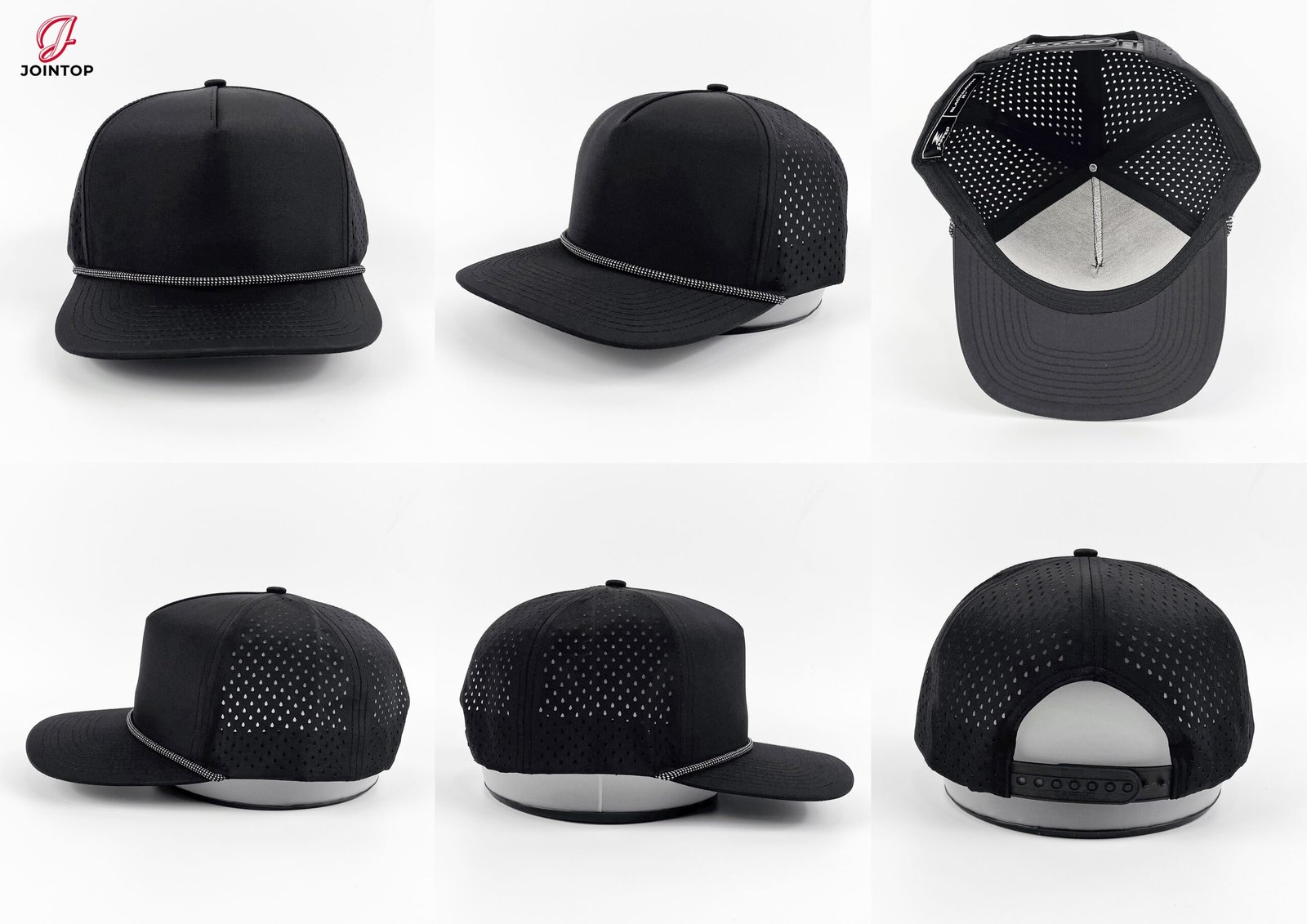
Define the fishing job before selecting features
“Fishing” does not describe one exposure. A shoreline program, an offshore charter uniform, and a tournament merchandise line can use the same basic cap silhouette while needing different decisions on wind stability, ventilation, water contact, sweat management, and decoration. Put the expected environment in the request for quotation so each supplier is pricing the same job.
| Program condition | Specification decision | Sample evidence to review |
|---|---|---|
| Hot, low-wind shoreline use | Prioritize airflow, sweat contact, brim shade, and low crown weight. | Fit after extended wear, sweatband feel, ventilation placement, and brim angle. |
| Open-water use with steady wind | Control fit range, closure security, crown depth, and brim stability. | Movement test on the intended size range and inspection of the closure under tension. |
| Frequent spray or light rain | Define water-repellent or water-resistant expectations, seam exposure, drying, and care. | Agreed fabric or finished-cap test, plus inspection of stitch lines, sweatband, and closure areas. |
| Logo-led retail collection | Balance decoration scale with panel shape, perforation, and crown support. | Approved logo dimensions, placement measurements, color reference, and side-profile review. |
Write observable conditions instead of stacking feature words. “Five-panel cap for warm-weather inshore use, moderate wind, occasional spray, and repeated hand cleaning” gives a development team something to work with. “Premium breathable waterproof fishing hat” leaves the hard choices unresolved and invites suppliers to quote different constructions.
Choose the five-panel or six-panel platform first
The panel layout controls fit, logo space, seam placement, and the way the crown handles wind. It should be fixed before fabric and decoration approval. JoinTop’s guide to five-panel and six-panel sports-hat platforms gives a broader comparison; for a fishing program, the decision comes down to the intended crown profile and the locations that must remain clear for ventilation.
Five-panel fishing caps
A five-panel crown can provide a broad front area for a wordmark, patch, or molded logo. The front may be seamless or have fewer visual breaks than a traditional six-panel cap, depending on the pattern. That clean face is useful for fishing brands with wide marks or detailed species graphics, but the panel still curves around the head. Approve the logo on the physical sample rather than treating the mock up as proof of final placement.
Five-panel patterns also make it easy to place laser perforation across side and rear zones. The sourcing risk is assuming that every five-panel cap has the same depth and front angle. Record finished crown height, opening shape, circumference range, and front-panel dimensions from the approved sample.
Six-panel fishing caps
A six-panel crown divides the shape through a center-front seam. It can support a familiar athletic or outdoor profile, but that seam affects embroidery and patch placement. A narrow mark may sit cleanly across it; a rigid badge or fine lettering may show distortion if the front curve, seam bulk, and attachment method are not considered together.
For either platform, decide whether the crown will be structured, lightly supported, or unstructured. Then test that construction after packing and wear. A cap that looks sharp on a display form may feel too rigid during active use, while a very soft crown can collapse around a larger logo.

Build the material package as one system
Fiber content alone does not tell a buyer how a finished fishing cap will handle heat, spray, sweat, color, or repeated care. Fabric construction, weight, stretch, finish, backing, panel geometry, perforation, thread, and sweatband all change the result. Compare suppliers using the same material questions and keep the approved swatch or material code with the sample record.
Polyester and nylon are common starting points for performance caps, but neither name guarantees a specific outcome. A light woven polyester may suit one program, while a denser nylon or a stretch blend may suit another. Review hand feel, recovery, surface appearance, color behavior, and the intended care condition on the actual candidate fabrics. The polyester versus nylon guide for performance caps explains the sourcing questions without turning the fiber name into a performance claim.
Water contact and ventilation pull in opposite directions
Large mesh zones and open laser perforations release heat, yet they also create direct openings. A water-repellent finish can reduce surface wetting on the face fabric, but it does not close needle holes, perforations, eyelets, panel seams, or the rear opening. If the brand wants a rain claim, define whether the evidence applies to the flat fabric or the complete cap.
AATCC TM22 addresses resistance to surface wetting, while AATCC TM127 addresses resistance to water penetration under hydrostatic pressure. These methods answer different questions. Put the selected method, specimen condition, and acceptance requirement beside the claim, and do not present a fabric result as proof for an assembled cap unless the evidence supports that scope.
The sweatband needs its own decision. Specify its composition, width, thickness, color, stretch behavior, seam placement, and contact feel. If “moisture-wicking,” “cooling,” or “quick-dry” will appear in marketing, agree on the test evidence and the exact component covered by the result. A branded performance term should not be inferred from a supplier’s general fabric description.
| Decision area | What to put in the specification | Common sourcing risk |
|---|---|---|
| Face fabric | Fiber content, construction, target weight or approved quality, stretch direction, color, finish, and care condition. | Suppliers quote fabrics with the same fiber name but different hand, density, recovery, or finish. |
| Ventilation | Method, hole shape and size, pattern file, placement boundaries, and excluded seam or logo zones. | Perforation drifts into seams, weakens a decoration area, or conflicts with the rain claim. |
| Brim | Finished length, width, curve, insert type, stitch rows, edge shape, and recovery requirement. | The brim shades poorly, looks different across sizes, or deforms after packing. |
| Sweatband | Material, width, color, stretch, seam location, and any claim evidence. | A comfortable sample is replaced by a different bulk quality or becomes visible at the edge. |
| Closure | Type, usable adjustment range, strap width, hardware color, branding, and pull check. | The closure loosens during movement or does not cover the intended head-size range. |
| Logo | Method, approved file, finished dimensions, color reference, placement measurements, and tolerance. | The logo puckers the front, crosses a seam badly, or varies in height across bulk units. |

Specify sun protection without overstating coverage
A curved-brim performance cap can shade the scalp, forehead, and eyes, but it does not provide the same coverage as a wide-brim hat. The CDC’s sun-safety guidance notes that a baseball cap leaves the ears and back of the neck exposed. A fishing brand can still develop a useful cap; its product description simply needs to separate brim shade from a textile UPF claim and avoid implying full head-and-neck coverage.
For a numeric UPF claim, test the approved fabric in the condition required by the brand’s target market and labeling plan. AATCC TM183 measures UV transmission or blocking through fabric and includes dry or wet specimen procedures. ASTM D6603 covers labeling of UV-protective textiles based on instrumental data. The result belongs to the tested material and condition. It should not be extended automatically to perforated zones, mesh, open rear areas, or a different bulk fabric.
Keep the claim file with the material approval, color reference, laboratory report, and marketing wording. If the fabric, finish, color, or perforation changes for a repeat order, review whether the previous evidence still applies. JoinTop’s UPF and UV hat design guide provides a fuller claim-scope checklist for sourcing teams.
Match the logo method to the crown
Fishing-cap branding often asks one front panel to carry a detailed species mark, a wordmark, and an outdoor look at the same time. The decoration method has to fit the line weight, color count, panel curve, seam map, and intended feel. Flat embroidery, 3D embroidery, woven patches, printed patches, silicone or TPU elements, and heat-transfer methods solve different problems.
Dense embroidery can stiffen or pucker a light front panel. A rigid badge can bridge a curve poorly. Heat-applied decorations require compatible fabric and process conditions. Any method that adds needle holes or bonded layers may affect the way the decorated area handles water. Review the embroidery, patch, and printing comparison, then approve the chosen method on the exact crown and fabric.
- Provide vector logo files and a physical color reference where color matching matters.
- State finished logo width and height, not only the scale shown on the mock up.
- Measure placement from repeatable cap points such as the brim seam, panel centerline, or side seam.
- Inspect the front, side profile, inside backing, and panel shape after decoration.
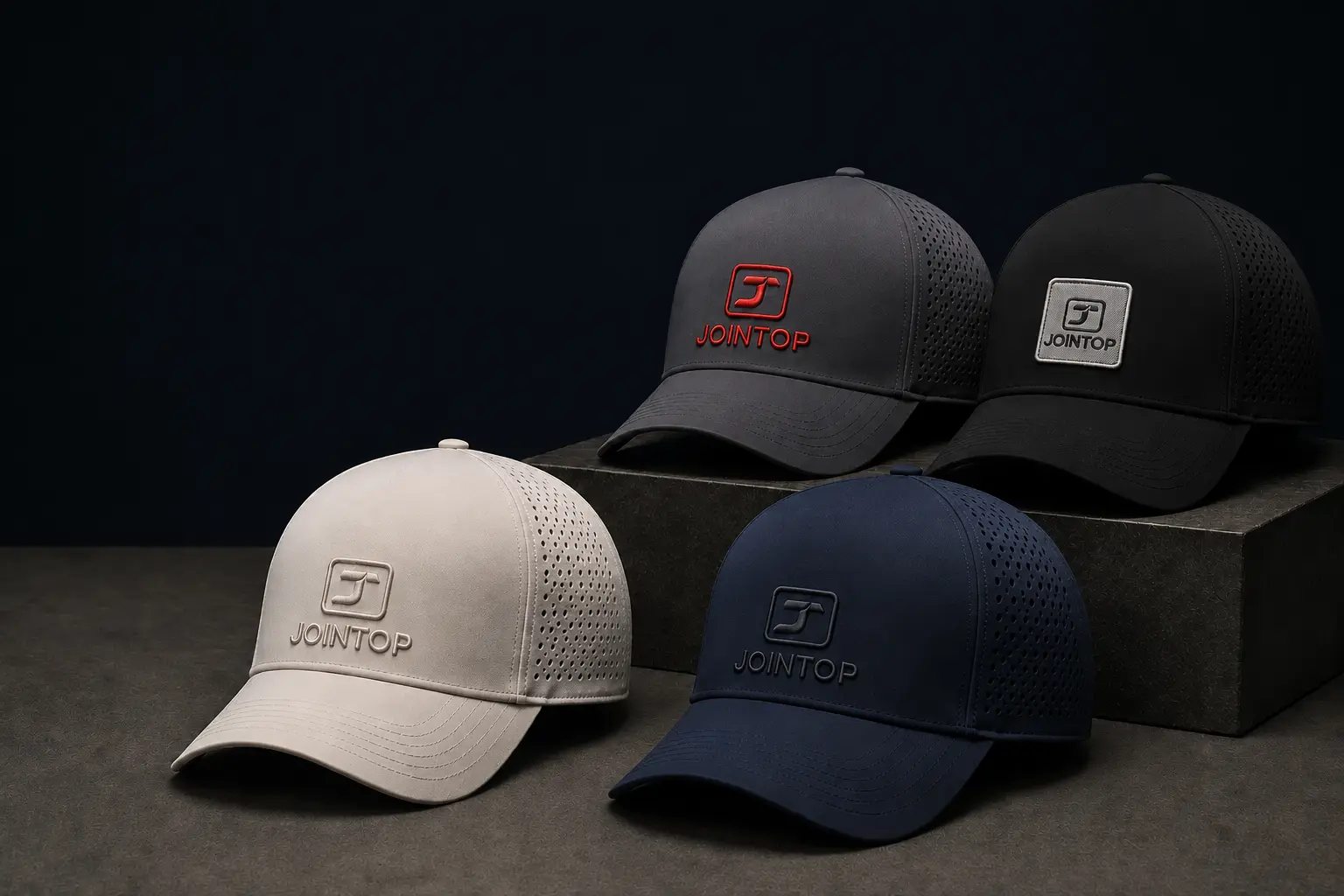
Run sampling as a sequence of decisions
A sample is useful when every review comment closes a defined decision. “Make it more premium” is hard to execute. “Reduce the front crown height, move the logo closer to the brim seam, use the approved navy swatch, and keep perforation outside the decoration boundary” gives the development team measurable changes.
- Lock the use brief. Record the fishing environment, wearer profile, claim scope, target market, quantity, colors, and delivery region.
- Approve the platform. Confirm five-panel or six-panel pattern, crown support, brim geometry, fit range, and closure.
- Approve materials and trims. Keep identified swatches or material codes for the face fabric, sweatband, closure, rope, thread, and logo component.
- Review the finished sample. Measure the cap, check fit on the intended range, inspect decoration and perforation, and run the agreed care or exposure checks.
- Create the approval record. Store signed measurements, photos, comments, claim evidence, packaging, and the final approved sample before bulk release.
Keep feedback consolidated and tied to marked photos or dimensions. The custom-hat sample feedback guide shows how to turn subjective comments into production instructions.
Translate the approved sample into bulk quality control
The approved sample is a reference, but the purchase order still needs written acceptance points. Agree on the inspection stage, sampling plan, defect classes, measurement tolerances, functional checks, and disposition process before production. Do not wait for the final inspection to decide whether a shifted logo, uneven perforation, or loose closure counts as a major problem.
| Bulk inspection point | What the inspector compares | Examples of unacceptable variation |
|---|---|---|
| Fit and measurements | Approved circumference range, crown dimensions, opening, brim length, and closure range. | Shallow crown, inconsistent opening, unusable adjustment range, or brim outside the agreed tolerance. |
| Panel construction | Panel symmetry, seam alignment, puckering, top button, eyelets or perforation, and internal finishing. | Twisted crown, skipped stitches, exposed raw edges, blocked holes, or perforation entering a seam. |
| Logo | Approved dimensions, placement, color, edge quality, stitch or bond condition, and backing. | Logo drift, loose threads, lifting edges, distorted lettering, or visible adhesive. |
| Materials and color | Approved swatch, finish, hand, shade, sweatband, rope, closure, and thread. | Unapproved substitution, mixed shades, changed surface finish, or inconsistent trim color. |
| Functional checks | Agreed closure pull, brim recovery, care check, and any water or UV evidence required by the brief. | Closure slippage, permanent brim distortion, claim evidence tied to a different material, or failure under the agreed method. |
| Packing | Approved shape support, labeling, quantity, carton method, and moisture protection where specified. | Crushed crowns, bent brims, mixed colors, missing labels, or carton quantities that do not match the packing list. |
For a broader inspection framework, use JoinTop’s custom-hat production and bulk quality-control guide. The useful part is the discipline: one approved standard, one defect language, and one record of any accepted change.
Protect the repeat order from silent changes
Fishing programs often return in new colors or with revised logos. Preserve the product identity before that happens. Keep the pattern or measurement set, material and trim codes, color standards, perforation file, logo file, placement sheet, approved sample photos, test reports, packing standard, and a dated change log.
Ask the supplier to disclose a proposed substitution before cutting. A replacement fabric may match the fiber content and still change hand, stretch, shade, perforation edge, decoration behavior, or claim evidence. Reapprove the affected component and update the record instead of relying on the previous sample.
Prepare a quote-ready performance fishing hat brief
- Reference cap or clear front, side, rear, and interior views
- Five-panel or six-panel structure, crown profile, brim shape, and fit range
- Target quantity by color and any planned size split
- Fishing environment, water exposure, ventilation priority, and sun-claim scope
- Preferred fabric, stretch, finish, sweatband, closure, rope, and other trims
- Logo files, decoration method, finished size, placement, and color references
- Target market, required test or labeling evidence, packaging, and delivery region
For a fishing-cap project, send JoinTop the reference style, panel construction, target quantity, colors, logo method, performance requirements, target market, and delivery region through the contact page. That information is enough to identify the open specification decisions before quotation or sampling.


 English
 German
 Spanish
 French
 Amharic
 Portuguese
 Italian
 Swedish
 Turkish
 Belarusian
 Danish