

Short answer: Good custom youth hats are not adult caps made smaller. A brand needs to define the wearer and sales market, build a realistic size range, scale the crown and visor together, test the finished cap on the intended fit range, and keep the approved measurements and components ready for reorders.
Most youth-cap problems do not show up in a flat product photo. They show up when the cap reaches the wearer: the crown covers the ears, the visor looks oversized, the closure is already near its limit, or a small logo becomes unreadable on the curved front.
For a brand, those details affect more than comfort. They influence returns, online size claims, SKU planning, product-safety files, and repeat-order consistency. This guide is for product, sourcing, merchandising, and quality teams developing custom youth hats in commercial quantities—not for shoppers ordering one personalized cap.

What must “youth size” mean on a purchase order?
Youth is a market label, not a complete specification. It can describe very different wearers depending on the country, sport, retailer, and collection. Before discussing fabric or embroidery, define four things: the intended age band, destination market, use case, and customer-facing fit promise.
A junior golf cap, an elementary-school uniform cap, and a family lifestyle collection may all use the word “youth.” They should not automatically use the same pattern. The brand brief should connect the sales promise to measurements that a factory and quality team can check.
| Buyer decision | What production needs | Why it matters |
|---|---|---|
| Who will wear it? | Age band plus actual head-circumference data from the target market | Age alone does not define head size or proportion |
| How will it be sold? | Size name, stated fit range, and channel requirements | The product page, label, and finished cap need to agree |
| What will they do in it? | School, team, golf, outdoor, travel, or lifestyle use | Use changes the right crown, fabric, closure, and sweatband |
| Where will it be sold? | Destination countries and compliance owner | Age classification and required evidence vary by market |
In the United States, a product designed or intended primarily for children 12 or younger may be a children’s product. The U.S. Consumer Product Safety Commission considers factors such as product size, packaging, promotion, and how consumers commonly recognize the item; its children’s product guidance explains the classification approach. That is another reason the age statement and physical design should tell the same story.
How should a brand build the youth fit range?
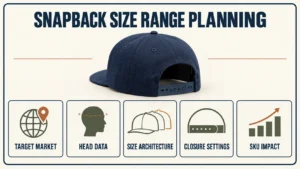
Start with head measurements from people who resemble the intended customer group. Record how each measurement was taken, then examine the spread instead of designing around one average. Existing adult sales data can help with a broader assortment, but it cannot be scaled down to create a youth range. JoinTop’s high-traffic hat-size guide for brands is useful context for adult and adjustable sizing; youth development still needs its own fit evidence.
Head circumference is only the first number. The team also needs crown depth, front-panel height, opening shape, visor length and width, ear clearance, sweatband behavior, and the usable travel of the closure. Two caps can share a nominal circumference and still sit very differently.
One adjustable size or two youth blocks?
A single adjustable size can work when the intended wearers sit comfortably inside the closure range and the crown and visor remain proportional at both ends. It becomes a weak promise when the smallest wearer needs the closure almost fully tightened while the largest wearer uses its last practical setting.
Hypothetical example: a brand plans one cap for younger schoolchildren and early teenagers. The sample fastens on both groups, but on the younger group the back opening collapses and the visor dominates the face; on the older group the closure is nearly maxed out. The right correction may be two proportional cap blocks, not a longer closure on the same crown. This is an illustration of the decision, not a universal age-to-size chart.
- Use one adjustable block when target wearers fit near the useful middle of the closure range and the worn shape stays consistent.
- Use two youth blocks when closure extremes, crown depth, or visor proportion create visibly different fits.
- Use several fitted sizes only when the sales channel can explain, stock, and replenish them accurately.
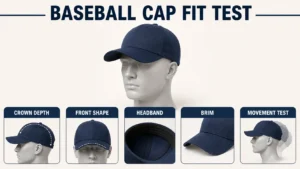
For every option, photograph the same front, side, back, and three-quarter views. Record head circumference and closure setting beside each image. The method in the cap fit-test guide turns “fits well” into evidence a supplier can reproduce.
Which construction choices matter most on a smaller cap?
The best construction follows the use case. A washed lifestyle cap may need a softer crown. A team program may prefer a structured front that keeps a consistent uniform look. A youth outdoor range may need a lighter, quick-drying fabric and deliberate ventilation. The brand should decide what the cap must do before selecting a fashionable detail.
Crown and visor
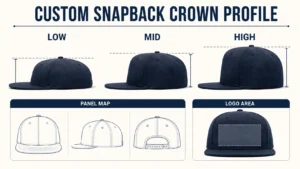
Scale the crown and visor as one system. Reducing only the head opening can leave an adult-depth crown that reaches the ears. Keeping an adult visor can make the cap feel front-heavy. Review crown depth, front height, visor length, curve, stiffness, and recovery on the intended wearers—not only on a table.
Closure and sweatband
Check the finished closure at its smallest, middle, and largest approved settings. Look at tail management, edge finish, spacing, attachment, and the shape of the back opening. The sweatband should stay flat throughout that range and should not form a hard ridge at the forehead.
Fabric and components
Judge fabric by the real environment: heat, sweat, repeated handling, school use, or outdoor wear. Keep decorative hardware and loose components purposeful. Every added trim creates another sourcing, durability, and compliance decision.

How do you keep the logo readable on a youth crown?
Do not shrink adult artwork by a fixed percentage and send it straight to production. A smaller front area changes the usable width, curvature, seam relationship, and viewing distance. Fine text may close up. A wide mark may wrap toward the sides. A center seam may split a letter or narrow outline.
Lock the finished logo width and height for each cap block. Add placement measurement points, the decoration method, physical color references, and a rule for whether the artwork may cross a seam. Review the cap from normal wearing distance as well as close up.
| What you see on the sample | Likely cause | Decision to make |
|---|---|---|
| Small letters fill in | Too much detail for the finished embroidery size | Approve a simplified youth artwork version |
| Logo looks too high | Adult placement measurement used on a shorter front | Set placement for the youth block |
| Edges pull near a seam | Artwork, digitizing, and crown construction conflict | Move, simplify, or change the decoration method |
| Adult and youth caps look unrelated | Identical dimensions used instead of visual proportion | Approve the two versions side by side |
Use the embroidery digitizing checklist for stitch-specific decisions and the logo placement guide to keep the mark consistent through colorways and reorders.
What should sampling prove before bulk production?
A strong sample process answers one group of questions at a time. Trying to approve fit, decoration, color, packaging, and compliance on one rushed sample makes the cause of each problem harder to isolate.
- Fit sample: prove the crown block, visor proportion, sweatband, and closure range. Record who tested it, head measurements, closure settings, and the approved worn views under an appropriate brand protocol.
- Material and decoration sample: use the actual fabric, logo method, placement, thread or patch colors, labels, and trims. A rendering can guide direction but cannot prove shape, hand feel, stitch behavior, or physical color.
- Production-release sample: close the size chart, bill of materials, artwork versions, color references, packaging, inspection points, required documents, and delivery plan. Name the person authorized to release bulk.
JoinTop’s typical sample time is 7–14 days. Typical bulk production is 35–45 days after sample approval. Artwork revisions, sample shipping, buyer review, testing, and freight sit outside those ranges unless they are included in a project-specific schedule.
Where does product compliance enter the process?
Compliance starts during product definition, not after the purchase order. The brand or importer should identify the rules for every destination market before final trims, labels, coatings, inks, or packaging are approved. The supplier can provide component and production information, but it should not guess the legal scope for the importer.
For U.S. children’s products that are subject to applicable children’s product safety rules, the CPSC describes third-party testing and the written Children’s Product Certificate process in its CPC guidance. It also explains that the domestic manufacturer or importer is responsible for issuing the certificate, even when a laboratory or supplier helps prepare information.
Product and packaging identifiers also need early attention. The CPSC’s tracking-label guidance covers the information that must be ascertainable for children’s products, including the manufacturer or private labeler, production location and date, and batch or run details. A practical tech pack therefore needs product codes and lot logic, not just artwork.
This is product-development guidance, not legal advice. Requirements depend on the finished product, components, claims, intended age, and destination. The responsible compliance professional or importer should approve the final requirement matrix.
How do mature brands protect a youth-cap reorder?
The second order should not be rebuilt from email history. Keep the approved sample, measurement sheet, closure-range photos, artwork page, bill of materials, physical color references, lot information, inspection record, packaging version, and applicable compliance evidence under one product code.
When feedback arrives, diagnose it before changing the pattern. “Too small” may mean a tight opening, shallow crown, short closure range, oversized visor, or a sweatband that does not relax as expected. A broad size increase can fix one complaint and damage another part of the fit.
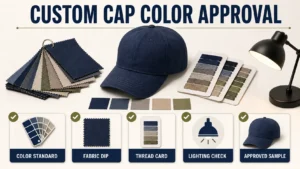
Before a repeat order, list every proposed change. A new fabric source, coating, closure, badge, factory, or size claim can reopen fit, color, durability, or compliance checks. For color decisions across lots, use the process in the cap color approval guide instead of relying on a screen value.
What affects price, MOQ, and lead time?
JoinTop’s standard MOQ is 100 pieces per style and color. That minimum does not decide the right size split. A two-block youth range, five colorways, and two decoration methods create more approval and inventory work than one proven block in two colors, even if the total quantity is the same.
Ask suppliers to quote the same construction, component list, logo size, colorways, labels, packaging, testing responsibilities, and delivery basis. Otherwise, the lowest price may represent a different cap or an incomplete service scope.
For a launch date, work backward from the required warehouse arrival. Allow time for fit correction before colorways are sampled. If two size blocks use the same logo, confirm whether they need separate digitizing or placement files. A small early decision can prevent a multi-SKU revision later.
What should you send for a useful quote?
A qualified development request should include:
- company or brand website and sales channel;
- intended age group, target market, and cap use case;
- head-size data or the size promise already used by the brand;
- preferred cap style, crown, visor, closure, and material references;
- logo artwork, finished-size target, and decoration direction;
- quantity per style and color, split by proposed youth size block;
- SKU count, forecast, and likely reorder pattern;
- compliance owner and known testing or documentation needs;
- labels, packaging, destination, target cost basis, and required delivery date;
- the person responsible for sample and bulk approval.

 English
  German
  Spanish
  French
  Amharic
  Portuguese
  Italian
  Swedish
  Turkish
  Belarusian
  Danish