
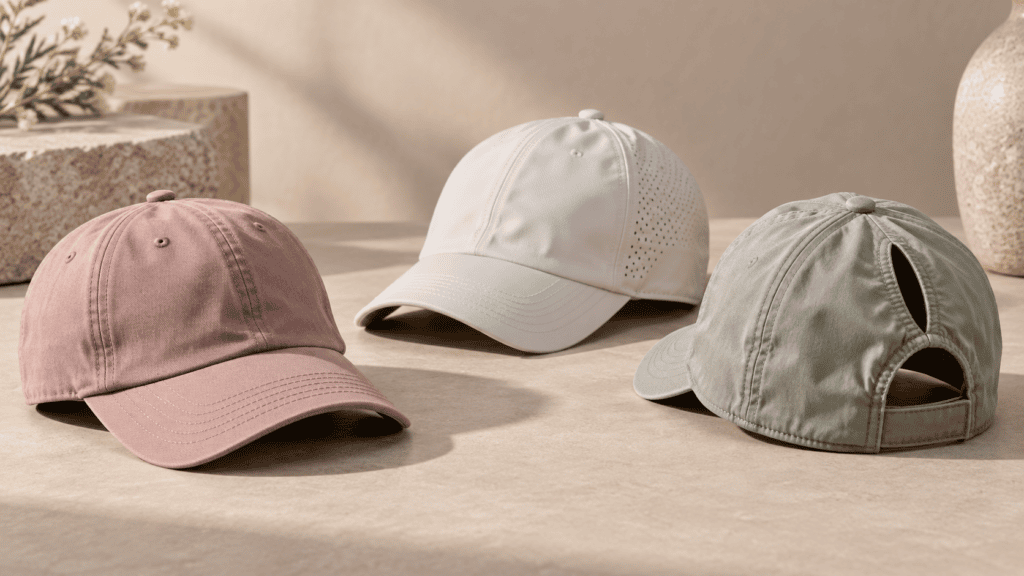
For brands sourcing sun protection hats for women, the product brief should control three separate things: how much area the cap shades, how the textile handles ultraviolet transmission, and how the finished cap fits the intended wearer. A normal five-panel or six-panel performance cap can shade the scalp, forehead, and eyes, but it does not cover the ears and neck like a wide-brim hat. A UPF claim also needs test evidence tied to the approved fabric and its actual condition, rather than an assumption based on fiber content or color.
This is a B2B development guide for headwear brands, importers, wholesalers, and sourcing teams. It focuses on the information a supplier needs before quotation and sampling: claim scope, five- or six-panel construction, fit block, brim geometry, fabric, ventilation, logo method, sample approval, bulk quality control, packaging, and reorder records. For a broader overview of UV terminology, see JoinTop’s UPF and UV hat design guide for brands.
Start with the sun protection claim your brand can support
The phrase “sun protection hats for women” can describe several different products. One brand may want a lightweight performance cap for golf and running. Another may need a deeper crown and longer curved brim for outdoor staff. A third may only need a fashion cap whose brim provides shade, without a numeric UPF label. These programs should not share the same specification or marketing claim.
Separate shade coverage from textile UV performance at the start of the brief. Brim length, brim curve, crown height, wearing angle, and head position affect shade. Fabric construction, color, stretch, moisture, finishing, and openings affect ultraviolet transmission. A laboratory result for an unperforated fabric panel does not describe the shade created by the brim, and it does not turn the complete cap into full head-and-neck protection.
| Procurement requirement | What to write in the brief | Evidence to approve | Risk if left vague |
|---|---|---|---|
| Shade coverage | Brim length, width, curve, wearing angle, and the areas the brand intends the cap to shade | Approved cap measurements and wear-trial photos from agreed positions | Marketing language promises coverage the cap shape does not provide |
| Textile UV claim | Target claim, test method, specimen condition, colors, and whether the result applies to fabric or finished headwear | Report for the approved material and agreed test condition | A supplier’s general fabric statement is reused as SKU-specific proof |
| Openings | Eyelets, laser perforations, mesh zones, back opening, and ponytail opening | Approved placement map and finished sample | High-exposure areas contain more open space than the claim file reflects |
| Use condition | Dry or wet use, expected stretch, care method, and intended activity | Testing and wear review in the condition relevant to the product | Performance changes after moisture, stretch, washing, or abrasion |
| Claim ownership | Person responsible for approving product copy, labels, hangtags, and sales materials | Signed claim record linked to the SKU | Sales language becomes stronger than the available evidence |
AATCC TM183 measures the transmission or blocking of ultraviolet radiation through fabric and provides procedures for dry or wet specimens. For U.S. labeling programs, AATCC points to ASTM D6544 for specimen preparation and ASTM D6603 for labeling of UV-protective textiles. The current test route should be confirmed with the testing laboratory and the brand’s compliance team before the product copy is written.
The claim file needs to match the product that will be sold. If a fabric is changed, a pale color is added, a stretch construction is introduced, or a large perforated zone replaces a solid panel, the original evidence may no longer answer the same question. The Federal Trade Commission’s advertising substantiation policy states that objective product claims require a reasonable basis before advertising is released. Brands selling in other markets should confirm the applicable labeling and advertising rules there.
Coverage language needs equal care. The Skin Cancer Foundation’s guidance on sun-protective clothing favors wide brims for shading the face, scalp, ears, and neck. A standard performance cap offers a different coverage pattern. Describe that pattern accurately instead of implying that a curved visor protects every exposed area.
Define the fit block instead of relying on a women’s label
“Women’s fit” is a merchandising direction, not a measurable specification. Head size and preferred fit vary within every market. A sourcing team should provide an approved reference cap or a target measurement set, then test the sample on people who represent the intended customer group. The goal is a repeatable fit block, not a generic promise that one cap fits all women.
- Head-size range: state the range the closure must accommodate and the points where fit will be checked.
- Crown measurements: record front height, side depth, back depth, panel seam lengths, and the position of the sweatband.
- Brim geometry: specify length, width, curve, thickness, stitch rows, and the angle where the brim joins the crown.
- Closure range: approve the usable adjustment range, loose-end management, hardware edges, and the feel against hair and skin.
- Hair accommodation: decide whether the normal back opening is sufficient or whether the design needs a different opening or closure position.
- Wear position: record whether the sample sits level or tilted and how that position changes brim shade and pressure around the temples.
A larger rear opening may make a ponytail easier to position, but it also reduces fabric coverage and can change how the back panels hold their shape. Raising the opening can force the closure upward. Lowering it can weaken the visual balance of the crown. Review the opening, closure, fit, and coverage as one system. JoinTop’s guide to custom ladies’ hat fit blocks and reorder planning covers the measurement file in more detail.
Choose a five-panel or six-panel crown for the intended fit and logo
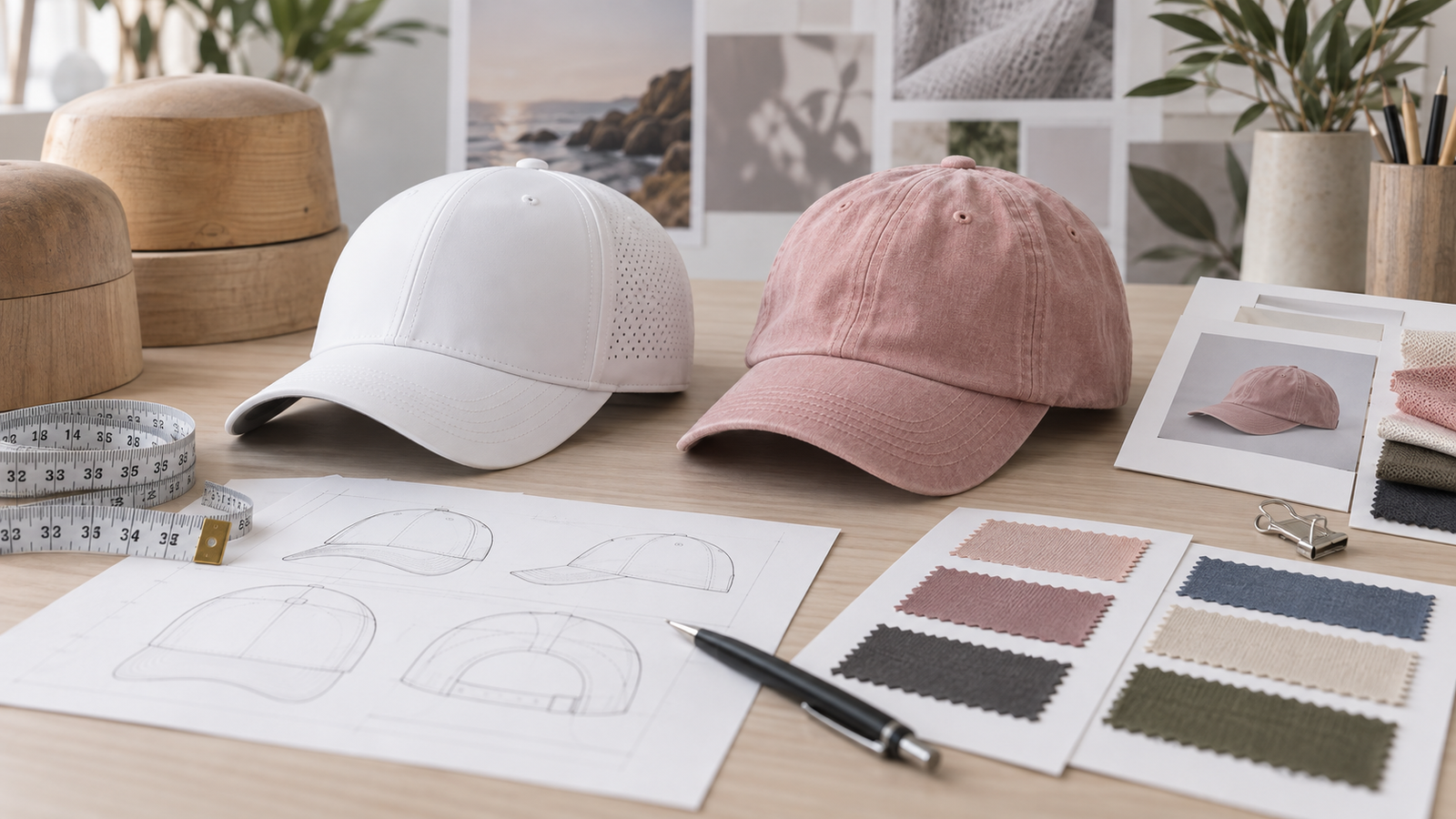
Both structures can work for a women’s sun-protection performance cap. The decision should follow the approved silhouette, fit block, logo method, and ventilation plan. Five-panel and six-panel describe seam architecture. They do not guarantee a particular depth, level of structure, or performance.
| Decision point | Five-panel performance cap | Six-panel performance cap | Sample check |
|---|---|---|---|
| Front logo area | A seamless front panel can give a broad, uninterrupted decoration area | A center front seam divides the logo zone and may affect small text or flat patches | Review the actual sew-out or molded component on the finished crown |
| Crown shaping | Shape depends heavily on the front-panel pattern, side seams, and any reinforcement | More panel seams can distribute curvature around the head | Measure the sample and compare front, side, and back views with the approved reference |
| Ventilation | Perforation can be placed on side and rear panels while keeping the front clean | Ventilation can be distributed across multiple side and rear panels | Confirm open-area placement against coverage and claim requirements |
| Fit adjustment | Panel proportions may suit a low or medium profile, subject to the pattern | Panel geometry can support a rounded profile, subject to the pattern | Run the same wearer and measurement review for both options |
| Bulk risk | Front-panel distortion is visible when the material, reinforcement, or logo is mismatched | Uneven center seams and panel symmetry are easy to notice | Keep front-view photos and measurements in the approved quality file |
A five-panel crown is useful when the brand wants one continuous front logo field. The clean panel does not remove the need for shaping. Material stiffness, the angle of the front panel, seam tension, and the weight of the decoration can pull the crown forward or create a flat wall above the brim. Review the cap from the side as well as the front.
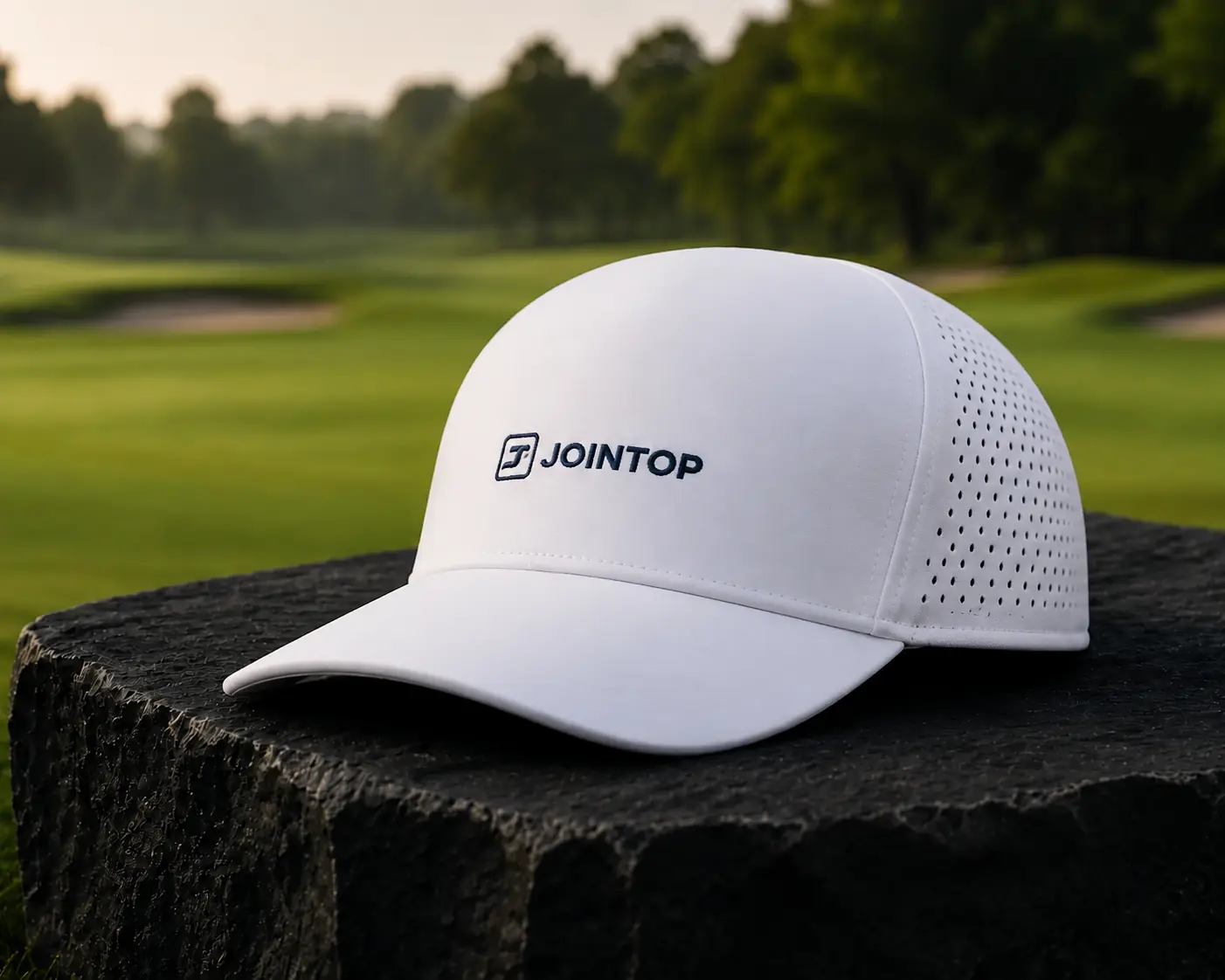
A six-panel crown creates a center front seam and a more segmented pattern. That seam can help distribute curvature, but it also becomes part of the logo decision. Embroidery that crosses the seam may shift or become uneven. A patch may bridge the seam if its base, adhesive, and sewing method are compatible with the crown. The five-panel versus six-panel guide provides a broader structure comparison for product teams.
Specify fabric and UV performance as separate decisions
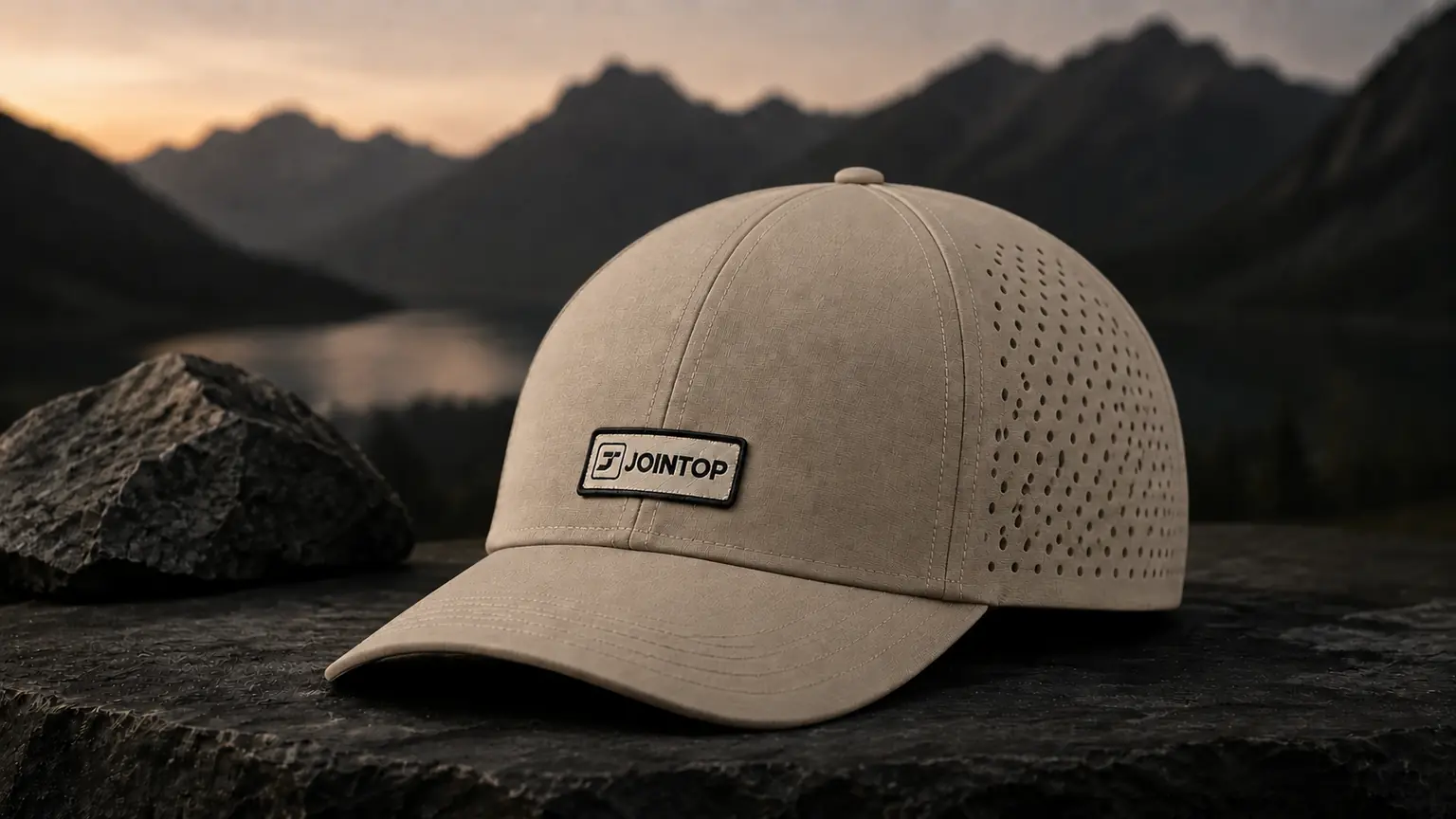
Fiber names do not establish UV performance on their own. Polyester, nylon, cotton, and blends can be made in different weights, weaves, knits, colors, stretch levels, and finishes. Two fabrics with the same fiber composition can transmit different amounts of ultraviolet radiation. Ask for the exact material reference, construction, finish, approved color, and test condition.
Performance caps often use lightweight synthetic woven fabrics because brands want low bulk, shape recovery, and quicker moisture movement. Those outcomes still need to be evaluated on the selected material. A denser construction may improve coverage but feel warmer. A lighter construction may feel cooler but require a different ventilation map or claim. Stretch can improve fit while opening the textile structure under tension. Review the tradeoff instead of selecting a fabric from composition alone.
Color belongs in the approval plan. A test report for one shade should not be silently applied to every colorway if the laboratory or compliance team says color affects the result. The same rule applies when a fabric supplier changes a dye recipe, finish, or base construction. Keep the fabric lot reference and report with the approved SKU file. For material comparisons, use the questions in JoinTop’s polyester versus nylon guide for performance caps.
Place ventilation where it does not undermine the brief
Ventilation and sun coverage pull in opposite directions when the design removes material. Laser perforations, mesh panels, and eyelets can reduce heat buildup, but they create openings. A procurement team should define where openings are allowed, their approximate size and spacing, and whether the tested specimen represents that construction.
Keep the front and upper crown more closed when those areas are central to the coverage brief, then evaluate airflow at the side and rear panels. This is a design direction, not a substitute for testing. Large decorative perforation patterns can change crown stability, create weak points near seams, and produce visible variation if the cutting position drifts. Approve a placement map and inspect it against panel edges, seam allowance, and logo position.
Control the brim as a functional component
The visor is the main shading component on a normal performance cap. Write its length, width, curve, insert material, thickness, edge shape, stitch rows, and attachment angle into the specification. A longer brim can create more forward shade, but it may feel visually oversized on a shallow crown or interfere with the intended sport. A very tight curve can narrow the shaded area and alter how the cap sits at the temples.
Approve the brim after wear, moisture exposure, and packing conditions that match the program. Check whether it twists, develops an uneven curve, lifts away from the forehead, or presses against eyewear. If the cap will be shipped with a pre-curved visor, packaging must hold that shape without crushing the crown. If the brand wants a packable visor, the return-to-shape expectation needs its own sample test.
Match the logo method to the crown and claim
Decoration affects more than appearance. Dense embroidery adds needle holes and can pucker a light front panel. A thick molded patch can pull on a soft crown. Heat-applied graphics require compatible temperature, pressure, adhesive, and surface finish. A woven patch can carry fine detail, but the patch edge and attachment method still need to follow the crown curve.
- Embroidery: approve thread color, size, stitch coverage, backing, seam interaction, and the crown shape after sewing.
- Woven or printed patch: check border width, base stiffness, edge lift, wash behavior, and whether the patch bridges a front seam.
- Silicone, TPU, or rubber component: approve weight, thickness, color, surface, attachment, and flexibility on the selected fabric.
- Heat transfer: confirm bonding on the finished material and review gloss, press marks, edge adhesion, and performance after the agreed care cycle.
Do not infer that a logo method preserves or improves UV performance. If the brand’s claim depends on a specific part of the crown, ask the testing and compliance teams whether the decorated area needs separate consideration. Keep the approved decoration sample with the material report and finished-cap specification.
Approve the sample with measurements and claim evidence
A product photo cannot approve fit, coverage, or repeatability. The sample review should combine physical measurements, wear feedback, decoration checks, material references, and the evidence behind any objective performance claim. Record changes on the specification instead of relying on messages that can be separated from the SKU later.
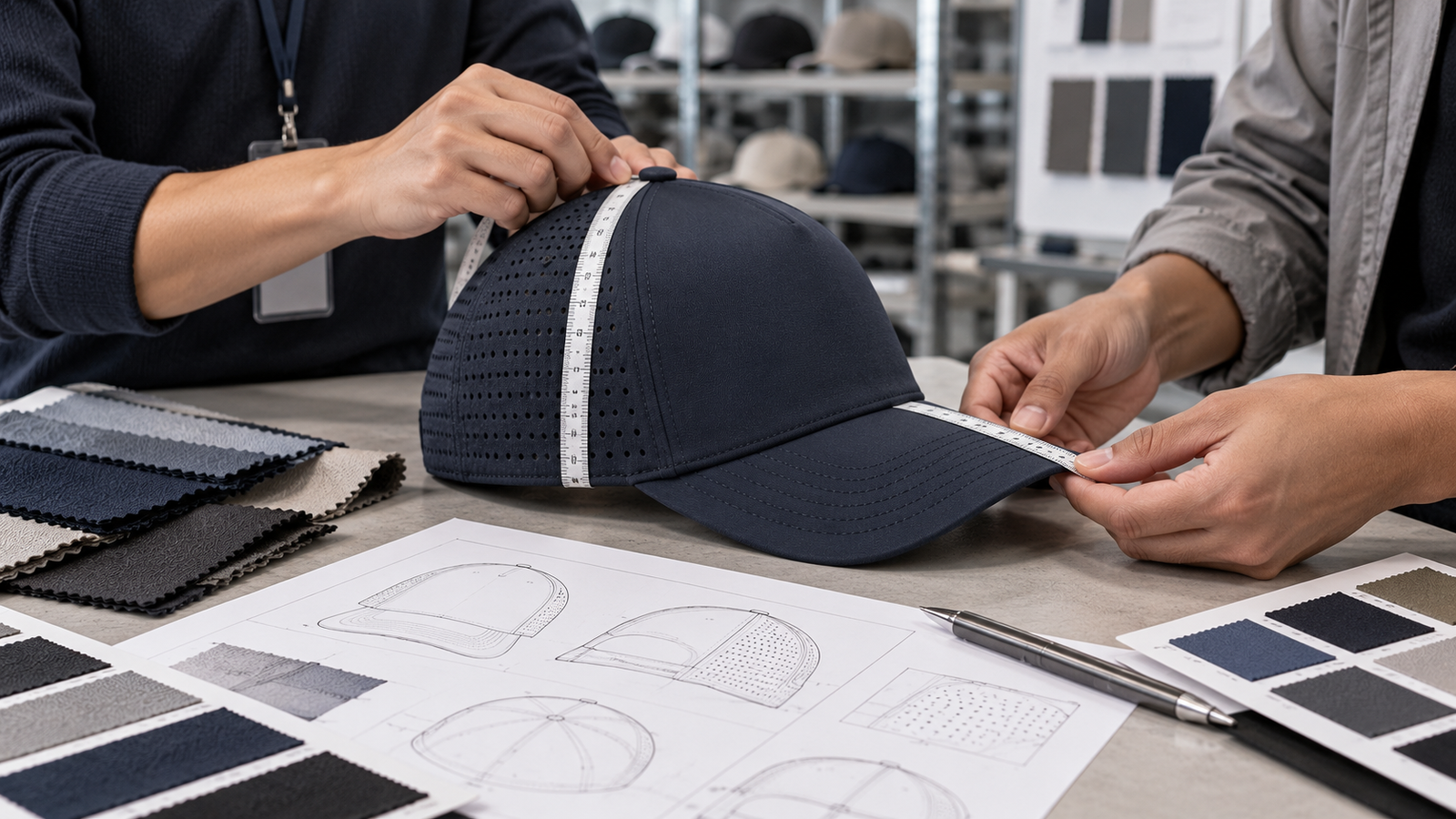
- Confirm the structure. Check the five- or six-panel pattern, crown profile, seam symmetry, brim construction, closure, sweatband, ventilation, and inside finishing.
- Measure the fit block. Compare crown and brim measurements with the specification and run a wear review on the intended user group.
- Verify the claim file. Match the material, color, construction, specimen condition, test method, and proposed wording.
- Approve the logo on the cap. Review position, size, color, surface, seam interaction, puckering, and crown shape after application.
- Test the intended use. Review the cap during the relevant activity and condition, including moisture or packing when those factors matter.
- Freeze the approval record. Keep the signed sample, measurements, material reference, trim details, artwork file, color standards, report, packaging method, and dated approval comments together.
Build bulk quality control around the approved cap
Bulk inspection should compare production with the approved sample and written specification. Visual checks alone can miss a gradual shift in crown depth, brim curve, closure range, perforation position, or logo height. Set tolerances and an inspection plan before production, then retain measurements by size, color, and production lot.
| Inspection area | Practical check | Hold or reject trigger | Reorder record |
|---|---|---|---|
| Crown and fit | Measure agreed points and compare front, side, back, and inside shape with the approved sample | Out-of-tolerance measurements, twisted seams, uneven panels, or a changed fit | Measurement sheet and approved pattern reference |
| Brim | Check length, width, curve, stitch rows, symmetry, attachment, and recovery after normal handling | Twist, delamination, uneven curve, exposed insert, or inconsistent shade geometry | Brim material, dimensions, photos, and packing method |
| Fabric and color | Match the approved material reference, hand feel, shade standard, finish, and lot information | Unapproved substitution, visible shade drift, finish change, or inconsistent stretch | Fabric code, color standard, and lot record |
| Ventilation | Compare hole size, spacing, placement, cut quality, and distance from seams | Blocked or scorched openings, shifted pattern, weak edges, or unapproved open area | Placement file and approved panel sample |
| Logo and trims | Check position, dimensions, color, attachment, surface, crown distortion, labels, and closure parts | Loose component, wrong color, sharp edge, pucker, misalignment, or missing trim | Approved component, placement measurements, and supplier code |
| Claim and labeling | Confirm hangtag, care label, fiber information, performance wording, and market-specific copy | Copy exceeds the approved evidence or does not match the SKU | Final label files and claim approval |
The inspection level, sample size, defect classes, and acceptance limits should match the brand’s quality plan and the risk of the feature. Define what counts as critical, major, and minor before inspection begins. JoinTop’s custom hat quality control guide explains how to turn the approved sample into a practical defect checklist.
Protect the brim and crown through packaging and reorders
Packaging can change the cap after inspection. A curved visor can flatten or twist when cartons are overfilled. A soft crown can arrive creased when the inside support is inconsistent. Surface finishes and light colors can pick up transfer marks from unapproved packing materials. Approve the folding method, crown support, visor position, inner packing, carton loading, SKU labels, and any moisture-control requirement on a packed sample.
For reorders, keep the approved cap and its specification active as a controlled reference. Record the pattern version, fabric and color codes, finish, ventilation file, sweatband, closure, logo component, label files, test reports, packaging, and dated changes. If one item changes, identify which approvals and claims need to be reopened. That discipline matters more than asking a supplier to make the next order “the same as last time.”
Send a complete brief before requesting a quote
For an actionable B2B quote, send the reference cap or target silhouette, five- or six-panel preference, target quantity, colorways, fit range, brim requirements, fabric and ventilation direction, logo files and placement, intended market, proposed sun-protection claim, testing requirement, packaging needs, and delivery country or region. If several choices are still open, identify them instead of hiding them behind a finished-looking mock up.
Brands developing sun protection performance caps can use JoinTop’s contact page to submit those specifications and request material, structure, logo, or sample-development feedback. A clear brief lets the sourcing discussion focus on the decisions that still need evidence, rather than forcing suppliers to quote different interpretations of the same hat.





 English
 German
 Spanish
 French
 Amharic
 Portuguese
 Italian
 Swedish
 Turkish
 Belarusian
 Danish