
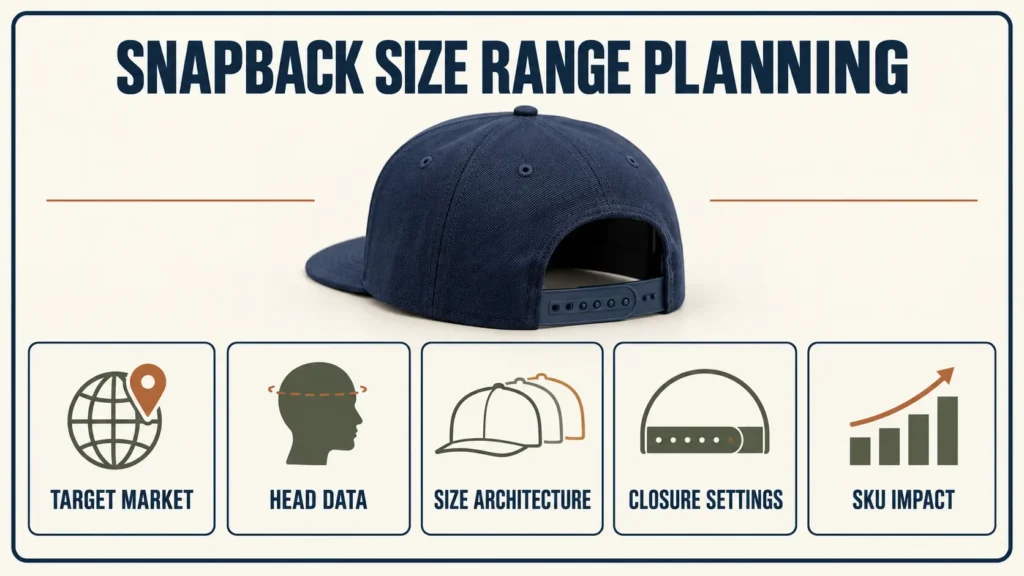
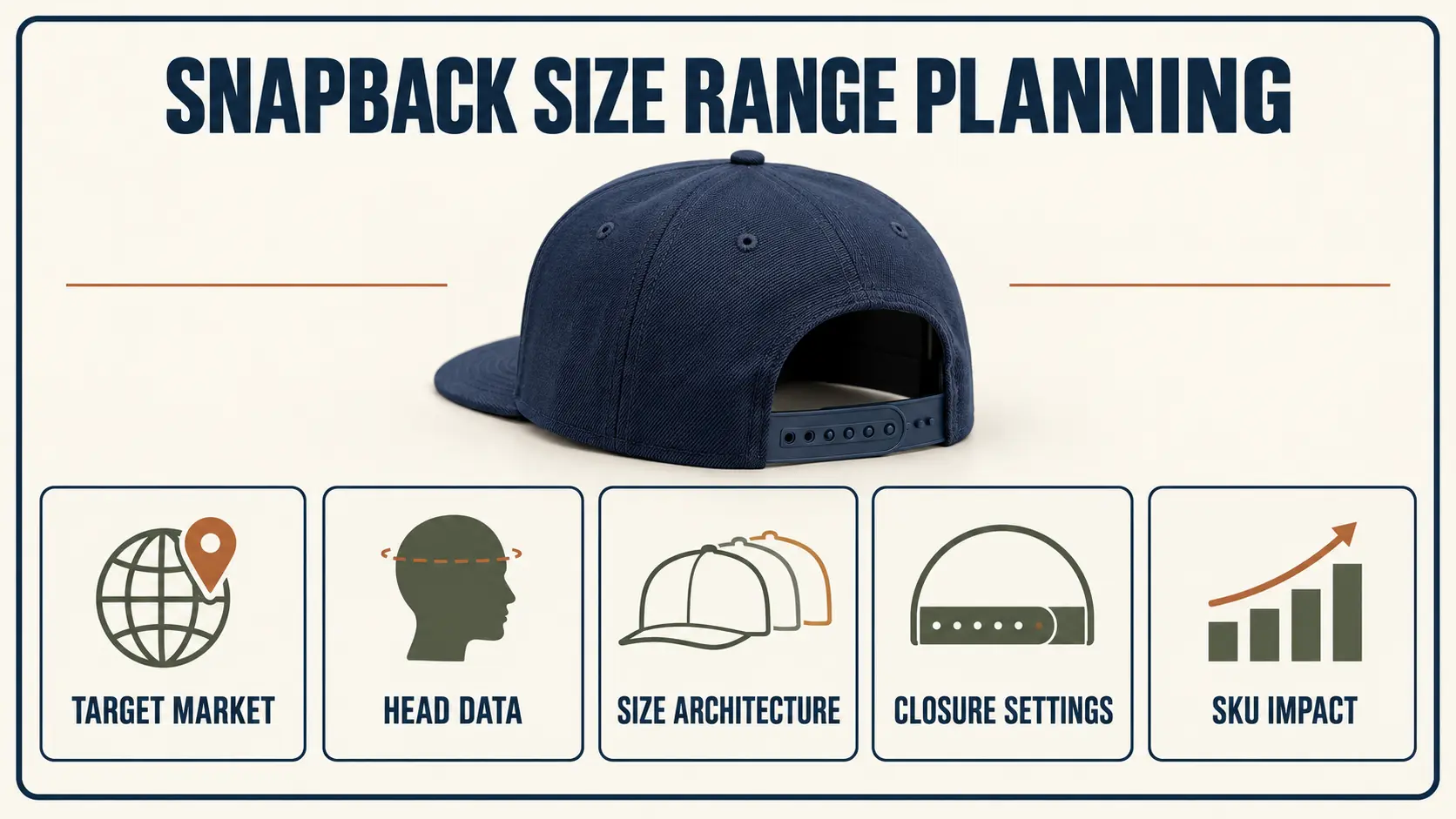
Custom snapback caps are adjustable. That does not mean one size is right for every customer. A plastic closure can join at several positions. Yet the crown may become too shallow, the rear opening may change shape, or the cap may lose stability near one end of the range.
That creates a business decision, not only a fitting problem. A mature brand must define which customers the product should cover. It must decide whether one size or two size groups make better business sense. The team also needs to know what the factory must hold steady in bulk.
This guide focuses on that range and assortment decision. It does not repeat a general cap-fitting routine. The goal is to turn available fit evidence into a controlled size strategy for multiple markets, SKUs, suppliers, and reorders.
Size coverage is an assortment decision, not a closure claim
A closure’s maximum physical span is not the same as an approved selling range. At the smallest usable setting, the rear panels may bunch or the crown may look oversized. At the largest setting, too few pegs may remain engaged, the front can pull backward, or pressure may rise around the opening.
Define two separate limits:
- Mechanical range: the settings at which the closure can physically connect.
- Commercial range: the settings at which fit, shape, stability, comfort, and appearance all meet the brand’s release rule.
The second range is the one that should guide product copy, assortment planning, and production approval. A brand should not describe the last possible snap as a valid fit merely because the closure stays connected.
Start with markets and channels, not one global average
Begin with the customers the collection is expected to serve. Separate data by target market, sales channel, product use, and cap block where those factors can change the result. A golf pro-shop program, a team dealer, and a lifestyle e-commerce line may have different wearer mixes and different tolerance for returns.
Use the brand’s own information first. Review past size sales, closure settings from wear trials, return reasons, service notes, retailer feedback, and approved reference caps. Do not replace evidence with country stereotypes or one office-wide average.
ISO 8559-5:2023 defines head and face measurement concepts that can help teams use consistent terms. ISO 15535:2023 provides general requirements for anthropometric databases. Neither standard tells a brand which commercial range to sell. The product team still needs relevant wearer evidence and its own acceptance rules.
Build a closure-setting distribution
An average head measurement can hide the buyers who sit near the edges of the proposed range. Record the closure position selected by each relevant wearer and connect it to the cap block, material version, and market segment. The distribution is more useful than one average because it shows where the product is actually being adjusted.
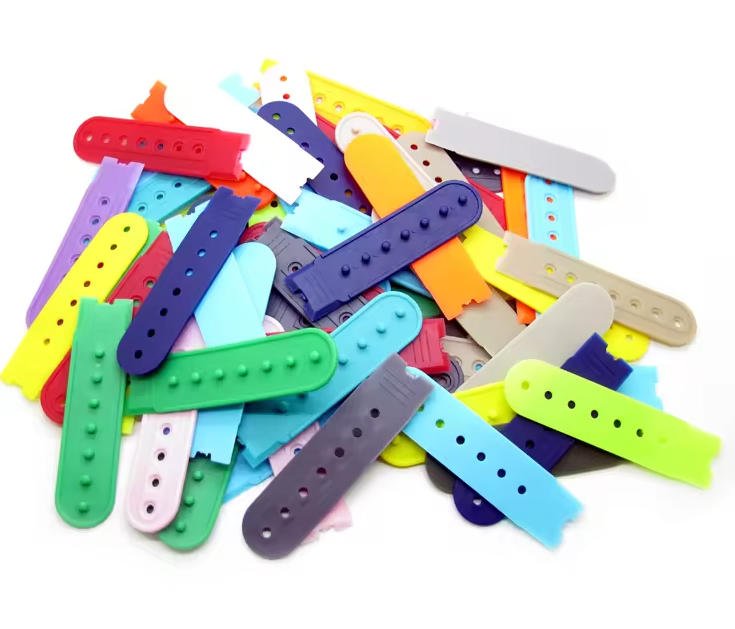
“Three snaps open” is not a reliable record if teams count from different ends or if suppliers use different peg layouts. Photograph the joined closure. Record the number of engaged pegs, the usable strap length, and the agreed internal measurement. Name the closure component and product version.
| Field | Why it matters | Decision it supports |
|---|---|---|
| Target market and channel | Shows which demand group the evidence represents | Global or market-specific range |
| Cap block and material version | Separates closure effects from crown or fabric changes | Shared block or separate validation |
| Head measurement method | Keeps records comparable | Usable coverage boundaries |
| Selected closure position | Shows where wearers cluster and where settings run out | One-size or two-size strategy |
| Fit and return reason code | Identifies pressure, depth, shape, or stability issues | Pattern, claim, or assortment change |
Choose a size architecture before expanding colorways
Once the team can see the useful coverage, choose the simplest architecture that meets the commercial goal. Do this before approving every colorway. Otherwise, a late size decision can multiply samples, labels, packaging records, purchase-order lines, and inventory.
| Architecture | When it may work | Main tradeoff |
|---|---|---|
| One adjustable size | The core wearer group stays within a stable fit and appearance range | Lowest SKU complexity, but weaker edge coverage |
| Two overlapping size groups | Demand at both ends is meaningful and one crown cannot serve both well | Better coverage, but more inventory and labeling |
| Market-specific block or range | Channels or regions show repeatable differences in fit evidence | More precise offer, but higher development and control burden |
| Narrower product claim | The current cap serves the core group well but not the intended extremes | No new SKU, but marketing must avoid overstating coverage |
Model the SKU and inventory effect
A second size can improve coverage, but it also divides demand. Product and merchandising teams should model that division at style, colorway, and channel level. A color that is already low volume may not support two size groups at the same reorder frequency as a core color.
Use scenarios instead of one confident forecast. For each option, compare expected units by size group and MOQ exposure by style and color. Then review safety stock, packaging, warehouse slots, retailer setup, and the risk of an uneven reorder. JoinTop’s confirmed standard MOQ is 100 pieces per style and color. Whether a size split works still depends on the full program and approved specification.
Do not invent a percentage split when the brand has no evidence. Start with a written planning assumption and label it clearly. Update it when samples, preorders, retailer input, or live sales provide better information.
Control the product variables that move the range
The same closure does not create the same commercial range on every cap. Treat these as controlled variables:
- Crown block: depth, panel shape, support, and rear-panel geometry affect how the cap behaves when tightened.
- Sweatband: finished length, thickness, recovery, grip, and seam placement affect pressure and stability.
- Closure: strap length, peg spacing, material stiffness, attachment, and opening geometry affect usable settings.
- Shell material: stretch, shrinkage, stiffness, and lamination can change the relationship between the pattern and the wearer.
- Decoration: a heavy front application can change balance and may require a different support decision.
JoinTop’s published snapback closure guide compares closure types. Range planning has a different job: it decides how a chosen block and closure support the intended market and assortment.
Create one range decision record
A mature program needs more than comments in an email thread. Create a controlled record that product, merchandising, sourcing, quality, and the factory can use. It should include:
- target markets, channels, and product use;
- approved cap block, pattern, material, sweatband, and closure versions;
- measurement method and named closure-position method;
- commercial coverage limits and the reason for any excluded edge settings;
- one-size, two-size, market-specific, or narrower-claim decision;
- SKU, colorway, labeling, and packaging consequences;
- approval owner, date, evidence source, and next review trigger.
Store the decision with the approved sample and hat tech pack. If the brand changes the block, fabric, sweatband, closure, or target market, the record makes it clear which assumptions may no longer hold.
Write product claims that match the evidence
“One size fits all” is usually broader than the product evidence can support. Even “one size fits most” needs an internal definition of “most” for the intended customer group. Marketing copy should not imply that the cap covers populations the team did not evaluate.
When needed, product teams can use a narrower and more useful statement. Options include an adjustable adult range, a market-specific guide, or two named size groups with overlap. The exact public wording is a brand and legal decision. The factory must keep the approved product version in line with the range decision behind that wording.
Translate the decision into a supplier brief
Send every supplier the same block version, closure specification, measurement method, selling range, evidence request, and change rule. Without one basis, suppliers may quote or sample different versions of an “adjustable snapback.” Price and performance then become hard to compare.
The brief should also state which changes require notification and reapproval. A replacement closure that looks similar may use different spacing or stiffness. A new sweatband or shell material may change pressure and recovery. These are not automatic failures, but they are reasons to reassess the range decision.
Carry the range into bulk production and reorders
Bulk inspection cannot reproduce the brand’s full market study. It can confirm that production still matches the approved components and measurements. Define checks for closure identity and attachment, sweatband length, rear-opening geometry, key crown measurements, and appearance at named settings.
For reorders, compare the bill of materials, pattern version, supplier lot, and approved range record before deciding whether routine inspection is enough. Revalidate when a meaningful component or market assumption changes. This prevents a historic “one size” claim from surviving after the product underneath it has changed.
Use live data to improve the next buy
After launch, review size-related returns and service notes by SKU, colorway, channel, market, and production lot. Use separate reason codes for pressure, shallow depth, excess crown volume, rear-opening shape, closure failure, and poor stability. A general “did not fit” code is too broad for a product decision.
A pattern in one market may point to assortment coverage. A pattern in one lot may point to production drift. A pattern after a material change may justify revalidation. These are investigation signals, not proof of a cause. Product, quality, and sourcing teams should review them together before changing the block or size architecture.


 English
  German
  Spanish
  French
  Amharic
  Portuguese
  Italian
  Swedish
  Turkish
  Belarusian
  Danish