

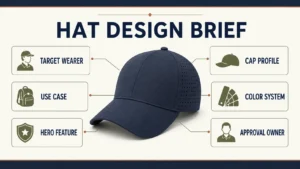
For brands, importers, wholesalers, and sourcing teams developing a men’s waterproof performance cap, the product brief must control the full construction: fit block, five- or six-panel crown, face fabric, water barrier or finish, seam plan, ventilation, sweatband, brim, closure, logo, and packaging. These specifications allow suppliers to quote the same product and give the brand measurable criteria for sample approval and bulk inspection.
This guide is written for companies developing private-label or custom waterproof caps. It focuses on the decisions that must be fixed before quotation and sampling: product architecture, claim scope, materials, decoration, fit approval, bulk quality control, packaging, and repeat-order control for a normal five-panel or six-panel custom performance cap.
Define the rain claim before choosing the fabric
Start by writing the exposure in plain language. State how long the cap may be worn in rain, whether the wearer is moving or stationary, and whether the product is expected to handle light showers, wind-driven rain, or repeated wetting. Also state what failure means. Surface darkening, droplets passing through a seam, a soaked sweatband, brim distortion, and uncomfortable heat are different failures and may require different changes.
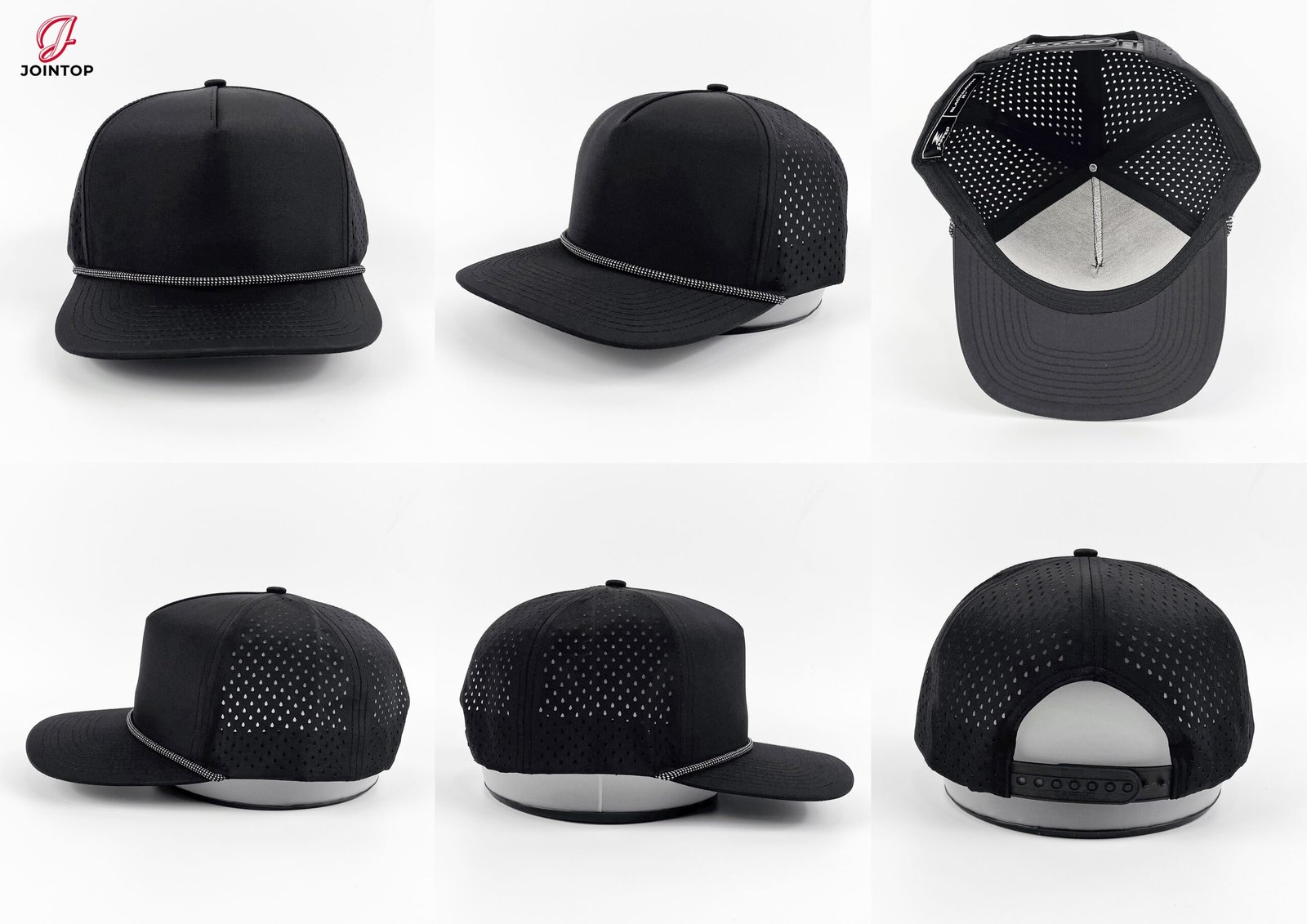
A water-repellent finish can reduce surface wetting, but that does not automatically make a sewn cap waterproof. Coatings or laminates can increase resistance to water penetration, while needle holes, ventilation openings, and closure gaps can remain exposed. If the design includes large laser perforations for cooling, describe it as a water-resistant performance cap unless finished-product testing supports a stronger claim. This avoids promising two conflicting outcomes from the same opening.
For laboratory language, ISO 811:2018 describes a hydrostatic-pressure method for textile resistance to water penetration. AATCC TM127 also evaluates water resistance by hydrostatic pressure, while AATCC TM22 addresses resistance to surface wetting by spray. These methods answer different questions. The test method, specimen condition, direction of pressure, number of samples, and acceptance level should be agreed with the testing party instead of inferred from a marketing word.
| Procurement decision | What to put in the brief | Risk if left vague | Approval evidence |
|---|---|---|---|
| Rain scenario | Light shower, repeated wetting, or longer exposure; activity and climate | Supplier prices a different protection level | Written use case and sample test |
| Claim wording | Water-repellent, water-resistant, or waterproof, subject to substantiation | Sales copy exceeds the tested construction | Claim file linked to the approved SKU |
| Material route | Face fiber, weave, finish, coating or laminate, color, and hand feel | Correct face fabric but wrong finish or stiffness | Approved swatch and finished cap |
| Water-entry control | Seams, eyelets, top button, brim join, closure opening, and sweatband edge | Fabric passes while the cap leaks | Finished-product review by area |
| Comfort limit | Ventilation, sweat handling, weight, noise, and acceptable warmth | Protection improves but wearability falls | Wear trial in the intended activity |
Treat men’s fit as measurements, not a label
“Men’s” is a merchandising direction, not a fit specification. Two caps with the same nominal circumference can feel different because crown depth, front-panel angle, brim curve, sweatband stretch, seam allowance, and closure position change how the cap sits. Replace assumptions such as “standard men’s fit” with an approved reference cap, target head-size range, crown measurements, brim measurements, closure range, and fit comments from more than one wearer.
Fit also affects weather performance. A crown that is too shallow can ride upward and expose more of the head. A crown that is too deep may press on the ears or create folds that hold water. An over-tight sweatband becomes less comfortable when wet, while a loose back opening can admit rain. Record how the sample feels at the front seam, temple, ear area, and rear opening rather than approving fit from a tabletop photo.
Five-panel or six-panel: choose the platform before decoration
A five-panel performance cap gives the logo a broad front area and can avoid a center-front seam, although its side seams and crown geometry still need inspection. A six-panel cap provides a familiar baseball-cap shape but places a seam through the front center; that seam affects logo placement and may create an additional water-entry path. Neither platform is automatically more waterproof. The better choice is the one that matches the fit, decoration, ventilation, and seam-control plan.
Ask the supplier to identify which measurements come from an existing block and which will change. If crown height, panel width, brim curve, or closure position is altered, approve a new physical sample. Do not assume that moving the same artwork from a six-panel crown to a five-panel crown preserves its visual size or centerline.

Choose material as part of the cap system
Fiber name alone does not predict performance. Polyester and nylon are available in many yarn sizes, weaves, weights, stretch levels, finishes, coatings, and laminates. A lightweight woven nylon may feel technical but show seam puckering. A polyester face may offer stable color yet become stiff after a barrier treatment. Evaluate the exact finished material proposed for the colorway, not a generic swatch labeled only by fiber content.
Your performance-cap material review should include face appearance, hand feel, stretch and recovery, fold memory, noise, odor, color consistency, marking, and behavior after wetting and drying. If a chemical or sustainability claim matters, request documentation for the exact material and finish. Do not carry a PFAS-free, recycled-content, or certification statement from one fabric to another without supplier and testing confirmation.
- Face fabric: Specify fiber content, construction, color reference, weight or approved handle, and visible surface standard.
- Barrier or finish: Identify the proposed water-repellent finish, coating, or laminate and the test attached to it.
- Supporting parts: Review thread, seam treatment, sweatband, lining or reinforcement, brim insert, closure, top button, and labels.
- Color risk: Test dark and light colorways when the finish, backing, heat exposure, or visible marking could differ.
- Care route: Match care instructions to the finished cap, because heat, detergent, and abrasion may affect a finish or bonded layer.
Map every water-entry path on the finished cap
Review the crown as a three-dimensional object. Mark the front seam, side and rear panel seams, top-button attachment, eyelets or perforations, brim-to-crown seam, sweatband stitching, label stitching, and rear closure opening. Then decide which areas will be treated, redesigned, accepted as limitations, or excluded from the claim. Curved cap seams can be harder to seal neatly than straight garment seams, so a visually clean sample matters as much as a material data sheet.
The brim needs its own wet review. Check whether the approved curve changes after wetting and air drying, whether the edge wrinkles, and whether water is directed toward or away from the face. The brim insert, cover fabric, rows of stitching, and the seam at the crown all affect the result. If the brief requires a packable or soft brim, define the acceptable recovery after folding rather than assuming a rigid baseball-cap standard.
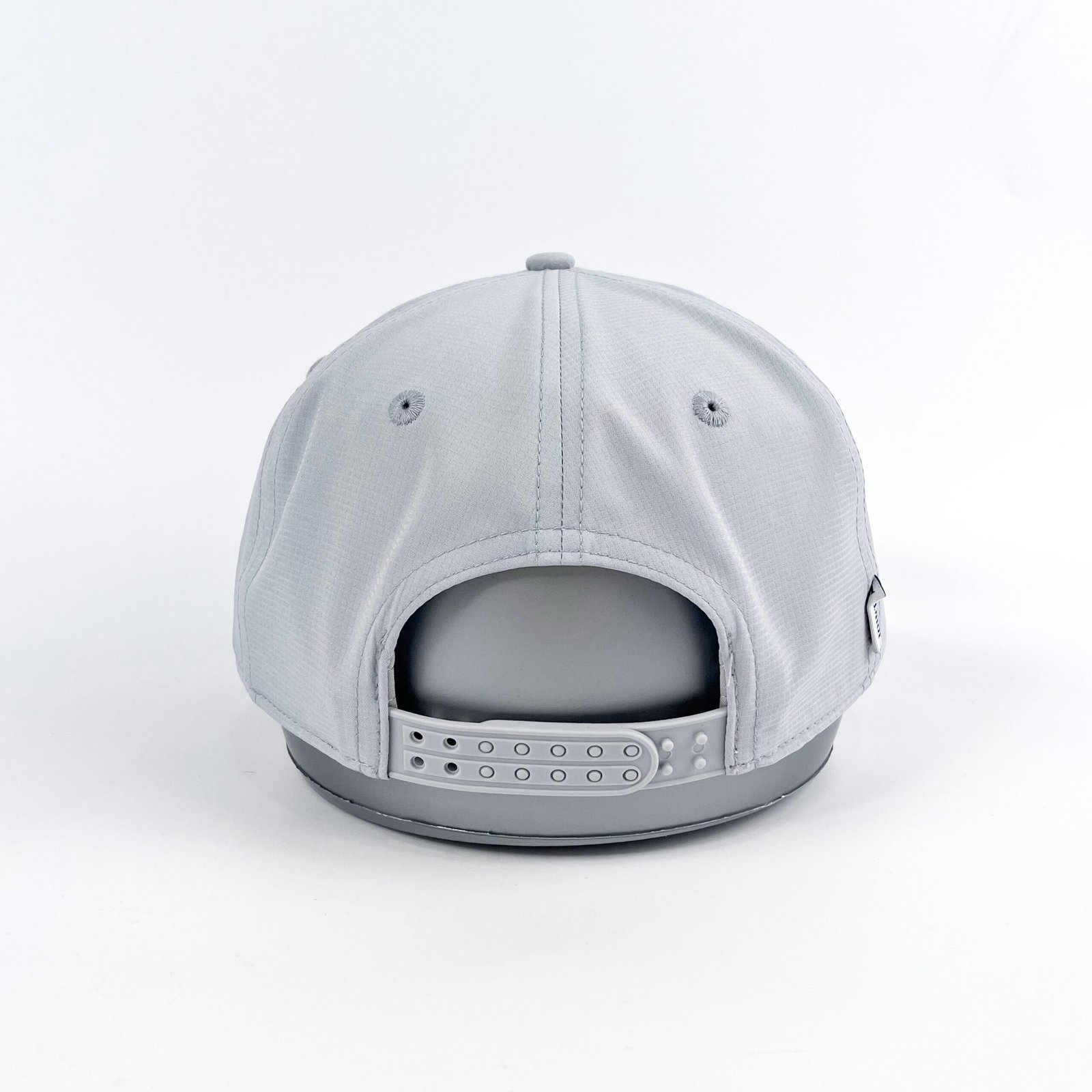
The sweatband and closure control comfort at the points where the cap meets the head. Check drying behavior, seam pressure, attachment, rear opening, and adjustment range. A metal buckle, plastic snap, hook-and-loop tab, or elastic closure can each work, but each changes the opening and fit. Price comparisons are only useful when suppliers are quoting the same closure, sweatband, and construction.
Ventilation is a deliberate trade-off
Laser perforations can improve airflow and suit running, golf, and active outdoor use, but every open hole changes the rain claim. Smaller openings, protected placement, or non-perforated front panels may reduce direct exposure, yet the finished cap still needs evaluation. If ventilation is central to the product, state that priority and choose claim language that the brand can substantiate rather than hiding the trade-off.
A useful comparison sample set can include one lightweight water-resistant construction, one stronger barrier construction, and one airflow-led performance construction using the same fit block. Wearing and wetting the three options makes the compromise visible to product, sales, and marketing teams before bulk approval.
Match the logo method to the barrier and crown
Decoration can change both appearance and water behavior. Direct embroidery adds needle penetrations and may pull or pucker a coated face. A patch can cover a larger area but still needs an attachment method. Heat-transfer or silicone options may reduce stitching, although temperature, pressure, adhesive compatibility, edge lift, and surface marking must be tested on the actual fabric. No logo method should be approved from a digital mockup alone.
Build a decoration sheet that states the visible logo width and height, color references, centerline, distance from seams and brim, relief or thickness, backing, attachment method, and acceptable appearance. For a six-panel cap, show how the center seam passes through or around the mark. For a five-panel cap, check that the broader front does not make the same logo look undersized.
Use JoinTop’s overview of logo techniques for custom hats to shortlist methods, then approve the selected method on the final material and color. If the surface finish changes between colorways, review each affected combination rather than assuming the decoration will behave identically.
Build sample approval around decisions
A useful sample process closes questions in a fixed order. Lock the use case and fit block before spending time on exact decoration. Lock the material and construction before making claim copy. Then use the final pre-production sample as the reference for appearance, measurements, components, and packaging. The custom hat sampling process should leave an approval record that another sourcing manager or inspector can follow.
- Send the reference cap or dimensioned sketch, intended activity, target market, and target quantity.
- Approve the five-panel or six-panel fit direction, head-size range, crown, brim, sweatband, and closure.
- Compare finished material swatches for hand feel, appearance, water behavior, and decoration compatibility.
- Review the first physical sample for fit and construction before treating color or logo placement as final.
- Evaluate the finished cap under the agreed wetting, drying, wear, and appearance checks.
- Approve the logo on the actual fabric, including size, position, surface effect, and attachment.
- Sign off a pre-production sample, measurement chart, bill of materials, color references, packing method, and test record.
Photographs are useful records, but they cannot replace fit, hand feel, or wet assessment. Keep dated comments and identify the sample version being approved. If one feature changes after approval—such as perforation size, sweatband, thread, backing, finish, or closure—record the change and decide which checks must be repeated.
Turn the approved sample into bulk quality control
Bulk inspection needs measurable checkpoints, not “same as sample” by itself. The inspector should have the approved sample, measurement method, tolerances, bill of materials, color and logo standards, defect examples, test requirements, and packing instructions. Agree on the inspection stage and sampling plan before production starts. A late inspection can identify defects, but it cannot always recover a schedule or replace finished goods.
| Inspection area | What to check | Typical risk | Control record |
|---|---|---|---|
| Fit and measurements | Crown dimensions, circumference, brim, closure range, and size marking | Correct materials on the wrong fit block | Measurement chart and retained sample |
| Materials and color | Face, finish, sweatband, thread, brim insert, closure, and labels | Unapproved substitution or shade variation | Bill of materials and color standard |
| Construction | Panel alignment, seam quality, top button, brim join, and treatment | Leak path, puckering, asymmetry, or discomfort | Defect photos and workmanship standard |
| Decoration | Logo size, position, color, attachment, surface, and edge quality | Drift, puckering, lifting, or material damage | Placement sheet and approved strike-off |
| Performance | Agreed fabric and finished-cap checks on identified samples | Claim applied to untested construction | Test method, result, sample ID, and date |
| Packing | Shape protection, dryness, quantity, labels, carton arrangement | Creasing, odor, deformation, or mixed SKUs | Packing specification and inspection photos |
Keep performance and appearance decisions connected. A seam-treatment change may improve water resistance but create visible stiffness. A tighter sweatband may improve initial fit on one wearer but fail the intended size range. Use the hat quality control process to compare bulk production with the approved system rather than inspecting isolated parts.

Compare suppliers with one controlled brief
Supplier comparison is unreliable when each factory interprets “waterproof performance cap” differently. One may quote a treated woven fabric with open seams; another may quote a laminated fabric with added seam work. Send the same platform, components, claim target, test plan, decoration, quantities, color count, packaging, and delivery destination to every supplier. Ask them to identify assumptions and alternatives separately.
| Comparison point | Evidence to request | Warning sign |
|---|---|---|
| Fit control | Reference block, measurement method, size range, and physical sample | “Standard size” without dimensions |
| Material control | Exact swatch, finish description, component list, and traceable color | Generic fabric name with no finish identification |
| Claim support | Proposed method, tested specimen, acceptance level, and limitations | Waterproof promise based only on water beading |
| Decoration readiness | Sample on the actual material and color | Approval requested from mockup only |
| Bulk consistency | Pre-production sign-off, inspection plan, retained sample, and change control | No process for substitutions or repeat orders |
| Commercial clarity | Quote assumptions, quantity by color, tooling, packaging, and delivery basis | Low headline price with major items excluded |
If an alternative lowers cost or improves comfort, request it as a clearly labeled option instead of letting it replace the base specification. Comparing two controlled constructions teaches the buying team more than comparing three unaligned prices.
Protect the claim through packing and repeat orders
A finished cap should be dry before packing. Confirm how the crown and brim are supported, how many caps are compressed together, and how cartons are protected from moisture and deformation. Coated or laminated surfaces may crease, mark, or block when packed under pressure, so packing should be approved with the same attention as the cap.
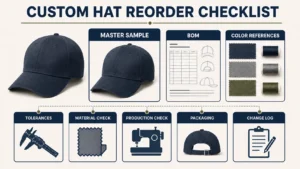
Repeat orders need change control. Record the base pattern, measurements, material code, finish, color reference, thread, seam treatment, sweatband, closure, decoration file, placement, test record, and packing method. If the original material is unavailable, do not approve a substitute from composition alone. Repeat the checks affected by the new construction.
Marketing teams should keep the claim linked to the tested SKU and colorway. The U.S. Federal Trade Commission’s advertising substantiation policy explains that objective claims need a reasonable basis before they are disseminated. For a sourcing team, the practical action is simple: keep the test, sample identity, construction, and approved wording in one product file.
Prepare a quote-ready men’s waterproof cap brief
- Reference cap, sketch, or approved five-panel or six-panel platform
- Target quantity by style and color, plus expected reorder direction
- Head-size range, crown and brim direction, closure, and fit comments
- Target market, activity, climate, rain exposure, and intended claim
- Fabric direction, hand feel, color references, finish, and documentation needs
- Logo files, dimensions, placement, preferred method, and acceptable alternatives
- Required sample approvals, test methods, inspection plan, and packaging
- Delivery region, target window, and quotation basis
To request a development review or quotation, send those details through the JoinTop contact page. Include the reference style, panel structure, target quantity, colors, logo method, market, performance requirement, delivery region, and timing so the team can respond to a defined project rather than guess at the construction.



 English
 German
 Spanish
 French
 Amharic
 Portuguese
 Italian
 Swedish
 Turkish
 Belarusian
 Danish