
A low unit price can look attractive. Then you learn that the quote leaves out the sample, special packaging, duty, or a better sweatband. The problem is often not the supplier. It is the request. If two factories receive different details, their prices are not truly comparable.
A useful custom hat RFQ checklist gives every supplier the same target. It also helps your team spot open decisions before they cause a new sample round. The goal is not to write a long email. The goal is to send a short, complete buying package.
Broad searches for custom hats often begin with style and price. A seasonal or repeat program has a harder control question. Can every supplier price the same scope, follow the same approval path, and repeat it across colors, delivery waves, and future orders? The RFQ should make those conditions visible before a buying team compares numbers.
Start with the job the hat must do
Tell the factory who will wear the hat and where. A cotton event cap may share the same logo as a golf cap or retail snapback. Yet they need different materials and construction. Include the sales channel, target season, climate, and expected retail position. These details help a manufacturer suggest options without guessing.
Use plain statements. Examples are “summer golf merchandise for the U.S. market” and “streetwear drop with a firm high crown.” Avoid broad words such as “best quality.” They do not define a material, stitch, tolerance, or test.
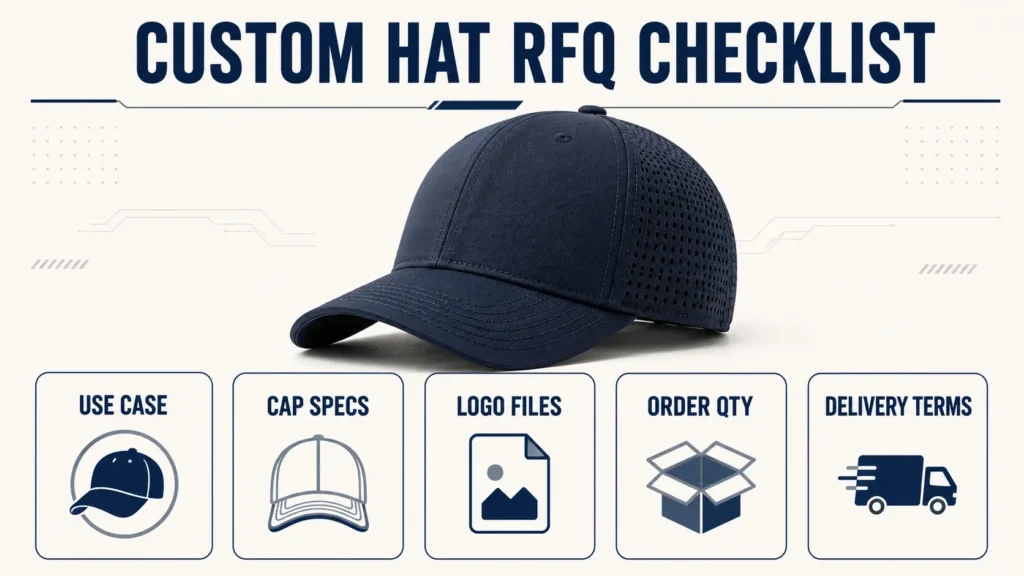
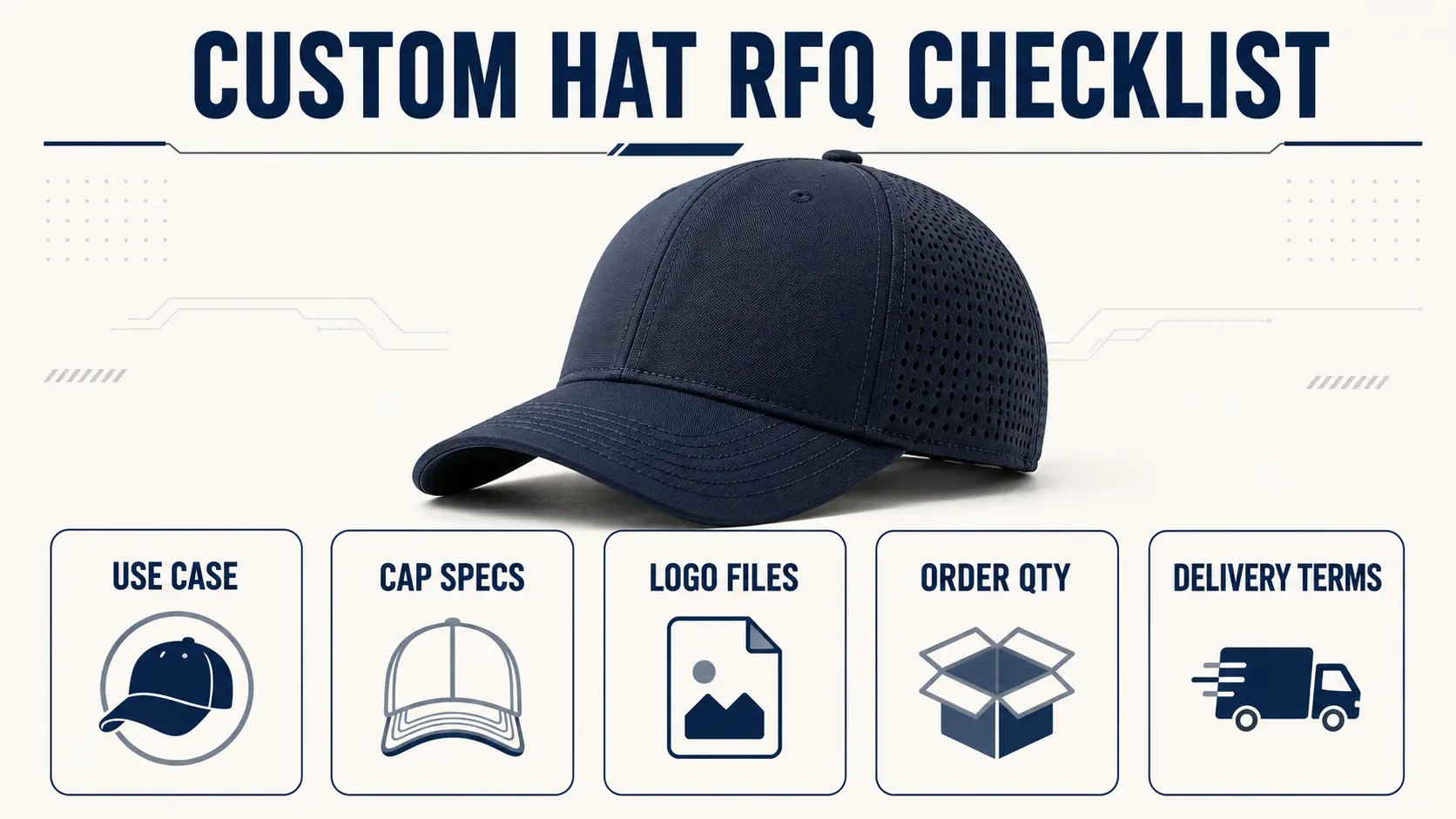
Put these nine items in every hat RFQ
| RFQ field | What to provide | Why it changes the quote |
|---|---|---|
| Cap construction | 5-, 6-, or 7-panel; structured or unstructured; crown profile; brim shape | Pattern, support material, and sewing time differ |
| Material | Fiber, fabric type, weight or reference sample, finish, and color | Fabric price and performance vary widely |
| Logo | Vector art, finished size, position, colors, and method | Flat embroidery, 3D puff, patch, and print use different processes |
| Quantity | Units by style and color, plus expected reorder size | Material minimums and setup costs affect the unit price |
| Fit | Target head range, closure type, and fit reference | Pattern and trim lengths may need adjustment |
| Labels | Brand, care, fiber, country-of-origin, hangtag, and barcode needs | Each trim has artwork, setup, and packing work |
| Packaging | Polybag, carton, insert, sticker, folding, and carton-mark rules | Materials and carton volume affect landed cost |
| Quality plan | Key measurements, tolerances, tests, and inspection level | Extra testing and inspection must be planned |
| Delivery | Ship-to place, required date, and requested Incoterm | Freight responsibility can change the apparent price |
If your team already uses a product specification, attach it. If not, a simple custom hat tech pack can put these choices on one controlled document.
Turn the RFQ into a collection-level quote matrix
A mature brand rarely buys one isolated cap. It may have a core golf style, a lighter tournament version, two logo placements, and several colorways. Do not send each item as a separate email with a different format. Build one SKU matrix that shows which elements are shared and which change.
Give every style and colorway a code. Add forecast quantity, initial buy quantity, likely reorder size, target delivery wave, market, and channel. Then list the common construction block, material family, logo method, labels, and packaging. If one color needs custom dyeing or one market needs different labeling, flag it as an exception. This lets a supplier plan common materials and setup without silently treating every SKU as a separate product.
The matrix also protects the comparison. A supplier may offer a lower price by combining colors, using one stock material, or shipping everything at once. Another may price split deliveries and separate color approvals. Neither answer is useful until the commercial assumptions appear beside the number.
- Base scope: the construction, material, logo, labels, and packaging shared across the program;
- SKU exceptions: every color, trim, artwork, or market rule that changes the build;
- volume plan: initial units, forecast, reorder pattern, and whether quantities may be combined;
- delivery plan: one shipment or staged releases, named destinations, and required dates;
- approval plan: who signs off color, fit, logo, testing, cost, and production changes.
Send artwork that a production team can use
A small PNG placed in an email is not enough for a reliable embroidery or patch quote. Send the original vector file when possible. State the finished logo width and height in millimeters, the number of colors, and the exact placement. Adobe explains why vector artwork can be scaled without the same loss of detail as a pixel image in its vector file overview.
Call out whether your logo may cross a front seam. A large 3D puff logo can behave differently on a six-panel cap than on a five-panel front. If the method is still open, ask the factory to quote two named options. Do not ask for “embroidery or something similar,” because the answers will not describe the same product.
Separate sample cost from bulk cost
Ask each supplier to show each cost on its own line. Include the sample, setup or mold, courier, bulk unit, packaging, testing, and inspection. Also request the sample and bulk timing. At JoinTop, the confirmed minimum is 100 pieces per style and color. Sampling is about 7–14 days. Bulk production is about 35–45 days. A specific design may need a fresh check before you plan a launch.
A sample is not only a small bulk order. It is the point where the team checks fit, shape, logo, color, and sewing before more material is committed. Read the custom hat sampling process before setting an approval deadline.
Separate product choices from commercial assumptions
A quote can change even when the cap does not. Currency, payment terms, quote validity, material reservation, delivery waves, and forecast commitment all affect the commercial basis. Put these items in a separate section so the product team can approve the cap while sourcing and finance review the deal.
Ask what happens if the final quantity moves, a color is dropped, a launch date shifts, or the brand asks for a second delivery. Ask which setup costs apply once and which return on a reorder. If the factory suggests a lower-cost material or process, require a named alternate option rather than allowing the approved base product to change inside the quote.
For ongoing programs, define how price changes will be handled. The RFQ does not need to predict every future cost. It should state the reference period, currency, included scope, and events that require a new quotation. This gives both teams a cleaner record when the same cap returns six months later.
Make the shipping term and destination exact
“Shipping included” is not a complete term. Name the destination city or postal code. Add the requested transport method and delivery duty. The ICC Incoterms rules define common delivery terms. Still, an Incoterm does not replace a full quote. Ask which costs are included. Also ask which party handles customs steps.
For U.S. imports, the importer or customs broker should verify the current classification, duty, and entry requirements. The official U.S. Customs and Border Protection importing guide is a better starting point than a fixed duty number copied from an old quote. Rules and rates can change, so do not compare landed costs using an unverified assumption.
Add labels and quality checks before the price is final
If the product will be sold in the United States, include the required label content in the RFQ. The FTC apparel labeling resources explain federal labeling areas that buyers should review. Your legal or compliance team should confirm what applies to your product and channel.
List the features that must be checked in production: crown height, brim width, logo position, closure function, major color, label copy, and packaging. A factory quality check is easier when the approved points are measurable. JoinTop’s hat quality control process shows how specifications and inspection fit together.
Score the supplier response, not only the unit price
For a strategic program, the RFQ response itself is evidence. A supplier that identifies open specifications, separates alternates, explains sample gates, and names exclusions is easier to manage than one that returns only a number. Add a simple response score beside the cost comparison.
Review specification completeness, proposed sample path, quality controls, change handling, timeline logic, packaging detail, and communication ownership. Do not reward a supplier for agreeing to every request without explaining technical conflicts. A useful factory response may challenge a logo size, fabric claim, or delivery plan before those choices become expensive.
This is not a substitute for an audit or reference check. It is a way to see whether the supplier understood the program and can turn a broad custom-hat request into controlled work.
Use one comparison sheet for every supplier
When the quotes arrive, move each answer into the same columns. Mark every item left out. Mark every guess. One supplier may quote a stock fabric. Another may include custom-dyed fabric. One may use a basic sweatband. Another may include a branded fast-drying band. The lowest number is not the lowest fair number until these differences are visible.
Send a short follow-up list for missing items. Ask for a revised quote with a version date. This creates a cleaner approval record and keeps the final purchase order tied to the same specifications used for sampling.




 English
  German
  Spanish
  French
  Amharic
  Portuguese
  Italian
  Swedish
  Turkish
  Belarusian
  Danish