

Wool for hats works best when a brand treats it as a complete fabric-and-construction specification, not as a premium-sounding fiber name. In a normal five-panel or six-panel cap, wool or a wool blend can add warmth, texture, shape, and a cold-weather look. It does not automatically make the cap quick-drying, waterproof, abrasion-resistant, or easy to wash. Those results depend on the exact fiber content, fabric construction, weight, finish, backing, sweatband, ventilation, care method, and finished-cap testing.
The strongest programs usually sit between lifestyle headwear and cold-weather performance. A sourcing team can use a wool shell for visual value, then engineer comfort through a lower-bulk crown, a suitable sweatband, controlled reinforcement, and a closure that still fits after conditioning. If the product is intended for high-output running in warm weather, a lightweight synthetic performance fabric will often be the more defensible starting point.
Decide where wool belongs in the product line
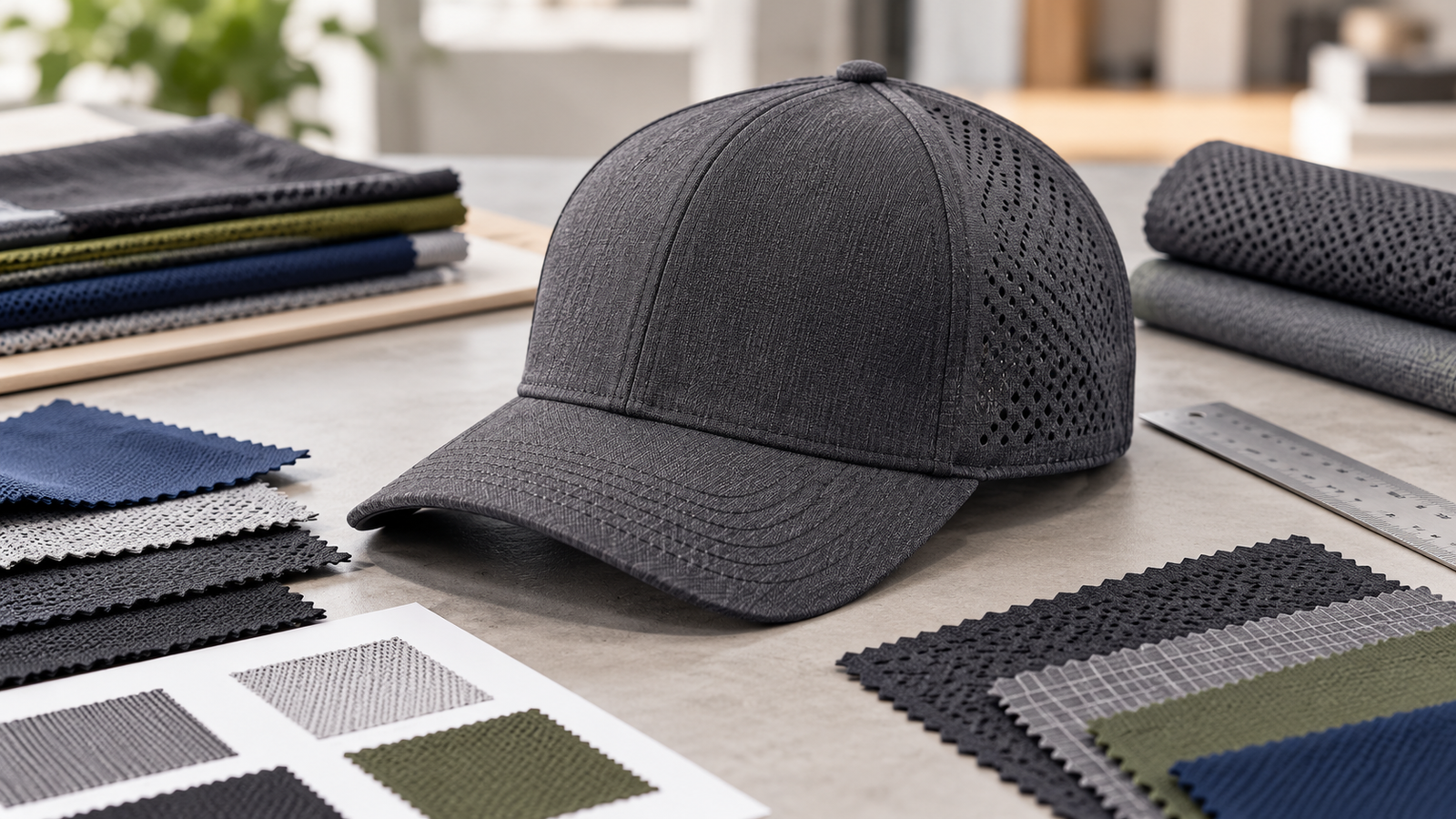
Start with the wearing environment. Wool fibers can absorb moisture vapor and help regulate the microclimate around the wearer, while their natural crimp contributes to insulation. The Woolmark explanation of wool fiber structure describes these properties at the fiber level. A finished cap still needs its own validation because the wearer feels the complete crown, sweatband, seams, reinforcement, and closure rather than an isolated fiber.
| Program goal | Useful material direction | Main risk to resolve |
|---|---|---|
| Premium cold-weather lifestyle cap | Woven wool or a wool-rich blend with a controlled surface and enough body for the selected crown | Pilling, care shrinkage, seam bulk, and shade variation can undermine the premium look |
| Cold-weather golf or outdoor cap | Wool-blend shell combined with a performance sweatband and deliberately placed ventilation | The cap may feel warm but retain sweat at the forehead or dry too slowly between uses |
| Light rain or snow program | Tested wool or wool-blend fabric with an agreed surface finish and finished-cap exposure check | Wool content alone is not evidence of water resistance; seams, logos, and the brim remain entry points |
| High-output warm-weather running cap | Usually a lightweight synthetic woven or stretch fabric rather than wool | A wool shell may add unnecessary warmth, weight, care limits, or drying time |
This decision prevents a common sourcing error: choosing wool for its story and asking the factory to solve the use case later. Put the target climate, activity level, expected wear duration, cleaning method, and intended retail claim into the product brief before reviewing swatches.
Specify the fiber content, not a vague wool look
“Wool look,” “wool touch,” and “wool blend” are not interchangeable specifications. One swatch may be all wool, another may contain a modest wool percentage with polyester or nylon, and a third may be fully synthetic with a brushed surface. Each route changes labeling, hand feel, dimensional stability, pilling behavior, price, and repeat-order control.
For products sold in the United States, hats that contain any wool are covered by the Wool Products Labeling Act even though hats are generally exempt from the Textile Act. The Federal Trade Commission’s textile and wool labeling guidance explains that covered wool products need accurate fiber content, country-of-origin information, and identification of the responsible manufacturer, importer, or marketer. Wool and recycled wool must be identified by name and percentage. The brand or importer remains responsible for the accuracy of the claim, so a supplier description should be supported by composition records and, when risk justifies it, independent fiber testing.
Care planning deserves the same discipline. Hats are exempt from the FTC rule that requires a permanent care label on covered apparel, but that exemption does not make an unsupported care instruction safe. Give the end customer a tested cleaning method through the sewn label, hangtag, packaging, or product page as appropriate for the target market. Other markets may apply different labeling rules, so the destination country belongs in the sourcing brief.
| Specification field | What to lock before sampling | Why it matters in bulk |
|---|---|---|
| Fiber composition | Percentage of wool, recycled wool, and every blend fiber; approved supplier evidence | Controls labeling, cost, hand feel, and whether repeat lots match the approved claim |
| Fabric construction | Woven or knit structure, yarn direction, density, and agreed mass per unit area | Two fabrics with the same fiber percentages can sew, stretch, and recover differently |
| Surface and finish | Brushed, milled, smooth, coated, or other finish; face side and cutting direction | Changes appearance, pilling risk, logo clarity, and shade under directional light |
| Dimensional stability | Conditioning or cleaning method and maximum accepted change for fabric and finished cap | Controls crown depth, circumference, visor position, and seam appearance after care |
| Backing and reinforcement | Front-panel support, lamination or interlining, adhesive compatibility, and hand feel | Too much support makes the crown board-like; too little may allow collapse or embroidery distortion |
| Sweatband and lining | Material, width, stretch, color, moisture behavior, and attachment method | The sweatband drives forehead comfort and can transfer dye or change fit |
| Color standard | Approved lab dip or physical standard, viewing light, and lot-to-lot tolerance | Heathered and textured fabrics can look different by lot, direction, and lighting |
| Care communication | Test-supported cleaning method and the exact wording planned for the target market | Prevents a care instruction from causing felting, shrinkage, distortion, or logo damage |

Choose the blend around the failure risk
All-wool fabric can deliver a clear material story and a distinctive hand, but it also puts more pressure on shrinkage control, surface consistency, and care communication. A wool-polyester or wool-nylon blend may improve dimensional stability or abrasion performance, depending on the yarn and construction. The synthetic percentage alone does not prove the improvement. Request side-by-side swatches, then test the actual candidate fabrics under the same method.
Felting shrinkage is a particular development risk. Woolmark’s explanation of machine-washable wool notes that heat, moisture, and mechanical agitation can cause the scales on wool fibers to interlock, producing irreversible densification and shrinkage. A shrink-resist or machine-washable treatment can change that behavior, but the sourcing team should confirm the treatment, the approved care route, and performance after repeated cycles rather than relying on the word “washable.”
Use the blend decision to solve a named problem. Nylon may be considered when abrasion is a concern; polyester may support stability or faster moisture release in some constructions; a small elastic component may help fit in a stretch system. Every benefit remains conditional on yarn, fabric construction, finish, and cap design. Record the intended function in the custom hat tech pack so the supplier can propose and price comparable options.
Five-panel and six-panel crowns handle wool differently
A normal five-panel cap gives the logo a broad front field and reduces the number of front seams. It can work well with a textured wool fabric, provided the front panel does not become too stiff after reinforcement. A six-panel cap gives a familiar baseball profile, but the center-front seam adds bulk and creates another alignment point for directional or heathered fabric.
| Construction decision | Five-panel check | Six-panel check |
|---|---|---|
| Front crown | Confirm panel curvature, reinforcement coverage, and whether the fabric bows or ripples across the wide front | Confirm center-front seam bulk, matching, top-button alignment, and symmetry across both front panels |
| Fabric direction | Mark the face and cutting direction so the front panel reads evenly | Mirror the front panels correctly and control nap or heather direction across all six pieces |
| Ventilation | Place eyelets or perforated inserts without weakening the wider front or side panel | Balance side and rear ventilation while preserving the traditional panel shape |
| Fit approval | Check front height, side-wall shape, rear opening, and visor angle on the target head range | Check circumference, crown depth, center-front pressure, and seam allowance consistency |
Seam allowance and pressing matter more as fabric gets thicker. A bulky stack at the center front, top button, visor join, or rear opening can change both comfort and appearance. Ask the sample room to record any skiving, grading, pressing, or reinforcement adjustment so the same construction can be repeated in production.
Build performance around the complete cap
Wool can manage moisture vapor, yet a wool cap can still feel damp if the sweatband holds liquid, the crown has little airflow, or the lining blocks evaporation. For a cold-weather performance cap, define which part of the system handles sweat, which part supplies warmth, and where moisture can leave the crown.
- Sweatband: compare absorbency, wicking, dry time, stretch recovery, dye transfer, and feel against the forehead.
- Ventilation: place eyelets, perforated panels, or breathable inserts where they support the activity without making the cap look like a warm shell attached to a summer back panel.
- Brim: confirm visor stiffness, stitch count, edge recovery, and dimensional change after the approved conditioning or care process.
- Closure: verify adjustability with the chosen sweatband and crown thickness. A closure approved on a thin nylon cap may not produce the same fit on a wool build.
- Weather claim: do not translate warmth or natural surface resistance into “waterproof.” Test the planned finish, seams, visor, and complete cap against the actual claim.
Match the logo method to the wool surface
Wool texture can soften fine edges and hide small stitch details. Dense embroidery can also compress the face, distort a lightly reinforced panel, or create a visible halo around the design. Approve a sew-out on the production fabric, with the intended backing and thread, before approving the cap sample.
- Flat embroidery: useful for clear wordmarks and moderate detail, but very small counters and thin strokes may disappear into a brushed surface.
- 3D puff embroidery: creates a strong premium signal when the logo geometry supports it. Check foam coverage, edge definition, needle perforation, and panel recovery.
- Woven or embroidered patch: separates fine artwork from the wool texture. Confirm patch edge, attachment stitch, heat exposure, and whether the patch changes the front-panel hand.
- Molded silicone or TPU patch: can add a technical contrast, but the attachment method and heat or adhesive process must be tested on the actual wool blend.
Use a staged sample approval process
A finished sample is too late to discover that the fabric pills, the crown shrinks, or the logo loses detail. Break approval into smaller decisions and keep each approved reference with a date and version number.
- Approve the material route. Review composition evidence, construction, weight, surface, color, finish, backing compatibility, and care proposal.
- Approve a fabric test set. Check dimensional change, pilling or abrasion risk, colorfastness, and appearance after the planned conditioning or cleaning method.
- Approve the crown block. Review an undecorated five-panel or six-panel sample for fit, seam bulk, panel direction, reinforcement, visor angle, ventilation, and closure range.
- Approve the logo sew-out. Use the production fabric, backing, thread, needle plan, patch edge, or attachment method.
- Approve the pre-production sample. Measure the complete cap, perform the agreed wear and care checks, confirm labeling and packaging, then release a signed reference for bulk.
Photographs help, but they do not replace measurements or a controlled sample record. The sample feedback method should identify the exact location, current measurement, requested result, priority, and approved revision.
Test the risks that can change the retail claim
The test plan should follow the product claim and sales channel. There is no universal pass level for every wool cap. The brand must choose the method, conditioning, specimen, and acceptance level before testing so a fabric result is not mistaken for proof of complete-cap performance.
| Risk | Useful evidence | Finished-cap follow-up |
|---|---|---|
| Fiber claim | Supplier composition records and qualified laboratory analysis when required | Check the sewn label, hangtag, carton data, and purchase order against the approved composition |
| Pilling and surface wear | Agreed pilling or abrasion method on the production fabric | Inspect crown contact points, brim edge, closure area, and logo perimeter after wear simulation |
| Dimensional change | Fabric and finished-cap measurements before and after the approved care or conditioning sequence | Recheck circumference, crown depth, visor position, panel symmetry, and seam smoothness |
| Color transfer and fading | Colorfastness to perspiration, rubbing, cleaning, and light as relevant to the program | Inspect the sweatband, lining, embroidery, pale trims, and adjacent panels for transfer or contrast change |
| Strength and construction | Fabric tear or breaking-strength data where the use case needs it | Pull-check critical seams, closure attachment, top button, visor join, and patch attachment |
The AATCC standards index lists recognized methods for fiber analysis, colorfastness to crocking and perspiration, laundering, and dimensional change. The ASTM textile standards index includes fabric mass, breaking strength, stiffness, abrasion, and pilling methods. Select methods with the laboratory and target-market requirements; do not copy a pass number from an unrelated garment or fabric.
Control fabric direction, shade, and measurements in bulk
Wool and wool-look fabrics can show direction more clearly than a smooth technical woven. If panels are rotated during cutting, the crown may appear to contain different colors even when every piece came from the same roll. The production file should mark the face, nap or grain direction, panel orientation, and any matching requirement around the center front.
- Incoming fabric: compare composition documents, roll identification, usable width, weight, shade, surface, defects, and approved finish.
- Cutting: control face side, direction, lot separation, panel pairing, and marker placement. Do not mix shade lots inside one cap.
- Sewing: watch seam bulk, skipped stitches, puckering, top-button buildup, visor attachment, and rear-opening symmetry.
- Decoration: compare placement, dimensions, thread or patch color, edge clarity, backing, and panel distortion with the approved sample.
- Final inspection: measure circumference and crown points, review shade under agreed lighting, check labels and care information, and confirm the cap is dry and correctly shaped before packing.
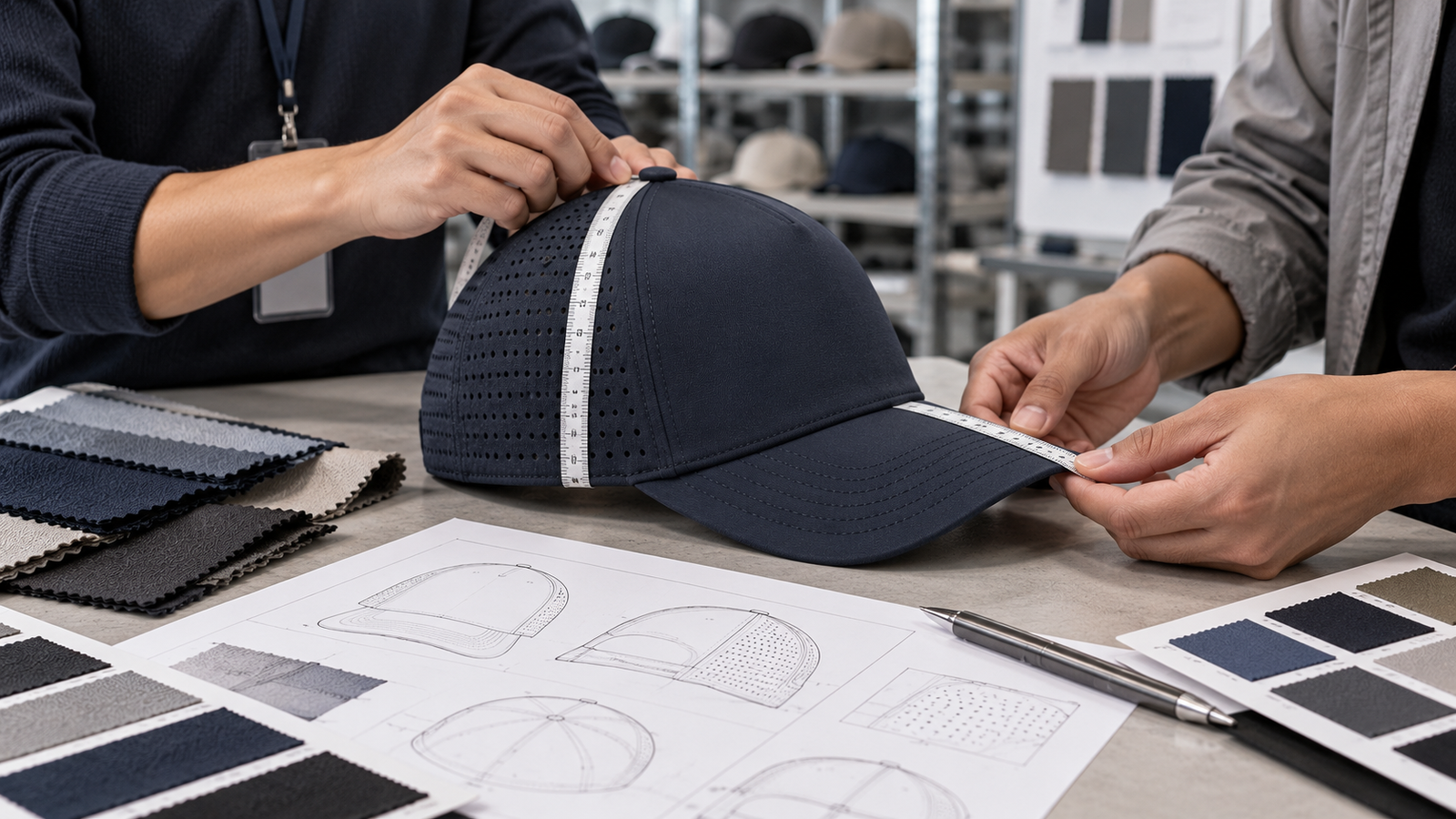
Use the same defect language and measurement points in development and production. JoinTop’s custom hat quality control guide gives procurement teams a structure for separating critical, major, and minor issues instead of resolving every defect by opinion at final inspection.
Plan seasonal supply and reorders before launch
Wool programs often depend on seasonal fabric availability and mill color lots. Ask whether the quoted fabric is stock-supported, made to order, or available only for a limited season. Confirm the minimum for the fabric and color separately from the cap order, because a factory may accept the cap quantity while the selected mill requires a larger fabric commitment.
For reorders, retain the approved cap, fabric cutting, composition record, color standard, test reports, logo sew-out, measurement chart, label file, and packaging specification. A new wool lot should be compared with the retained reference before cutting. If exact continuity is unlikely, the brand can plan a controlled seasonal color update rather than discovering the difference after goods are packed.
Packaging should protect the crown without flattening the textured surface or trapping process moisture. Confirm how many caps are nested, where pressure falls on the front panel and logo, whether tissue or supports are needed, and how cartons will be stored before shipment. Do not add a chemical, antimicrobial, or moth-resistant claim unless the treatment and target-market compliance have been confirmed.
Compare suppliers with one wool cap specification
Supplier quotes are only comparable when they describe the same product. Send one controlled brief and require each supplier to identify exceptions. A low price based on an unspecified wool percentage, a different backing, a generic sweatband, or no test allowance is not the same offer.
- Fiber percentages, fabric construction, agreed weight, finish, color standard, and composition evidence
- Five-panel or six-panel block, crown height, circumference range, visor construction, reinforcement, sweatband, ventilation, and closure
- Logo dimensions, placement, technique, backing, colors, and sew-out approval requirement
- Sample stages, revision allowance, test responsibility, inspection standard, packaging, target quantity, colors, delivery region, and requested date
- Declared substitutions, material lead-time risk, reorder conditions, and records that will be retained for repeat production
JoinTop develops normal five-panel and six-panel performance cap programs for brands, importers, wholesalers, and sourcing teams. To review a wool or wool-blend concept, send the project details through the contact page with your reference cap, preferred panel structure, target quantity, colors, logo method, target market, performance requirements, and delivery region. That information is enough to identify the material questions that must be settled before a reliable quote or sample plan can be prepared.



 English
 German
 Spanish
 French
 Amharic
 Portuguese
 Italian
 Swedish
 Turkish
 Belarusian
 Danish